July 21, 2026 | 09:41 GMT +7
Hotline: 0913.378.918

July 21, 2026 | 09:41 GMT +7
Hotline: 0913.378.918
By the time 169 lotus seeds flew into space in early 2025, Assoc. Prof. Dr. Dang Van Dong had quietly proven that research only has meaning when it generates value for life.
That event created a major resonance because it opened up possibilities for applying biotechnology, selecting and breeding new materials, and researching crop resilience under extreme conditions, in this case, outer space.
For Assoc. Prof. Dr. Dang Van Dong, Deputy Director of the Fruit and Vegetable Research Institute, one of the owners of the Mat Bang lotus seeds, that journey began with a simple question more than 30 years ago: Why research flowers in a country that is still struggling?
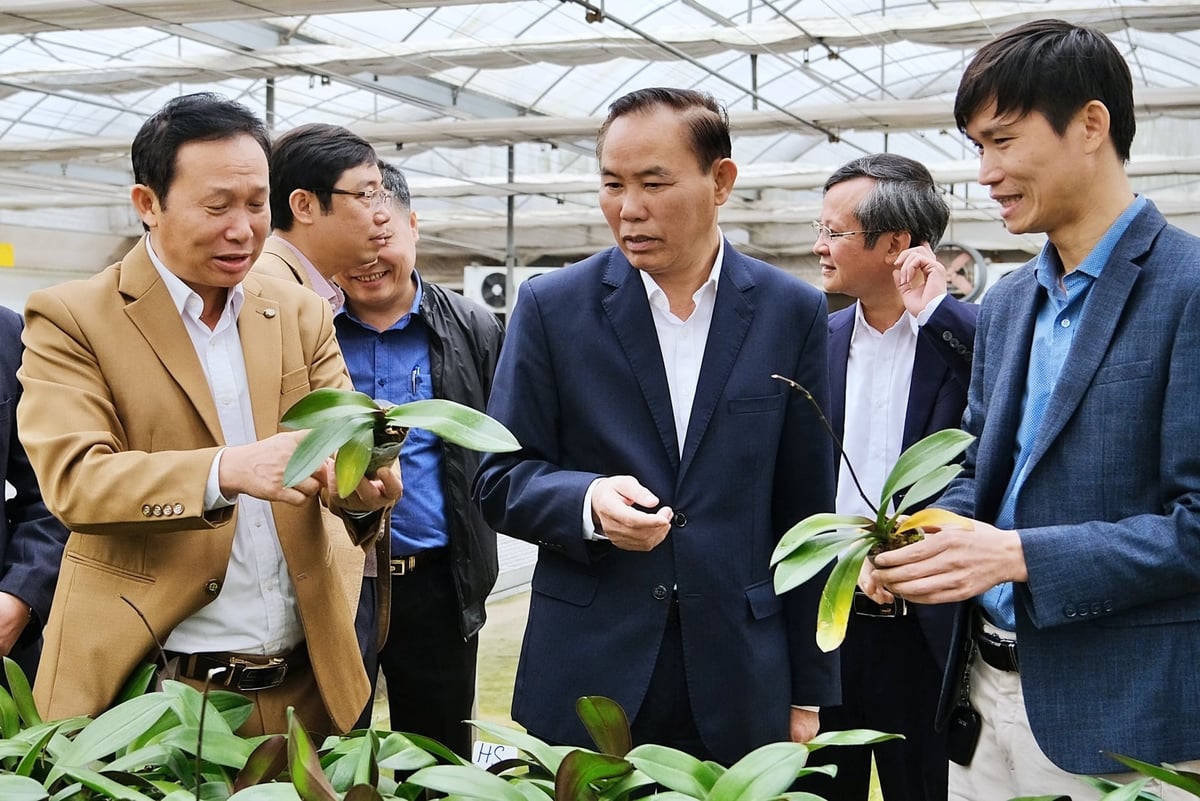
Assoc. Prof. Dr. Dang Van Dong (far left) presenting research results to former Deputy Minister of Agriculture and Environment Phung Duc Tien. Photo: Bao Thang.
Mr. Dong joined the Fruit and Vegetable Research Institute in 1993 after graduating from Hanoi University of Agriculture I. Born in 1966 to a farming family in Thai Binh, he chose to study agriculture to make farmers' work less arduous. But instead of going into crops that secure food, he attached himself to flowers and ornamental plants, a field that was still very new at the time and not considered an urgent necessity.
Those who questioned that choice were not without reason. In the early 1990s, the primary priority in agriculture was still ensuring enough to eat. Flowers were often viewed as a decorative, even luxury product, rather than a commodity sector that could generate livelihoods and high economic value.
Mr. Dong saw a different path: as living standards improve, people need not only food but also beautiful living spaces and a rich spiritual life. If there are good varieties, appropriate technology, and a market, flowers are not just for admiring but can create jobs, enrich farmers, form specialized cultivation zones, and reduce the money spent importing seeds from abroad.
Three decades later, the lotus seeds entering space are one of the milestones showing the distance the Vietnamese flower industry has traveled. From a field once standing on the margins of agricultural research, flowers and ornamental plants have stepped into high-tech greenhouses, tissue culture rooms with sensor-managed systems, and research programs capable of connecting with international markets.
Even so, not every hybrid combination makes it to the end of the road. Some lines are cared for and documented for a long time but must ultimately be discarded because their colors are unstable, their growth capacity is weak, or they are not suitable for commodity production. “Each new flower variety cannot be formed in just one or two seasons,” Mr. Dong said. Some results require many years to fully evaluate their stability, adaptability, and utility value.
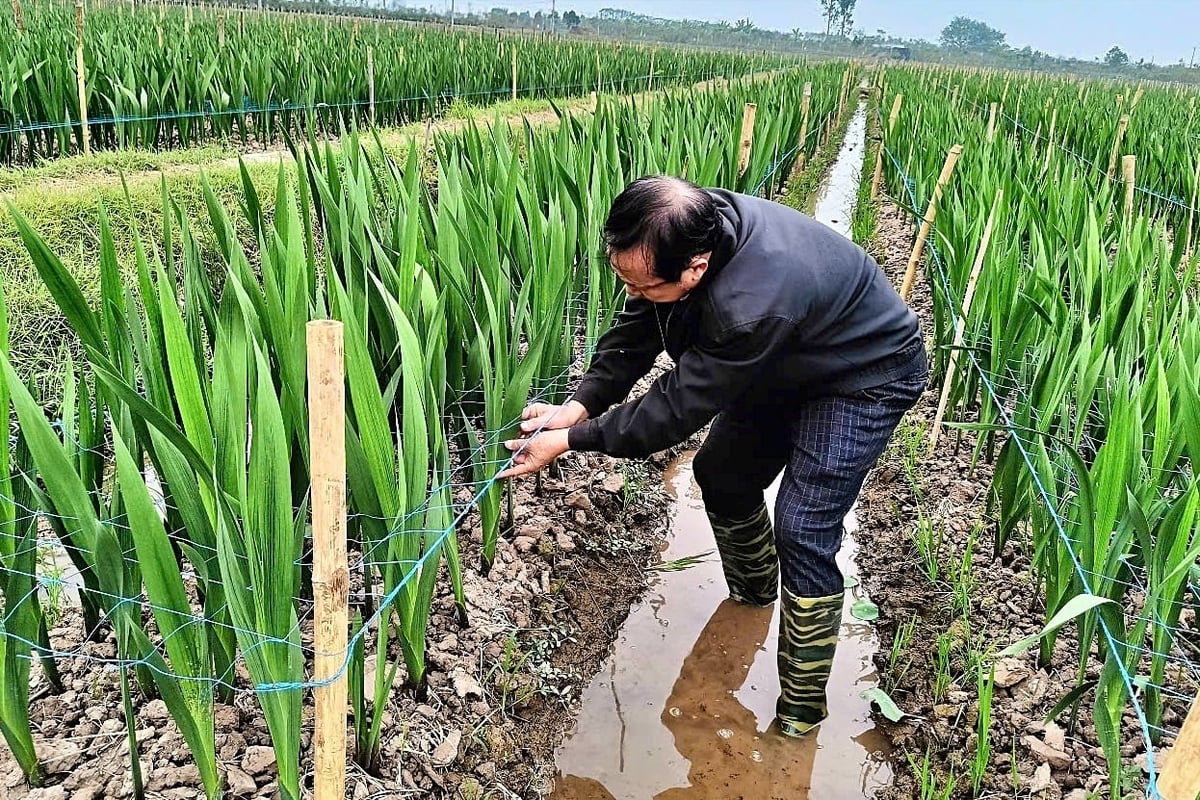
Assoc. Prof. Dr. Dang Van Dong caring for gladiolus flowers in the research field. Photo: Bao Thang.
That perseverance has contributed to creating a massive gene bank of varieties and technical protocols. According to Mr. Dong, the Flower and Ornamental Plant Research and Development Center (under the Fruit and Vegetable Research Institute) has researched, selected, and bred many varieties of Phalaenopsis orchids, lilies, gladioli, chrysanthemums, camellias, and lotuses, along with various other ornamental plants. To date, the unit has selected and bred over 100 flower varieties, built 32 technical protocols, and put nearly 30 Phalaenopsis orchid varieties into production.
Notably, two Phalaenopsis orchid varieties selected and bred by Viet Nam have had their copyrights transferred. The value of this lies not only in the amount of money collected but also in the fact that a plant variety created by domestic scientists is beginning to be recognized as a transacted intellectual asset.
Prior to that, Vietnamese Phalaenopsis orchid production relied heavily on imported seedling sources. Actively breeding varieties helps growers have more options suited to the domestic climate, reduces dependence on external sources, and opens the possibility of developing products with their own identity. Production protocols have also been perfected accordingly. By relying on experience across many stages, producers can now control the crop growth cycle more accurately, especially for flowers that must bloom right on the Lunar New Year.
Mr. Dong is particularly impressed with the lotus because it can create multiple layers of value. In addition to decoration, the lotus also yields seeds, tubers, rhizomes, leaves, tea, processed foods, and cosmetic ingredients. Low-lying areas or low-efficiency rice-growing acreage can be transitioned to lotus cultivation, combining the development of OCOP products, experiential tourism, and the preservation of rural landscapes.
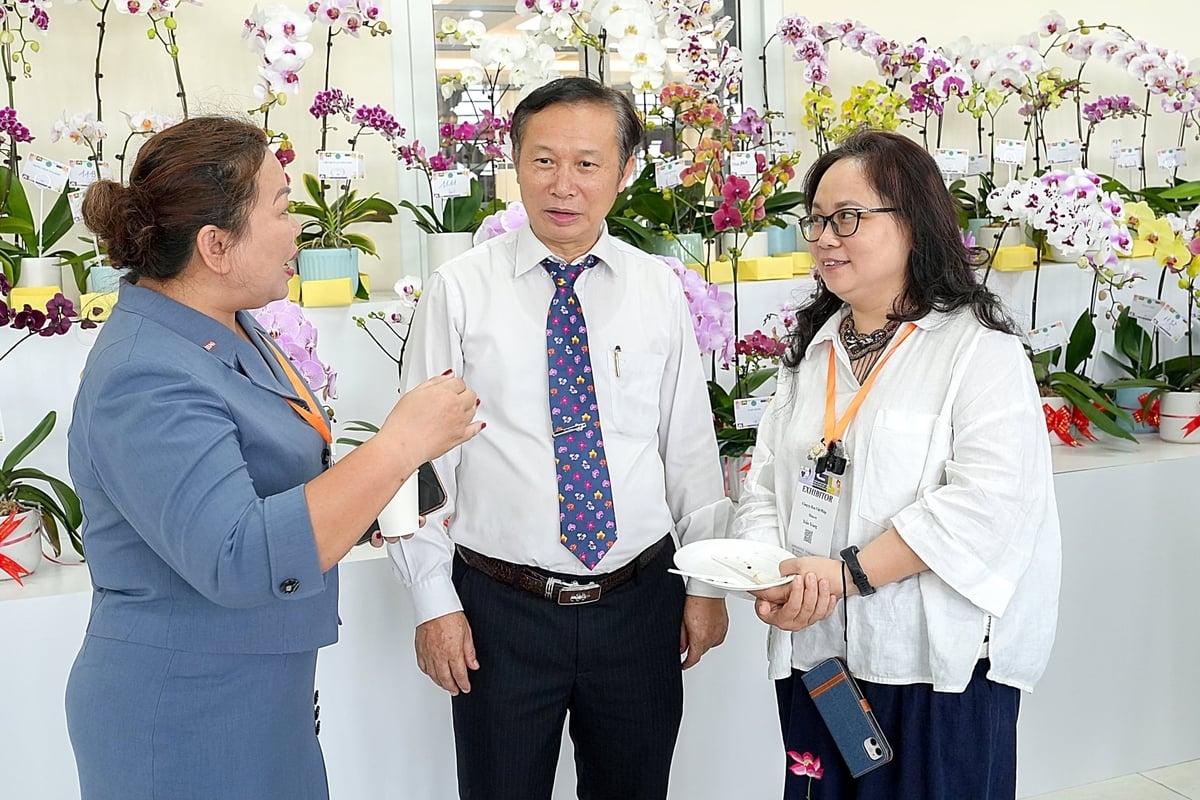
Assoc. Prof. Dr. Dang Van Dong (middle) proud that two Phalaenopsis orchid varieties have had their copyrights transferred. Photo: Bao Thang.
The scientists of the Fruit and Vegetable Research Institute have worked with local residents to rehabilitate many low-lying land areas, reorganize water canal systems, and divide production zones. These models initially yield much higher economic efficiency than traditional crops, creating landscapes and a foundation for rural tourism development.
To Mr. Dong, it is precisely the orchid greenhouses, camellia gardens, lotus fields, and flower zones sustained by farmers that are the clearest measure of applied science. He calls them “living papers”, where research results no longer lie in acceptance evaluation files but transform into people's incomes, enterprises' products, and the new face of a rural countryside.
Behind those flower seasons lies a far less glittering reality. Mr. Dong has lived through years of deficient infrastructure, tight budgets, and many research contents that had to be extended under difficult conditions. There were times when a result was evaluated and accepted but lacked the resources to be perfected. There were promising new varieties that could not find a business partner. And what saddens him most is seeing capable young cadres leave the Institute because their incomes were insufficient to cover living costs.
After more than three decades, what keeps him in the lab is probably still the feeling of stepping onto the field, seeing the flower varieties created by Vietnamese scientists helping local people earn better incomes.
But he is also frank that one cannot forever expect scientists to contribute solely out of passion. “Passion is a necessary condition, but it cannot replace salaries, laboratories, research funding, and a proper talent utilization mechanism,” he expressed. To retain young people, institutes must show them a sufficiently stable career path and the ability to live adequately on their expertise.
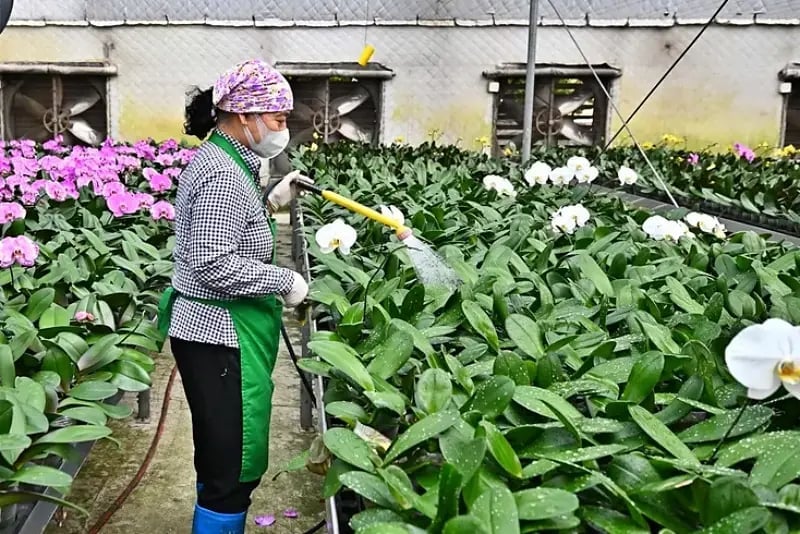
Thanks to flowers and ornamental plants, the income and life of many local residents have increased significantly. Photo: Bao Thang.
The bottleneck, according to him, lies not only in salaries but also in the gap between acceptance evaluation and the market. A research project is often considered complete when there are enough reports, new varieties, and explanatory documentation. But for the market, that is only the beginning.
A flower variety, after being recognized, must still have elite mother plants, disease-free multiplication systems, multi-regional trials, sufficiently large production scales, branding, packaging, and distribution networks. Research institutes usually lack the capital and business capacity to go all the way down this path. Meanwhile, enterprises want to receive a finished, low-risk product with an existing customer base.
As a result, the scientist has finished their task, but the enterprise does not yet want to start, leaving the product stranded in the middle.
That gap is particularly risky for the flower and ornamental plant industry because consumer tastes change rapidly. A flower color or plant shape might be popular today but lose attraction in just a few years. If the valuation, rights assignment, and variety transfer drag on, market opportunities may pass before procedures are completed.
To solve this equation, Mr. Dong proposed shifting from “researching first and then looking for a transfer venue” to research-on-demand and co-creating products. Enterprises must participate right from the stage of identifying demands, contributing capital, providing market information, arranging trial sites, and committing to receiving the product once it meets requirements. Along with that is an ecosystem consisting of the State, institutes, universities, science and technology enterprises, spin-off companies, and investment funds.
The State invests in foundational research, genetic resource conservation, and shares risks in the initial stage. The institute creates varieties and technology. The enterprise perfects products, organizes production, and opens markets. Funds sponsor the stage from after project acceptance to when the product is commercially viable, a period often referred to as the “valley of death” of technology.
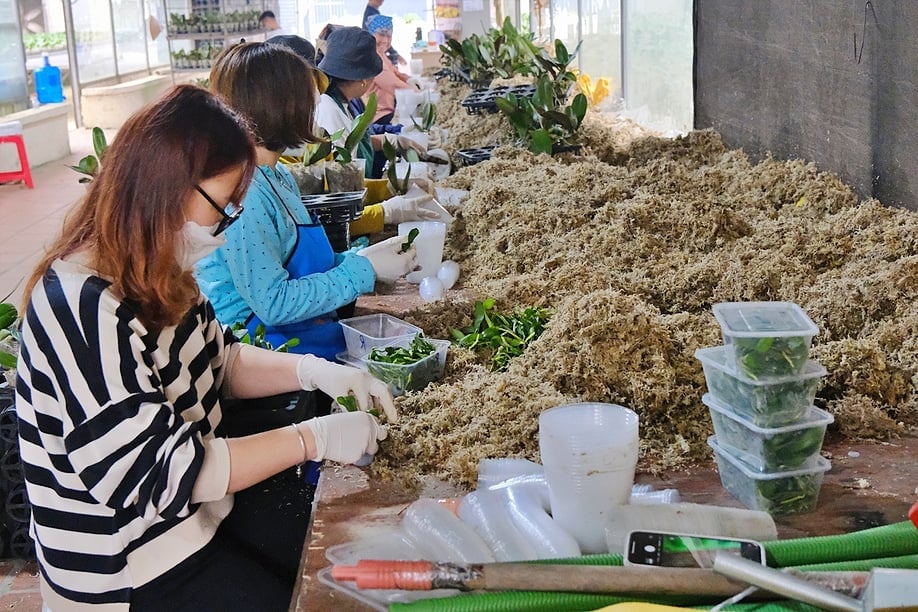
It is estimated that annually, the Fruit and Vegetable Research Institute supplies about 2 million flower seedlings to the market. Photo: Bao Thang.
The institutes themselves also need to change. Instead of letting breeders handle valuation, legal affairs, contracts, and finding clients on their own, each unit must have a professional department for intellectual property, commercialization, and business connectivity.
More importantly, scientists must enjoy proportionate benefits from the intellectual products they create. Their income should not only come from administrative salary scales but could include royalties, technology transfer fees, consulting fees, scientific services, or shares in spin-off companies.
When a flower variety is widely sold and generates revenue for an enterprise, the creator of that variety must receive a portion of the value. To Mr. Dong, this is not just a matter of money but also of fairness and the motivation to keep creating.
The 169 Mat Bang lotus seeds that went into space last year have returned to the research room. Scientists sowed them in the soil, monitoring each sprout and looking for changes that might not manifest immediately in the first generation. No one knows if that experiment will yield a new variety or simply add data for subsequent studies. Science inherently does not guarantee that every seed will sprout.
The story of the Mat Bang lotus variety shows that a Vietnamese research result can go very far when there are persistent people, sufficiently large goals, and a mechanism that helps knowledge continue to be nurtured. A flower variety needs soil, water, light, and time to bloom. Scientists also need a living wage, a good enough environment to be creative, and a sufficiently open mechanism for research results to become assets.
If only relying on passion, science might still create a few flower seasons. But for successive flower seasons to follow, those who sow the seeds of knowledge must be able to live on the very value they produce.
Translated by Ha Chi
(VAN) Viet Nam's forestry sector is shifting from resource extraction to the development of strategic ecological infrastructure, opening new drivers for the green economy and the carbon market.

(VAN) The sugarcane industry is shifting its focus from expanding cultivation area to improving the quality of raw material zones in order to build sustainable competitive advantage.
![HCMC fisheries complies with the law: [Final] Technology fills the gaps](https://t.ex-cdn.com/nongnghiepmoitruong.vn/608w/files/huytd/2026/07/17/1455-3-133654_171.jpg)
(VAN) Through smart vessel positioning solutions and the digitalization of fishing logbooks, HCMC is proactively tightening control of inactive fishing vessels, closing management loopholes from shore.
![Scientists' strength: [7] Waiting for a broad mechanism](https://t.ex-cdn.com/nongnghiepmoitruong.vn/608w/files/anhntk/2026/06/23/1119-dsc00323-nongnghiep-081103.jpeg)
(VAN) Besides developing new rice varieties, scientists also have to worry about finances, resources, and research aspirations.
![Scientists' strength: [6] Need a medicine strong enough](https://t.ex-cdn.com/nongnghiepmoitruong.vn/608w/files/benlc/2026/07/12/1618-chatgpt-image-12_15_17-10-thg-7-2026-122814_896.jpeg)
(VAN) Retaining scientists requires not only income but also a conducive research environment, a meritocratic mechanism, and trust.
![Scientists' strength: [5] Heavy burden of livelihood](https://t.ex-cdn.com/nongnghiepmoitruong.vn/608w/files/chinq/2026/07/17/2452-dsc_0566-081739_259-065506.jpg)
(VAN) Behind the research projects lies the arduous life of scientists, those who persistently cling to their profession amidst the pressure of making a living.

![Scientists' strength: [1] Thoughts of a former institute director](https://t.ex-cdn.com/nongnghiepmoitruong.vn/resize/174x104/files/benlc/2026/07/06/4051-_dsc2865-071318_463.jpg)
![Scientists' strength: [2] Key laboratory crisis](https://t.ex-cdn.com/nongnghiepmoitruong.vn/resize/174x104/files/benlc/2026/07/07/5846-dsc_0474-073322_439.jpg)
![Scientists' strength: [3] Cold shivers in the gene bank](https://t.ex-cdn.com/nongnghiepmoitruong.vn/resize/174x104/files/benlc/2026/07/08/2901-20210901_101217-100306_940.jpg)
![Scientists' strength: [4] Struggling to make ends meet](https://t.ex-cdn.com/nongnghiepmoitruong.vn/resize/174x104/files/tuongdt/2026/07/05/4118-z6770461445774_8c42773c23a8a113490e41c3772cf5ef-143810_411.jpg)