July 21, 2026 | 09:41 GMT +7
Hotline: 0913.378.918

July 21, 2026 | 09:41 GMT +7
Hotline: 0913.378.918
Throughout the course of human development, the status of forests has always evolved alongside the level of economic development. In the era of traditional industrialization, forests were viewed mainly as a source of timber, fuel, and land for expanding production. Entering the 21st century, however, under the pressures of climate change, biodiversity loss, resource competition, and the global green transition, forests are being repositioned as a strategic national asset.
Forest ecosystems form an integral part of a country's "natural infrastructure," playing a role no less important than energy, transport, or data infrastructure systems in ensuring long-term growth and national resilience.
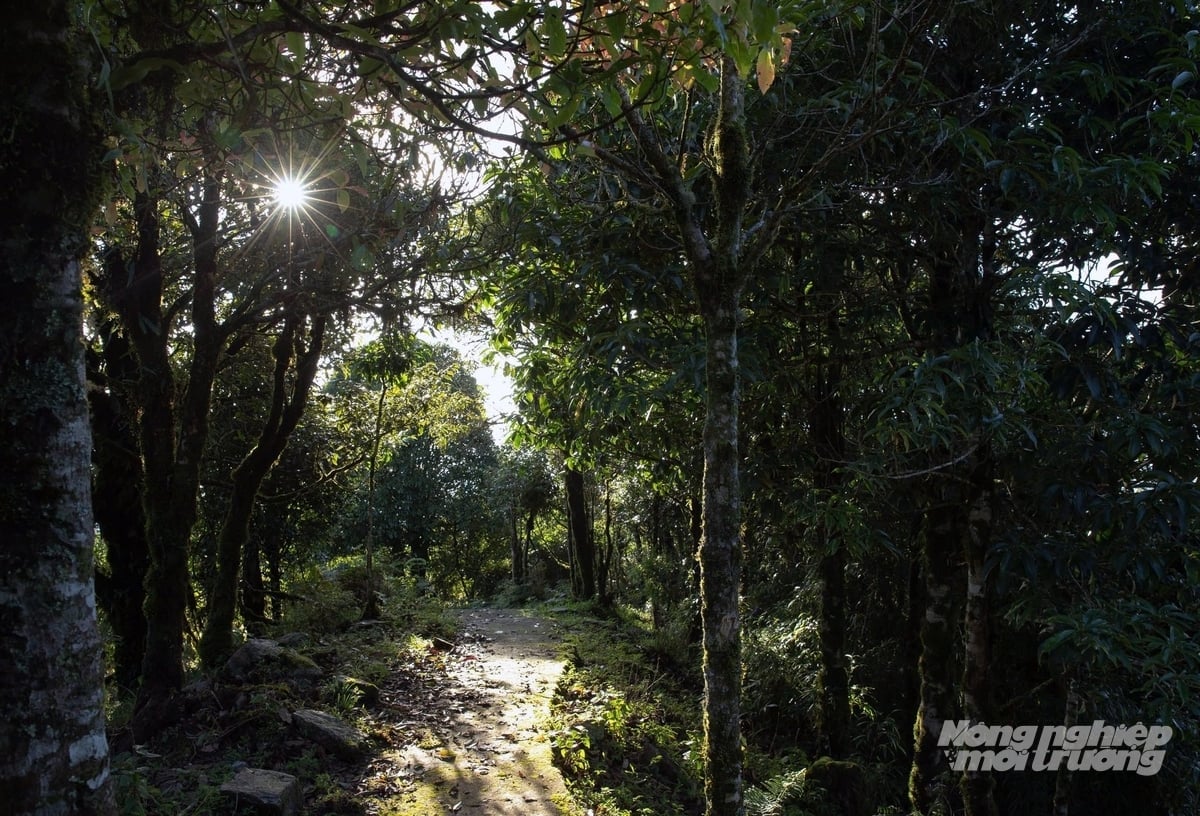
A section of forest atop Chieu Lau Thi peak, Ho Thau, Tuyen Quang. Photo: Khuong Trung.
This trend is unfolding strongly worldwide. According to assessments by the UN Food and Agriculture Organization (FAO), although global forest area has declined significantly over recent decades, the economic value of forest ecosystem services continues to rise as countries pursue net-zero emissions targets, develop circular economies, and conserve biodiversity. The Sixth Assessment Report of the Intergovernmental Panel on Climate Change (IPCC) likewise confirms that land and forest ecosystems could contribute roughly 30 percent of total global natural emissions-reduction potential by 2050, making them one of the most effective solutions for achieving international climate goals.
Against this backdrop, forestry development thinking worldwide is undergoing a fundamental shift: from resource extraction to ecological asset management; from a timber-based economy to a bioeconomy; from environmental protection to the creation of new development resources. Accordingly, countries such as Finland, Sweden, Canada, Germany, and Japan have built "forest-based bioeconomy" models, in which each unit of forest area generates not only timber products but also value from carbon, medicinal materials, bioenergy, biomaterials, ecotourism, and ecosystem services.
For Viet Nam, these strategic shifts carry particular significance. The country is entering a new stage of development, with the goal of becoming a high-income developed nation by 2045, which also requires sustaining high growth rates over many consecutive years. In this context, development can no longer rely mainly on resource extraction, cheap labor, or broad expansion of investment, but must instead be grounded in innovation, science and technology, digital transformation, and national resilience.
This is precisely the new development thinking that General Secretary and President To Lam has repeatedly emphasized, calling for a shift from "managing resources" to "creating resources," and from exploiting existing advantages to building new advantages for the country.
Viewed from this perspective, forestry is no longer solely a matter for the agricultural sector or environmental protection. Forests today are directly tied to ecological security, water security, climate security, energy security, and national development security. Experience in recent years shows that areas maintaining high forest cover tend to be more resilient to drought, flash floods, landslides, and extreme weather events. Conversely, forest loss brings greater economic losses, diminished water resources, and heightened development risks.
After nearly 40 years of reform, Viet Nam's forestry sector has achieved a number of important results. The forest coverage rate has remained stable at around 42 percent; the area of sustainably managed and certified forest continues to expand; and wood and forest product exports have for many years remained among the world's leaders, with export turnover of roughly 17 billion USD per year. Viet Nam is also one of the few developing countries to have maintained a relatively stable forest area while also building a large-scale wood-processing industry with international competitiveness.
However, when measured against the country's new development requirements, these results reflect only part of the forestry sector's potential. Value added generated per hectare of forest remains low compared with many developed countries; the economy beneath the forest canopy, ecosystem services, the carbon market, green finance, and forest-based bioindustry are all still in an early stage of development. Many important forestry resources have yet to be adequately quantified or brought into the economy's value-creation cycle - a situation that could be described as "untapped ecological resources."
In this context, the requirement is to shift from a mindset of forest management to one of value creation from forests. Where the primary goal was once to protect forest area, the coming period calls for a higher goal: raising the combined value of forest ecosystems. Each hectare of forest should be assessed not only by timber output but also by its capacity to absorb carbon, protect water resources, conserve biodiversity, support ecotourism development, supply medicinal materials, and generate sustainable livelihoods for local communities. This is the foundation of the multi-value forestry model that many advanced countries are now pursuing.
One of the greatest areas of development potential today is the forest carbon market. According to estimates from numerous international organizations, demand for high-quality carbon credits is expected to rise sharply in the coming decades as major economies implement cross-border carbon adjustment mechanisms and net-zero emissions commitments.
With more than 14 million hectares of existing forest, Viet Nam holds considerable potential to participate in the global carbon market while also generating additional financial resources for forest protection and restoration. International experience shows that many countries have turned forest carbon into an important source of revenue for rural development, nature conservation, and green growth.
At the same time, digital transformation is opening opportunities for a leap forward in the forestry sector. Remote sensing, artificial intelligence, big data, biotechnology, and digital platforms now make it possible to manage forest resources in real time, improve monitoring efficiency, provide early warning of forest fires, and optimize forest-product value chains. In the future, forests will serve not only as ecological space but also as data space, innovation space, and digital economic space.
From a national strategic perspective, forestry development must be positioned within Viet Nam's broader new growth model. Forestry is not merely a raw-material production sector but also a provider of essential ecosystem services for the entire economy. Investing in forests is investing in national resilience, water security, climate change adaptation, and the quality of long-term growth.
In this new era of development, the mission of Viet Nam's forestry sector cannot stop at forest protection alone. Forestry must become a pillar of the national bioeconomy, the green economy, and the country's sustainable development strategy. From a resource-extraction industry, forestry must transform into a value-creating sector; from environmental protection to building national competitive advantage; from managing forest area to developing national ecological assets.
This is not only a requirement for the forestry sector itself but also one of the important conditions for realizing the aspiration of building a strong and prosperous Viet Nam by the middle of the 21st century.
Translated by Linh Linh
![Scientists' strength: [8] Fairness and creative motivation](https://t.ex-cdn.com/nongnghiepmoitruong.vn/608w/files/content/2026/07/16/pgsts-dang-van-dong-cham-soc-hoa-lay-on-103239_191-082039.jpg)
(VAN) Scientists must enjoy proportionate benefits from the intellectual products they create.

(VAN) The sugarcane industry is shifting its focus from expanding cultivation area to improving the quality of raw material zones in order to build sustainable competitive advantage.
![HCMC fisheries complies with the law: [Final] Technology fills the gaps](https://t.ex-cdn.com/nongnghiepmoitruong.vn/608w/files/huytd/2026/07/17/1455-3-133654_171.jpg)
(VAN) Through smart vessel positioning solutions and the digitalization of fishing logbooks, HCMC is proactively tightening control of inactive fishing vessels, closing management loopholes from shore.
![Scientists' strength: [7] Waiting for a broad mechanism](https://t.ex-cdn.com/nongnghiepmoitruong.vn/608w/files/anhntk/2026/06/23/1119-dsc00323-nongnghiep-081103.jpeg)
(VAN) Besides developing new rice varieties, scientists also have to worry about finances, resources, and research aspirations.
![Scientists' strength: [6] Need a medicine strong enough](https://t.ex-cdn.com/nongnghiepmoitruong.vn/608w/files/benlc/2026/07/12/1618-chatgpt-image-12_15_17-10-thg-7-2026-122814_896.jpeg)
(VAN) Retaining scientists requires not only income but also a conducive research environment, a meritocratic mechanism, and trust.
![Scientists' strength: [5] Heavy burden of livelihood](https://t.ex-cdn.com/nongnghiepmoitruong.vn/608w/files/chinq/2026/07/17/2452-dsc_0566-081739_259-065506.jpg)
(VAN) Behind the research projects lies the arduous life of scientists, those who persistently cling to their profession amidst the pressure of making a living.
