July 21, 2026 | 10:28 GMT +7
Hotline: 0913.378.918

July 21, 2026 | 10:28 GMT +7
Hotline: 0913.378.918
Morning in the highlands, while the coffee orchards are still drenched in dew, inside the laboratories of the Western Highlands Agriculture and Forestry Science and Technology Institute (WASI), the test tubes, culture boxes, and analyzers are already lit.
Behind each new crop variety and each technical protocol transferred to farmers is a persistent journey of scientists. Some have never left the Western Highlands. Others brought back knowledge from renowned lecture halls abroad to continue clinging to this basalt land. Dr. Nguyen Viet Tru is one of those individuals.

Dr. Nguyen Viet Tru (left) together with a professor from the University of Copenhagen, Denmark, meeting to discuss an agricultural project. Photo: Pham Hoai.
Before becoming a doctor of biotechnology in charge of WASI's projects and international cooperation, he spent a year quietly working as an unpaid apprentice just to be allowed in the laboratory. For a young man born in Buon Lieng Ong, Dak Phoi Commune, a still-difficult M'nong ethnic minority area in Dak Lak Province, it was by no means an easy choice, but it was the only way to hold on to his dream of becoming a scientist.
Upon graduating from university, instead of choosing a job with a stable income, he decided to look to WASI with the desire to do science, accepting to start from absolute zero.
That perseverance unlocked a long journey. From someone who knew almost no English, he studied diligently to win a scholarship from the Ministry of Agriculture and Environment to pursue a master's degree in Japan, and then continued to be supported by professors at the University of Tsukuba to conduct research and train for a Ph.D.
During nearly seven years of studying and researching in Japan, he participated in many scientific works, was invited to continue post-doctoral research at Osaka University, and received numerous job offers from international organizations with highly attractive research conditions and compensation packages. Yet at the end of 2023, he decided to return.
"I always think that if those who are trained by the State's resources all choose to stay behind or move elsewhere, the value of that training will no longer be complete. I wanted to return so that the knowledge I learned could contribute to the country's agriculture, to the very place that created the conditions for me to grow up," Dr. Tru shared.
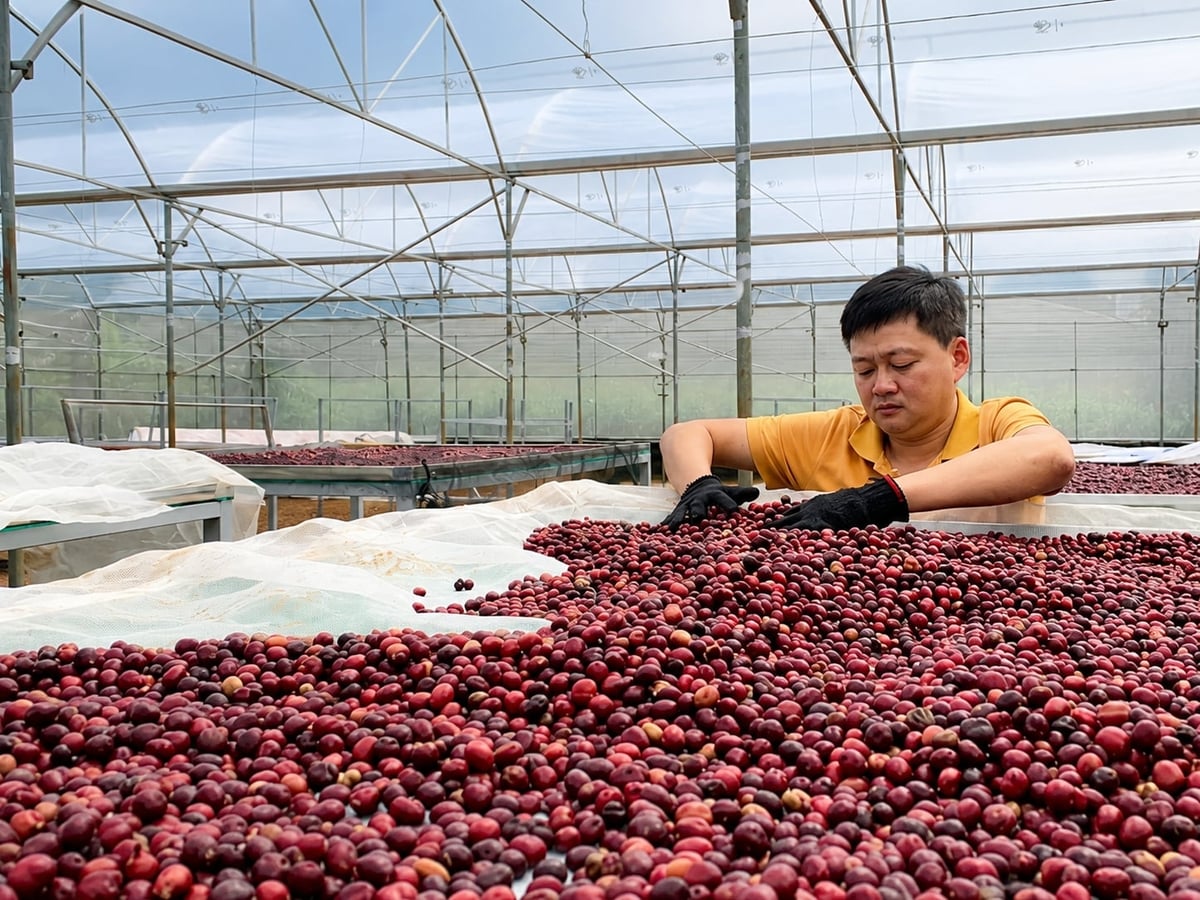
Dr. Nguyen Viet Tru selecting the highest quality coffee cherries for the Bolero project funded by the European Union. Photo: Pham Hoai.
But returning did not mean welcoming conveniences. Despite holding a Ph.D. and many years of research experience abroad, he still faces heavy pressure on a researcher's standard salary, while a family of two small children is behind him. Right at the place he chose to stick with, much of the equipment serving research in biotechnology, molecular biology, and microbiology is obsolete, failing to meet the requirements of modern research directions. Projects are still mostly driven toward immediate applications, while foundational and in-depth research, the very elements that generate scientific breakthroughs, still lacks invested resources.
According to Dr. Nguyen Viet Tru, what young scientists desire is not simply a higher income, but a research environment strong enough to leverage the knowledge they have been trained in. "We need a mechanism open enough to boldly pursue new ideas, along with systematic investment in laboratories, equipment, and long-term research programs. When scientists can live on their profession with peace of mind and are provided with conditions to develop their capacity, more young people trained abroad will choose to return and stick long-term with domestic research institutes," he expressed.
Regarding this issue, Dr. Tru believes that implementing major guidelines on scientific and technological development and innovation, especially Resolution No.57 of the Politburo, will open up opportunities for the young intellectual team to contribute more. "The value of a Ph.D. degree does not lie in how many opportunities it opens up for oneself, but in how the accumulated knowledge can return to serve farmers, contributing to creating better crop varieties, more efficient production protocols, and a sustainably developing agriculture," he affirmed.
The story of Dr. Nguyen Viet Tru is also the exact matter that Dr. Phan Viet Ha, Acting Deputy Director of the Western Highlands Agriculture and Forestry Science and Technology Institute, constantly ponders.
With many years of experience in research and management, Mr. Ha understands the value of a scientist better than anyone. To train a Ph.D., the State has to invest for decades, from university lecture halls and postgraduate programs to the research process both domestically and abroad. Yet keeping them to stay with the laboratories is a far from simple equation.
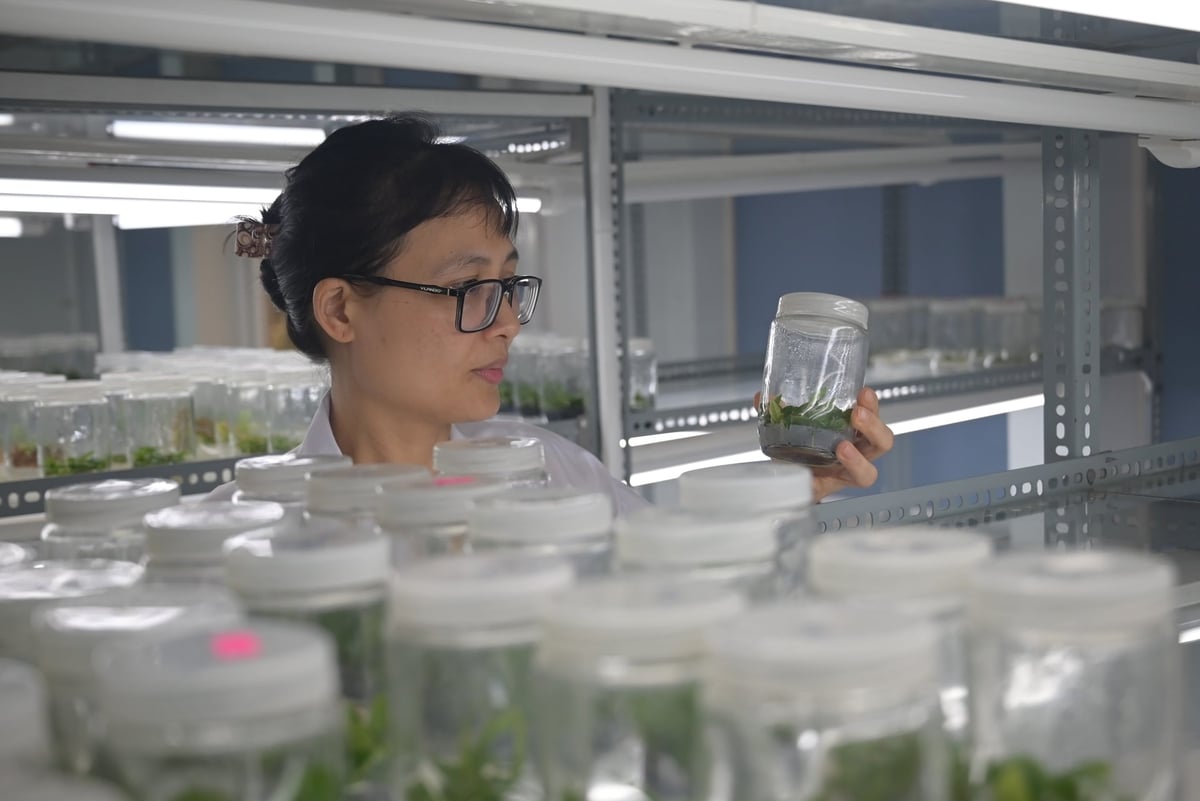
Scientists expect a "medicine" strong enough from mechanisms and policies to compensation schemes... Photo: Pham Hoai.
According to Dr. Ha, in a context where operating budgets still face many difficulties, the unit cannot just sit and wait for changes in mechanisms and policies; it must proactively find solutions from its internal strengths.
"We determine that we must balance revenues and expenditures reasonably, maximizing savings on expenditures to reserve resources to take care of the research staff. In parallel, the Institute steps up scientific cooperation, the transfer of technical advances, and expands service activities appropriate to our functions and duties to increase legitimate revenues. Only when we have additional resources will we have the conditions to better support staff who are truly capable and dedicated," Dr. Ha shared.
According to him, those solutions cannot yet produce significant changes in income, but they demonstrate the unit's determination to support its staff, especially the young research force. The more important thing is to build a fair working environment that encourages creativity and properly recognizes the value of each individual.
However, the effort of a single unit can only solve part of the equation. For scientists to truly dedicate themselves with peace of mind, there need to be more breakthrough policies on salaries, financial self-reliance mechanisms, the use of legitimate revenues, and talent attraction and utilization. When scientists can live off their profession and see long-term development opportunities, they will wholeheartedly pursue research that benefits the country.
The story of the scientists at WASI shows that love for the profession and a spirit of dedication are still keeping them with science. But to retain the intellectual team in the long run, passion alone is not enough.
What scientists expect is a "medicine" strong enough, from mechanisms, policies, and compensation schemes to research infrastructure investment, the working environment, and talent utilization mechanisms.
Spanning over 40 years of researching the coffee tree, from varieties to cultivation protocols, processing, preservation, and cultivation system management, WASI has achieved many important milestones. One of the Institute's most successful achievements is the research and transfer of coffee varieties and planting and care protocols. Currently, WASI has 14 Robusta coffee varieties and 6 Arabica coffee varieties introduced and put into production.
These coffee varieties possess typical characteristics such as high yields, good and uniform bean quality, and strong resistance against harsh climate conditions and pests..., contributing to driving Vietnam's coffee yield to the highest in the world (triple the world's average yield), with many coffee orchards reaching yields of 4 to 4.5 tons/hectare, and areas under good intensive cultivation exceeding 6 tons/hectare.
Translated by Ha Chi
(VAN) Viet Nam's forestry sector is shifting from resource extraction to the development of strategic ecological infrastructure, opening new drivers for the green economy and the carbon market.
![Scientists' strength: [8] Fairness and creative motivation](https://t.ex-cdn.com/nongnghiepmoitruong.vn/608w/files/content/2026/07/16/pgsts-dang-van-dong-cham-soc-hoa-lay-on-103239_191-082039.jpg)
(VAN) Scientists must enjoy proportionate benefits from the intellectual products they create.

(VAN) The sugarcane industry is shifting its focus from expanding cultivation area to improving the quality of raw material zones in order to build sustainable competitive advantage.
![HCMC fisheries complies with the law: [Final] Technology fills the gaps](https://t.ex-cdn.com/nongnghiepmoitruong.vn/608w/files/huytd/2026/07/17/1455-3-133654_171.jpg)
(VAN) Through smart vessel positioning solutions and the digitalization of fishing logbooks, HCMC is proactively tightening control of inactive fishing vessels, closing management loopholes from shore.
![Scientists' strength: [7] Waiting for a broad mechanism](https://t.ex-cdn.com/nongnghiepmoitruong.vn/608w/files/anhntk/2026/06/23/1119-dsc00323-nongnghiep-081103.jpeg)
(VAN) Besides developing new rice varieties, scientists also have to worry about finances, resources, and research aspirations.
![Scientists' strength: [5] Heavy burden of livelihood](https://t.ex-cdn.com/nongnghiepmoitruong.vn/608w/files/chinq/2026/07/17/2452-dsc_0566-081739_259-065506.jpg)
(VAN) Behind the research projects lies the arduous life of scientists, those who persistently cling to their profession amidst the pressure of making a living.

![Scientists' strength: [1] Thoughts of a former institute director](https://t.ex-cdn.com/nongnghiepmoitruong.vn/resize/174x104/files/benlc/2026/07/06/4051-_dsc2865-071318_463.jpg)
![Scientists' strength: [2] Key laboratory crisis](https://t.ex-cdn.com/nongnghiepmoitruong.vn/resize/174x104/files/benlc/2026/07/07/5846-dsc_0474-073322_439.jpg)
![Scientists' strength: [3] Cold shivers in the gene bank](https://t.ex-cdn.com/nongnghiepmoitruong.vn/resize/174x104/files/benlc/2026/07/08/2901-20210901_101217-100306_940.jpg)
![Scientists' strength: [4] Struggling to make ends meet](https://t.ex-cdn.com/nongnghiepmoitruong.vn/resize/174x104/files/tuongdt/2026/07/05/4118-z6770461445774_8c42773c23a8a113490e41c3772cf5ef-143810_411.jpg)