July 21, 2026 | 10:09 GMT +7
Hotline: 0913.378.918

July 21, 2026 | 10:09 GMT +7
Hotline: 0913.378.918
The agricultural sector possesses three national Key Laboratories, one of which is stationed at the Agricultural Genetics Institute with the explicit mandate to research and develop cell and gene technologies for production. Established in 2001 with an initial budget of approximately 50 to 60 billion VND, the laboratory was once equipped with state-of-the-art machinery. Today, those systems are not only obsolete but many have broken down completely, rendered useless by a lack of maintenance and repair funds. Yet, the waste of hardware is nothing compared to the waste of human talent.
When I arrived, Dr. Mai Duc Chung, the Director of the Key Laboratory, had just transferred to another institution a week prior. Once boasting a staff of over 100, the laboratory’s workforce has shrunk to just over 30 people, including contract workers. Among the five staff members at the Agricultural Genetics Institute who recently submitted applications for early retirement or resignation, three belonged to this Key Laboratory, including M.Sc. Nguyen Thi Bich Thuy, born in 1979.
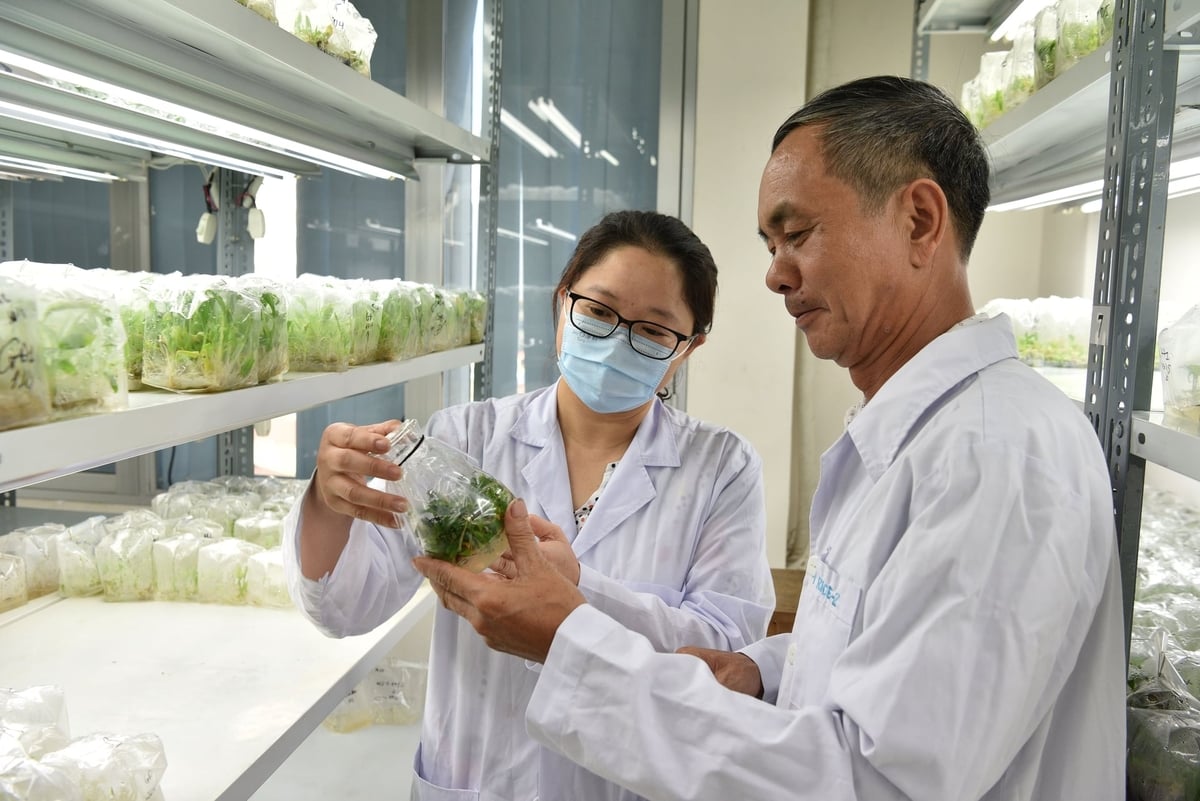
M.Sc. Van Dinh Hai and a colleague inspecting samples in the laboratory. Photo: Duong Dinh Tuong.
When asked about her reasons, Ms. Thuy pointed first to family demands, and second to the fact that her salary was simply insufficient to live on.
"None of the researchers earn a living wage, not even the project principal investigators. My official salary is over 12 million VND per month, but we only receive six months of pay per year. Once health insurance is deducted and the remaining sum is divided across twelve months, it isn't even enough to support myself, let alone my family. In the past, massive cohorts of agricultural students came here for internships, but recently that number has dwindled to just three or four. When they graduate, they usually abandon the profession and steer clear of scientific research entirely."
To make ends meet, almost everyone in the laboratory has to pinch pennies, packing lunchboxes from home to avoid the cost of eating out. Those who do not own a home and must pay rent face extreme hardships. To survive, alongside her institutional duties, Ms. Thuy had to sell cosmetics and agricultural products online. When she learned about Decree 154, which offers financial support for early retirement or resignation, she made the difficult decision to write her resignation letter.
M.Sc. Van Dinh Hai, born in 1969, served as the Head of the Research Station in Van Giang, Hung Yen province, a position under the Key Laboratory personnel. Every day, he commuted nearly 100 kilometers on a motorcycle between his home in Hanoi and the station, a grueling journey that earned him the special privilege of receiving his full salary. Yet, he still applied for early retirement. The exhaustion of the daily commute was part of it, but the second reason was sheer isolation: the entire station currently has only two staff members, himself and a security guard.
While Ms. Thuy and Mr. Hai view themselves as middle-aged researchers stepping aside to clear a path for younger talent, the reality is that young graduates are neither being given the opportunity nor do they want to step in. Consequently, losing key, leading figures who anchor research programs, such as Dr. Le Hung Linh (Head of the Molecular Biology Department, educated in South Korea) or Dr. Mai Duc Chung (Director of the Key Laboratory, educated in Russia), is a devastating blow.
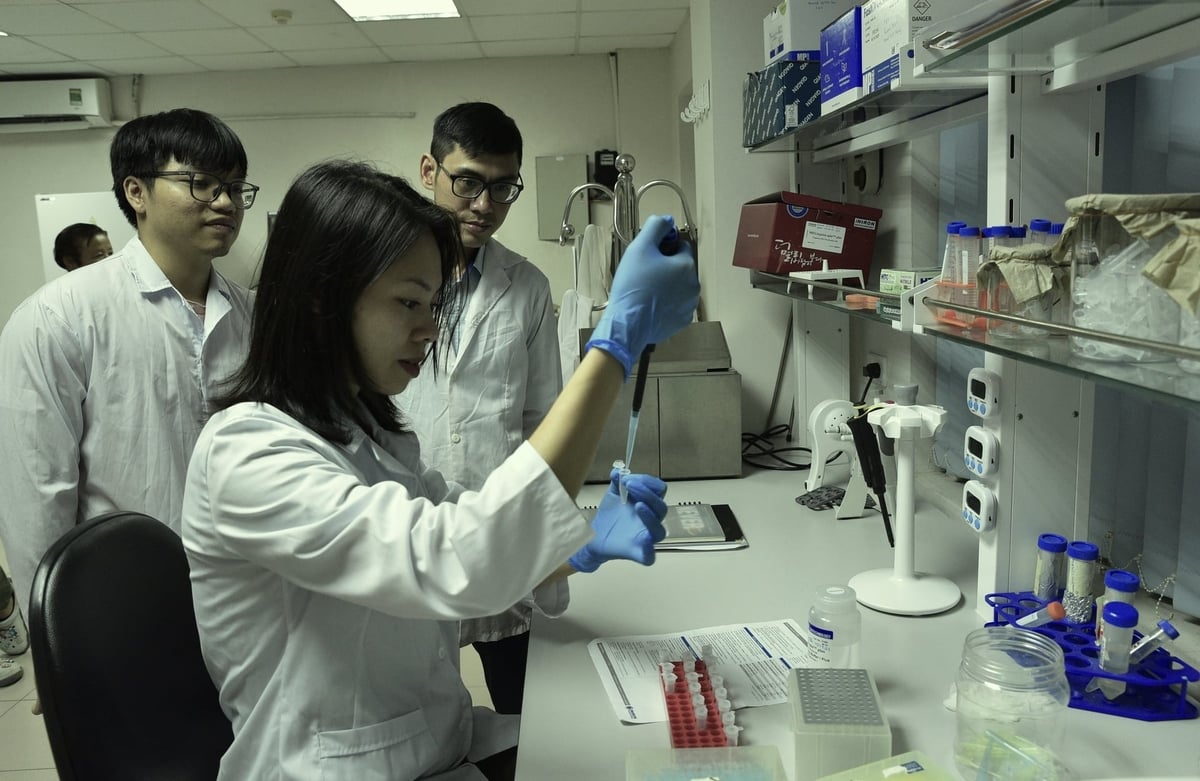
Scientific research at the Agricultural Genetics Institute. Photo: Duong Dinh Tuong.
Despite holding the title of Director, Dr. Chung spent his days stressing over how to secure salaries for his staff and himself. Because the state only guarantees six months of salary, their livelihoods depend entirely on highly volatile research grants. Given that over half of the Agricultural Genetics Institute's work focuses on basic research, achieving financial self-sufficiency is nearly impossible. By transferring to a new institution, Dr. Chung was guaranteed a full salary, allowing him to focus entirely on research without financial anxiety. Due to these financial strains, the Agricultural Genetics Institute has not held civil service recruitment exams for decades. Today, researchers born in the 1990s have become "rare gems," while those born after 2000 are virtually non-existent.
But in the laboratories, there were shadows, light and darkness, equipment that was broken and some that was working. In the darkness, with the help of others, the faces of the people were yellow and pale. Dr. Phung Thi Phuong Nhung guided me around once and then explained: The equipment here is outdated because the first batch of rocks was from 2000, and the last batch was purchased in 2008. The long-term financial policies have caused a "brain drain" in the Department.
Most PhDs who studied abroad couldn't stand it anymore and left, but she, who received both domestic and overseas training, remained. Her current salary is about 9 million dong/month, but the State only pays for 6 months each year; the rest comes from the Department's regular but small income from its tasks.
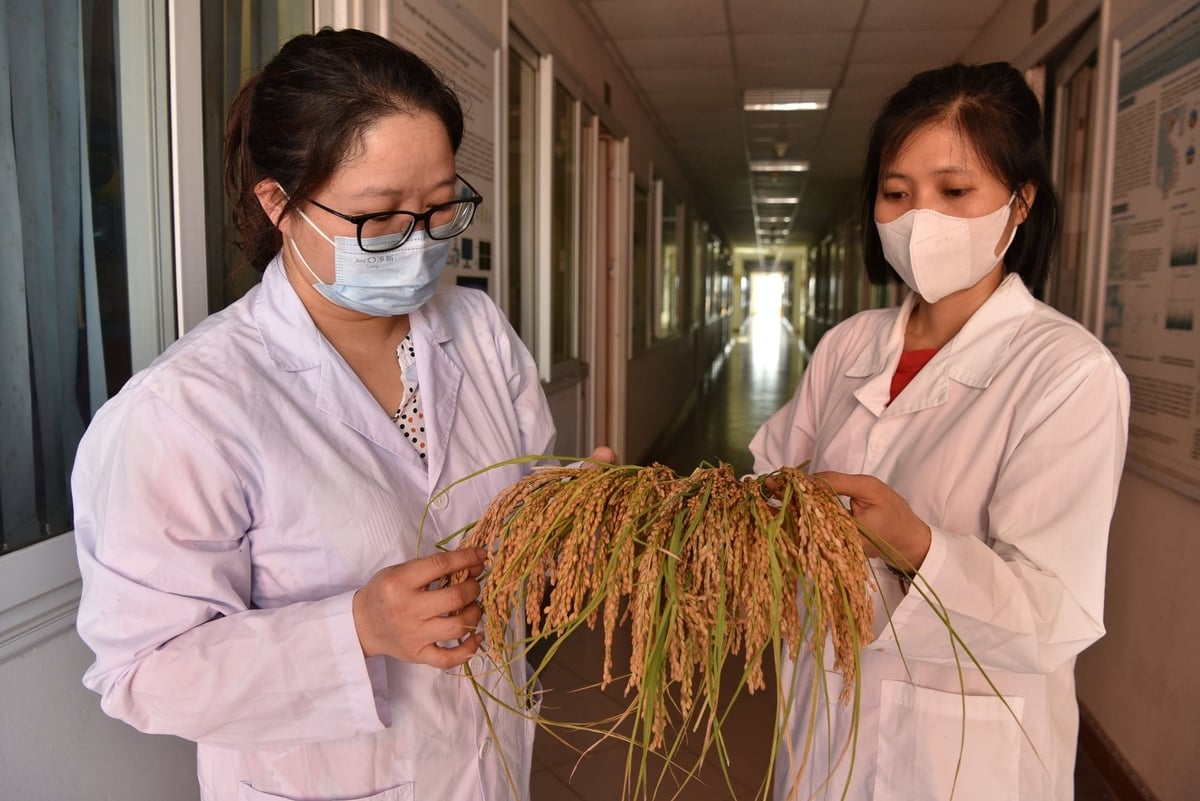
Dr. Phung Thi Phuong Nhung (left) and M.Sc. Tong Thi Huong checking rice samples. Photo: Duong Dinh Tuong.
Sitting and threshing rice seeds to extract the grains, Ms. Tong Thi Huong, a Master's degree holder, told me that scientists are now constantly on edge because, firstly, their salaries are low and only last six months (her current salary is 7,6 million VND/month). Secondly, science is a long, persistent process that requires continuity to achieve results, but now all research projects demand immediate results, which is very difficult. For example, her research on reducing emissions in rice plants is still in the exploratory stage, searching for relevant genes. Therefore, there is still a long way to go from the laboratory to production...
Under the financial self-reliance mechanism applied to public science and technology organizations, the state has systematically cut off portion of scientists' salaries regardless of whether they conduct basic or applied research. Left to "sink or swim" on their own, a growing number of researchers are choosing to walk away.
$ 1 = VND 26,450 - Source: Vietcombank.
Translated by Ha Chi
(VAN) Viet Nam's forestry sector is shifting from resource extraction to the development of strategic ecological infrastructure, opening new drivers for the green economy and the carbon market.
![Scientists' strength: [8] Fairness and creative motivation](https://t.ex-cdn.com/nongnghiepmoitruong.vn/608w/files/content/2026/07/16/pgsts-dang-van-dong-cham-soc-hoa-lay-on-103239_191-082039.jpg)
(VAN) Scientists must enjoy proportionate benefits from the intellectual products they create.

(VAN) The sugarcane industry is shifting its focus from expanding cultivation area to improving the quality of raw material zones in order to build sustainable competitive advantage.
![HCMC fisheries complies with the law: [Final] Technology fills the gaps](https://t.ex-cdn.com/nongnghiepmoitruong.vn/608w/files/huytd/2026/07/17/1455-3-133654_171.jpg)
(VAN) Through smart vessel positioning solutions and the digitalization of fishing logbooks, HCMC is proactively tightening control of inactive fishing vessels, closing management loopholes from shore.
![Scientists' strength: [7] Waiting for a broad mechanism](https://t.ex-cdn.com/nongnghiepmoitruong.vn/608w/files/anhntk/2026/06/23/1119-dsc00323-nongnghiep-081103.jpeg)
(VAN) Besides developing new rice varieties, scientists also have to worry about finances, resources, and research aspirations.
![Scientists' strength: [6] Need a medicine strong enough](https://t.ex-cdn.com/nongnghiepmoitruong.vn/608w/files/benlc/2026/07/12/1618-chatgpt-image-12_15_17-10-thg-7-2026-122814_896.jpeg)
(VAN) Retaining scientists requires not only income but also a conducive research environment, a meritocratic mechanism, and trust.
![Scientists' strength: [5] Heavy burden of livelihood](https://t.ex-cdn.com/nongnghiepmoitruong.vn/608w/files/chinq/2026/07/17/2452-dsc_0566-081739_259-065506.jpg)
(VAN) Behind the research projects lies the arduous life of scientists, those who persistently cling to their profession amidst the pressure of making a living.

![Scientists' strength: [1] Thoughts of a former institute director](https://t.ex-cdn.com/nongnghiepmoitruong.vn/resize/174x104/files/benlc/2026/07/06/4051-_dsc2865-071318_463.jpg)