July 21, 2026 | 21:35 GMT +7
Hotline: 0913.378.918

July 21, 2026 | 21:35 GMT +7
Hotline: 0913.378.918
An Giang Agricultural Extension Center has rolled out a high-quality, low-emission rice production model linked with purchasing businesses. The model is part of implementing the Project on Sustainable Development of One Million Hectares of High-Quality, Low-Emission Specialized Rice Cultivation Associated with Green Growth in the Mekong Delta through 2030, at the provincial level for 2026.
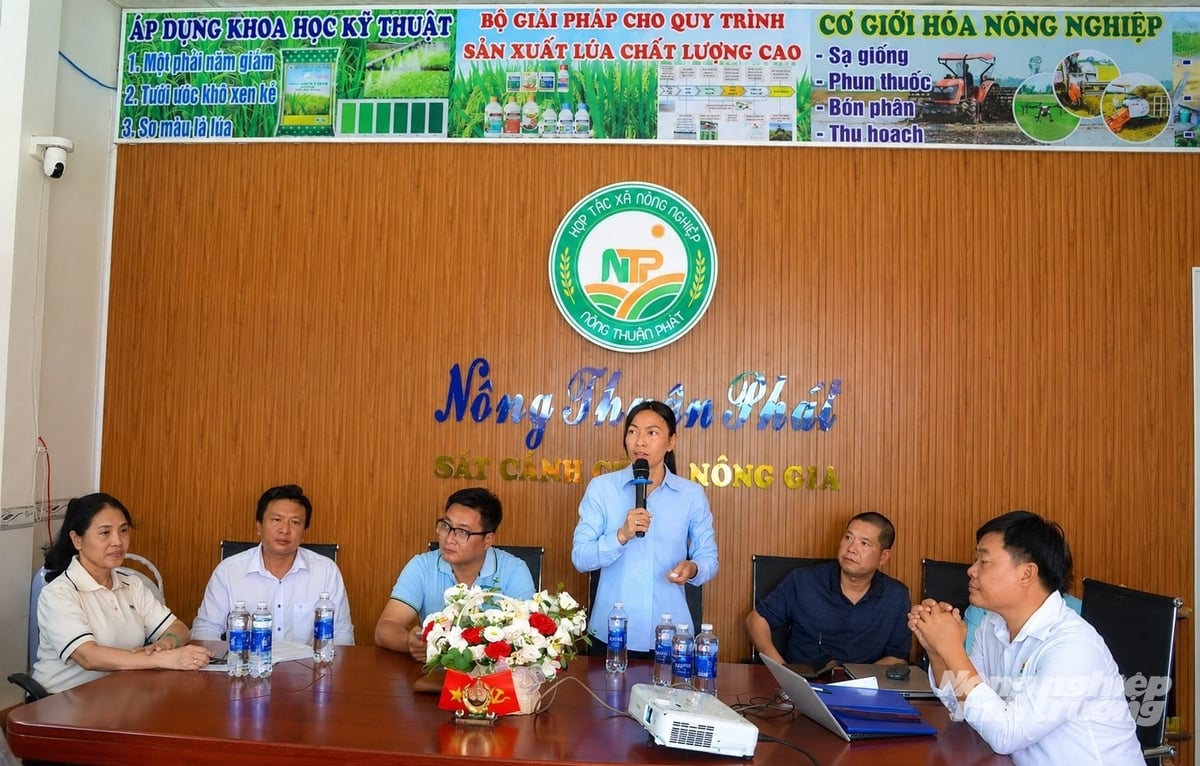
Tran Thi Cam Tu, deputy head of the Plant Production Division at the An Giang Agricultural Extension Center, presents support programs and technical procedures for implementing the model. Photo: Trung Chanh.
The model is being implemented on a minimum area of 200 hectares within the raw material zone of the Nong Thuan Phat Agricultural Cooperative branch (An Giang province), alongside a circular straw management model aimed at improving economic efficiency and reducing greenhouse gas emissions.
Tran Thi Cam Tu, deputy head of the Cultivation Division at the An Giang Agricultural Extension Center, said the areas selected must lie within concentrated production planning zones, have active irrigation systems and centralized water management, and infrastructure that meets mechanization requirements, and, in particular, must have production and consumption links with businesses in place. Participating farmers are trained in high-quality, low-emission rice production practices, as well as techniques for straw processing and mushroom cultivation. Field workshops are also held to evaluate the model's effectiveness and provide farmers with quicker access to new technological advances.
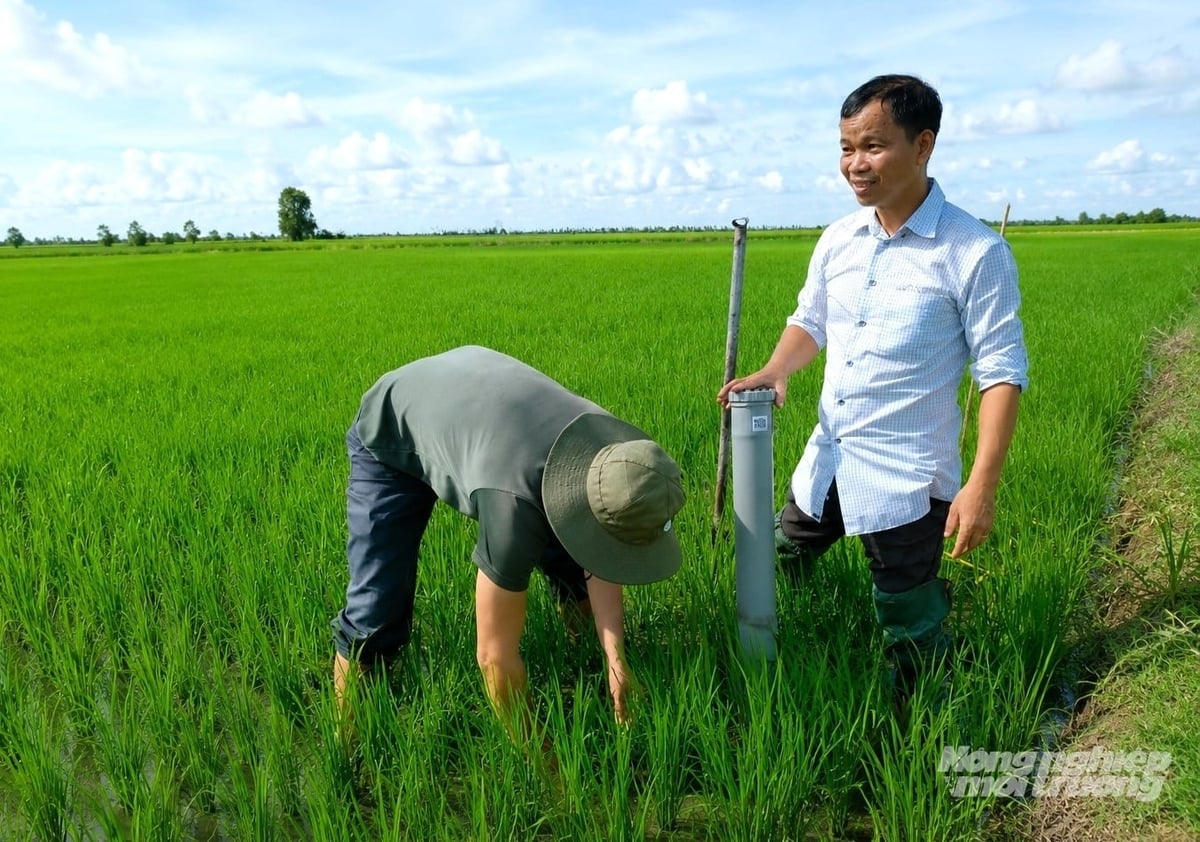
Extension staff install alternate wetting and drying (AWD) sensor systems in the field where the model is being implemented. Photo: Trung Chanh.
According to the plan, each 200-hectare model receives investment support of about 1.37 billion VND (approximately 53,300 to 53,900 USD). Of this, the state budget supports several key items, including smart insect monitoring stations, alternate wetting and drying (AWD) sensor systems, bio-organic fertilizer inputs, straw treatment products, and part of the cost of drone equipment. Farmers cover the cost of seed, production inputs and part of the equipment themselves, in line with regulations.
Alongside the rice production model, the program is also rolling out a 1,500-square-meter circular straw management model that supports farmers in growing straw mushrooms and producing compost from agricultural byproducts, with a budget of more than 26 million VND (roughly 1,010 to 1,020 USD) per model. The state budget covers 50 percent, with farmers covering the remainder, encouraging them to collect straw and generate additional value rather than burning it in the fields, which causes environmental pollution.
One highlight of the program is the building of a sustainable linkage chain between cooperatives and purchasing businesses. At the workshop, the Nong Thuan Phat Agricultural Cooperative and Thoai Son Food Company Limited signed a memorandum of cooperation to develop a 200-hectare raw material zone, with expected output of about 2,000 tons of DS1 rice seed in the 2026 summer-autumn crop.
Do Minh Hau, director of the Nong Thuan Phat Agricultural Cooperative, said the cooperative organizes production in strict accordance with emission-reduction technical procedures, keeps complete production logs, carries out traceability, and meets requirements for measurement, reporting and verification (MRV). The business, in turn, provides technical guidance, quality control and purchasing at prices above market rates for products that fully meet quality standards.
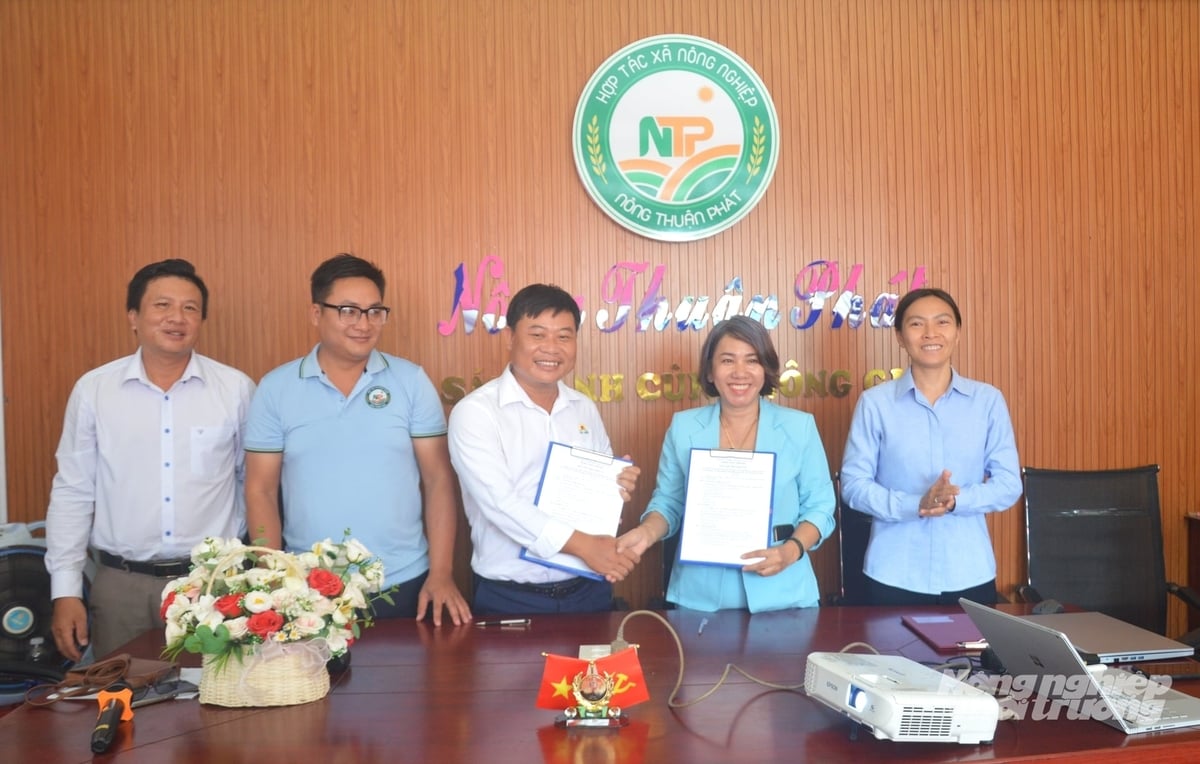
Representatives of the Nong Thuan Phat Agricultural Cooperative and Thoai Son Food Company Limited sign a memorandum of cooperation to develop a 200-hectare raw material zone and purchase the entire output in the 2026 summer-autumn crop. Photo: Trung Chanh.
In recent years, the Nong Thuan Phat Agricultural Cooperative has developed a linked rice-growing raw material area covering about 2,200 hectares in An Giang province and expects to expand it to 3,000 hectares by 2027. Building this linkage chain gives farmers confidence to produce, since their output is guaranteed, while also helping to establish raw material zones to serve processing and export.
Notably, the circular straw management model helps reduce post-harvest straw burning, uses byproducts to produce straw mushrooms and organic fertilizer, generates additional income for farming households, improves soil fertility, and reduces environmental pollution.
The models being rolled out are helping An Giang province expand the area participating in the One Million Hectares of Rice project, improve economic efficiency by cutting costs and raising the value of rice, and shift farmers' awareness toward green, low-emission production.
$ 1 = VND 26,460 - Source: Vietcombank.
Translated by Linh Linh

(VAN) Two Da Nang cooperatives were honored with the ‘Cooperative Star’ award for 2026, affirming the effectiveness of a dynamic, adaptable, and sustainably developing collective economic model.

(VAN) Policy credit has empowered many households in Hoa Vang commune to boldly invest in production, build effective economic models, and boost their income.

(VAN) Recently, the Lao Ministry of Agriculture and Environment delegation visited, worked, and signed a pact with the Vietnam Academy of Agricultural Sciences.

(VAN) Da Nang steps up free rabies vaccination in mountainous communes, delivering vaccines directly to villages to build an immunity shield.

(VAN) Native honeybee farming in Ha Tinh grew strongly, providing stable incomes and promoting sustainable rural economic development.
/2026/07/20/3847-3-113606_381.jpg)
(VAN) The global spread of the SAT-1 FMD virus strain underscores the need for Viet Nam to proactively enhance surveillance and develop response scenarios well in advance.

(VAN) Agricultural by-products are being recognized as resources that can generate new economic value, reduce emissions, and create new opportunities for green growth in circular agriculture.
