July 21, 2026 | 16:30 GMT +7
Hotline: 0913.378.918

July 21, 2026 | 16:30 GMT +7
Hotline: 0913.378.918
As one of the first companies to conduct a transaction immediately after Vietnam's carbon trading exchange officially commenced operations, AES Viet Nam views the occasion as a significant milestone for both the company and the country's energy transition.
According to Mr. Oliver Marquette, President of AES Viet Nam, carbon markets have been established in many countries and have proven effective in driving emissions reductions through market-based mechanisms.
"Carbon markets help establish a price for carbon and allow market forces to identify the most cost-effective solutions for reducing emissions. Therefore, Viet Nam's development of its own carbon market marks a highly significant milestone," he said.
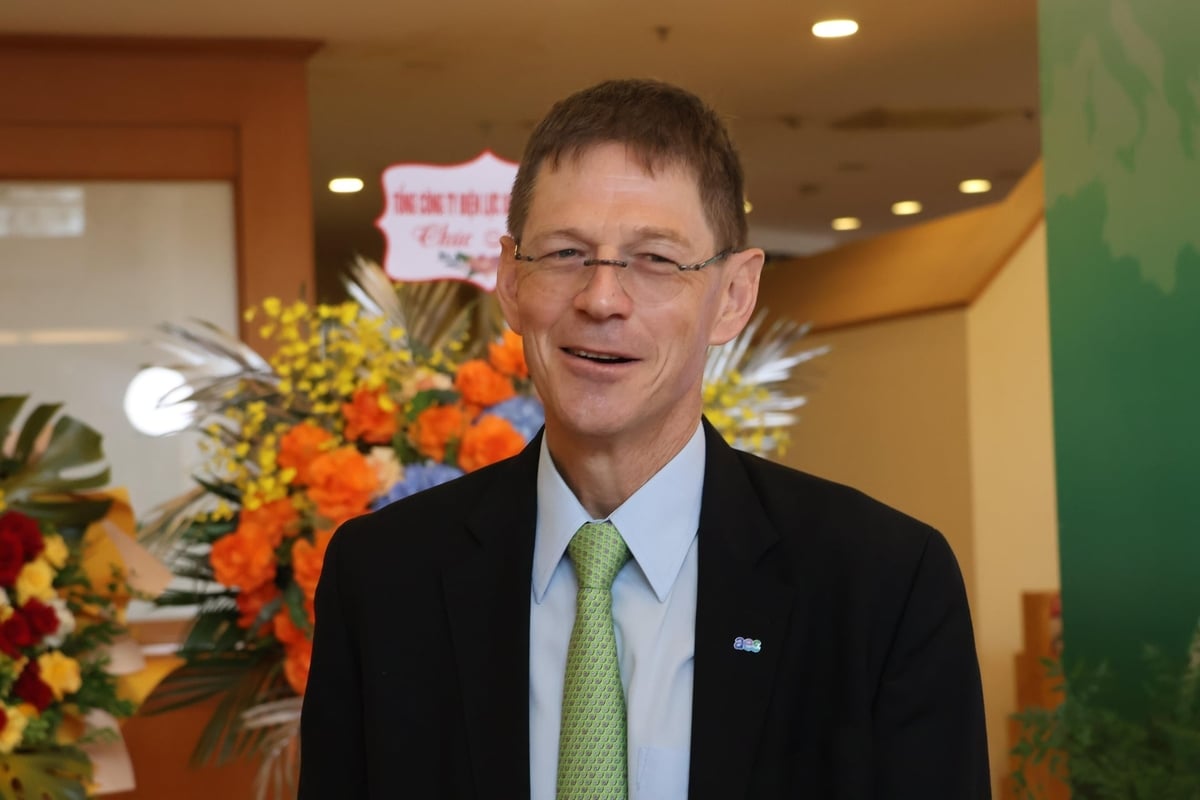
Mr. Oliver Marquette, President of AES Viet Nam. Photo: Khanh Ly.
Mr. Marquette said AES Vietnam completed its first transaction just minutes after the inaugural trading session began.
"We are very proud to have taken part in this historic moment and look forward to remaining an active participant in the carbon market in the years ahead," he said.
According to Mr. Marquette, the greatest significance of the carbon market lies not in the trading of carbon credits itself, but in establishing a price for greenhouse gas emissions. Once carbon is assigned a price, emitting businesses will need to factor carbon costs into their production decisions, creating stronger incentives to invest in clean technologies and low-emission energy sources.
For AES Vietnam, as a power producer, greenhouse gas emissions generated from electricity generation will need to be offset through the purchase of emissions allowances or carbon credits on the market.
"Every tonne of carbon emitted must be offset by carbon credits. This will become a critically important part of our business operations," he said.
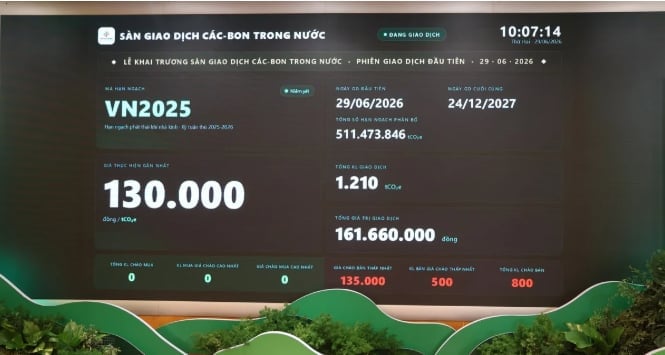
The electronic trading board records transactions shortly after Viet Nam's domestic carbon trading exchange officially commenced operations. Photo: Trung Nguyen.
Drawing on AES's experience in Europe, Mr. Marquette noted that the cost of purchasing emissions allowances has become a significant component of the operating costs of coal-fired power plants. This has compelled companies to adjust their investment strategies and accelerate the development of lower-emission power sources such as natural gas, hydropower, and renewable energy.
He believes that, once fully developed, the carbon market will help reshape the economics of the power sector and provide tangible incentives for Vietnam's decarbonization efforts.
Responding to views that Viet Nam has introduced a carbon market later than many other countries, the President of AES Viet Nam said each country follows its own development path and that Viet Nam is progressing on schedule.
According to Mr. Marquette, even Europe took many years to establish the legal framework, refine market mechanisms, and build a sufficiently broad participant base before its carbon market became fully effective.
"I do not believe Viet Nam is behind. This is a natural stage of development, and now is the right time to launch the market," he said.
He also welcomed Viet Nam's plan to expand the market from 2029, when a larger number of businesses are expected to participate in carbon trading. In his view, the current phase offers companies an opportunity to familiarize themselves with trading procedures, gain practical experience, and prepare for a larger, more mature market in the future.
For AES Viet Nam, the company's first transaction was intended primarily to test trading procedures rather than generate financial returns.
"The priority is to understand how the market operates, identify trading partners, and prepare thoroughly for the next stage," he said.
With many years of experience participating in carbon markets around the world, AES Viet Nam enjoys certain advantages as an early entrant. However, Mr. Marquette emphasized that it is equally important for Vietnamese businesses to engage with the market as early as possible.
"Companies that begin participating now will have time to learn and adapt before the market expands significantly. That will be a major competitive advantage in the future," he stressed.
AES Viet Nam is a subsidiary of The AES Corporation (US), one of the world's leading energy companies and one of the largest U.S. investors in Viet Nam's energy sector. Established in Viet Nam in 2010, the company operates the 1,242 MW Mong Duong 2 BOT Thermal Power Plant in Quang Ninh Province and is developing the 2,250 MW Son My 2 Combined Cycle Gas Turbine (CCGT) Power Plant and the Son My LNG Terminal in Binh Thuan Province. In addition, AES Vietnam is expanding its investments in renewable energy and battery energy storage systems (BESS), supporting Viet Nam's energy transition and greenhouse gas emissions reduction efforts.
Translated by Phuong Linh
(VAN) Viet Nam's forestry sector is shifting from resource extraction to the development of strategic ecological infrastructure, opening new drivers for the green economy and the carbon market.
![Scientists' strength: [8] Fairness and creative motivation](https://t.ex-cdn.com/nongnghiepmoitruong.vn/608w/files/content/2026/07/16/pgsts-dang-van-dong-cham-soc-hoa-lay-on-103239_191-082039.jpg)
(VAN) Scientists must enjoy proportionate benefits from the intellectual products they create.

(VAN) The sugarcane industry is shifting its focus from expanding cultivation area to improving the quality of raw material zones in order to build sustainable competitive advantage.
![HCMC fisheries complies with the law: [Final] Technology fills the gaps](https://t.ex-cdn.com/nongnghiepmoitruong.vn/608w/files/huytd/2026/07/17/1455-3-133654_171.jpg)
(VAN) Through smart vessel positioning solutions and the digitalization of fishing logbooks, HCMC is proactively tightening control of inactive fishing vessels, closing management loopholes from shore.
![Scientists' strength: [7] Waiting for a broad mechanism](https://t.ex-cdn.com/nongnghiepmoitruong.vn/608w/files/anhntk/2026/06/23/1119-dsc00323-nongnghiep-081103.jpeg)
(VAN) Besides developing new rice varieties, scientists also have to worry about finances, resources, and research aspirations.
![Scientists' strength: [6] Need a medicine strong enough](https://t.ex-cdn.com/nongnghiepmoitruong.vn/608w/files/benlc/2026/07/12/1618-chatgpt-image-12_15_17-10-thg-7-2026-122814_896.jpeg)
(VAN) Retaining scientists requires not only income but also a conducive research environment, a meritocratic mechanism, and trust.
![Scientists' strength: [5] Heavy burden of livelihood](https://t.ex-cdn.com/nongnghiepmoitruong.vn/608w/files/chinq/2026/07/17/2452-dsc_0566-081739_259-065506.jpg)
(VAN) Behind the research projects lies the arduous life of scientists, those who persistently cling to their profession amidst the pressure of making a living.
