July 21, 2026 | 21:18 GMT +7
Hotline: 0913.378.918

July 21, 2026 | 21:18 GMT +7
Hotline: 0913.378.918
Coconut shells, once regarded as waste after processing, are now being "revived" into export-grade activated carbon, biochar powder, and wood vinegar through a circular pyrolysis system self-developed and built by Mai Duc Lai, 47, of An Ninh hamlet, Vinh Huu commune, Dong Thap province.
A mechanical engineer who had worked in various fields, Lai decided in early 2026 to return to his wife's hometown to start a business turning agricultural by-products into activated carbon. He was driven by the fact that many traditional charcoal kilns still generate large amounts of smoke and dust, harming the environment. Dong Thap, one of Vietnam's largest coconut-growing provinces, produces enormous volumes of shells each year as a by-product of coconut processing, much of which has traditionally gone unused or been burned inefficiently, prompting Lai to see an opportunity where others saw waste.
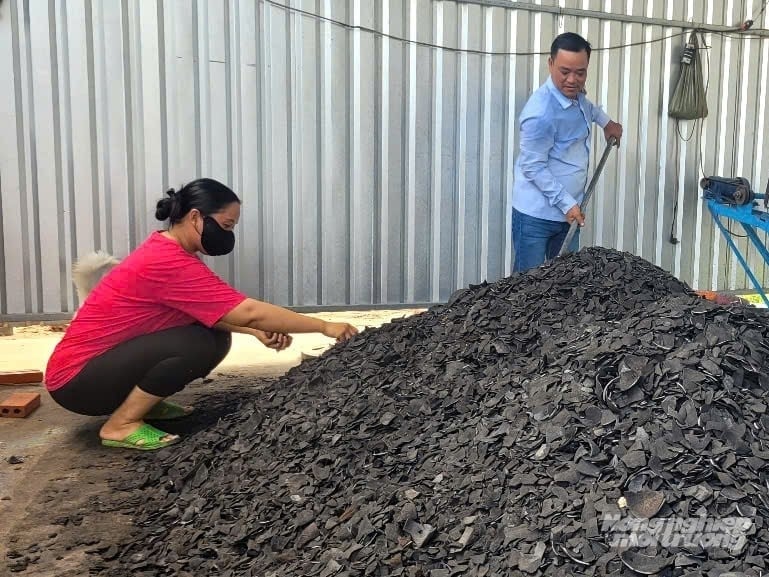
Mai Duc Lai operates his circular pyrolysis kiln system, turning coconut shells into activated carbon, wood vinegar, and biochar powder. Photo: Minh Dam.
After months of research, Lai successfully designed a pyrolysis system using circular technology. Its key feature is that all smoke generated during burning is captured and fed back into the combustion chamber to continue burning, allowing the kiln to reach around 700 degrees Celsius, reducing fuel consumption and releasing almost no smoke into the environment.
His facility currently operates three pyrolysis kilns made of 304 stainless steel, integrated with a gas recirculation system, oxygen supply fans, and wood vinegar condensing equipment.
The main raw material is coconut shells. After about three hours of pyrolysis, each batch yields three products: activated carbon, biochar powder, and wood vinegar.
The activated carbon meets export standards and is shipped to Japan; the biochar powder is used for soil improvement or to make honeycomb briquettes; and the wood vinegar is used in producing biological preparations and environmental treatment products.
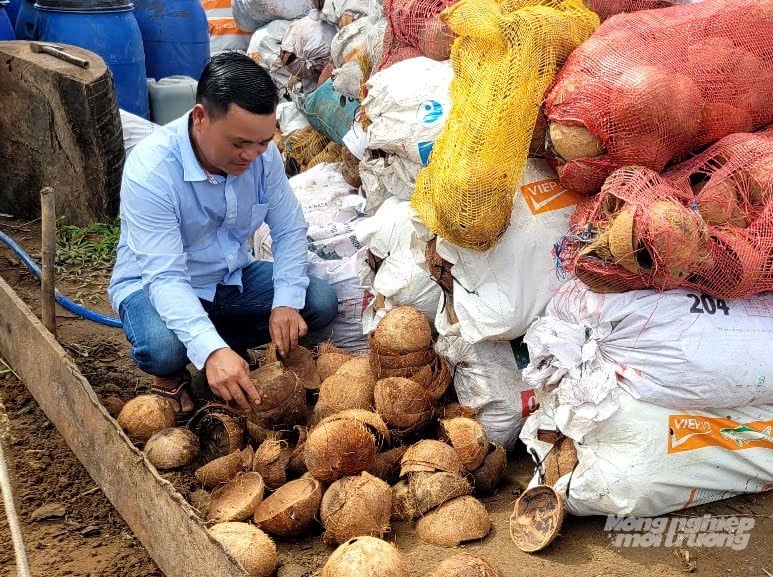
Coconut shells, an agricultural by-product, are used as raw material for activated carbon production under a circular economy model. Photo: Minh Dam.
In less than a year of operation, the facility now produces about 30 tons of activated carbon, 9,000 liters of wood vinegar, and roughly 6 tons of biochar powder each month. According to Lai, current output still falls short of market demand.
"I saw that this line of work benefits society, so I was determined to build it, to help treat waste without polluting the environment. It took me six months of experimenting before I succeeded in producing a quality product," Mai Duc Lai said.
Beyond coconut shells, the kiln system can also process many other agricultural by-products, such as mango peel, durian husk, corn stalks, and chili plants, helping raise the value of by-products, reduce post-harvest waste, and create additional raw material sources for production. This flexibility means the technology could potentially be adapted by farmers and cooperatives in other regions dealing with similar surpluses of crop residue.
After visiting the model, Pham Quang Truong, director of Truong Minh Phat private enterprise in Trung An ward, Dong Thap province, said the approach aligns well with the circular economy development trend.
"This model is very unique, especially since it produces almost no emissions, and the circulation process works very efficiently. If replicated widely, it would help local people make use of agricultural waste, generate additional income, and reduce environmental pollution," Truong said.
To secure a steady supply of raw material, Lai currently purchases coconut shells from various localities across the Mekong Delta and central provinces.
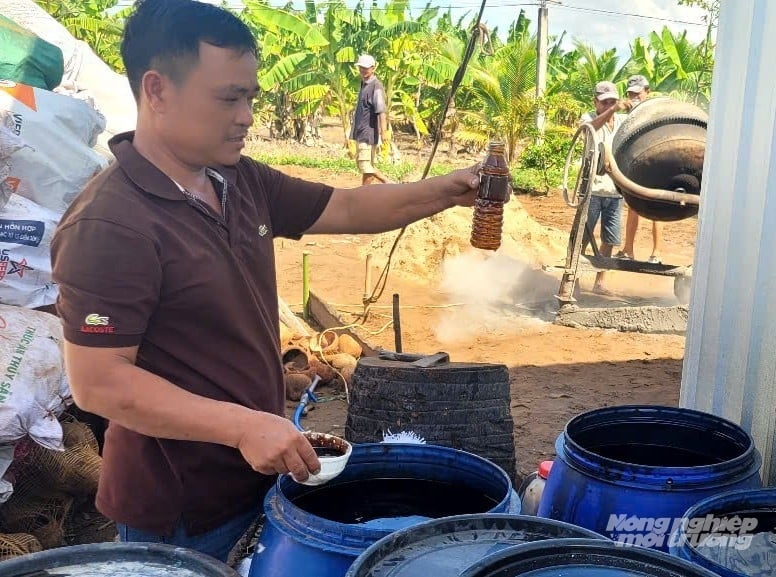
Each month, Mai Duc Lai's facility produces about 30 tons of activated carbon along with thousands of liters of wood vinegar from coconut shells. Photo: Minh Dam.
Going forward, he plans to establish a cooperative, expand his workshop, add more pyrolysis kilns, and partner with more households to build a large-scale production chain.
"I want to replicate this model to create more income for local people and partner units. Soon I'll set up a cooperative and expand the kilns and the workshop. I hope the government can support us with capital to invest in further development," Lai said.
The successful research and development of this circular biochar production kiln not only opens an effective path for making use of agricultural by-products, but also helps reduce emissions, protect the environment, and create products of high economic value.
Translated by Linh Linh

(VAN) Viet Nam - EFTA FTA opens the door to high-value markets while also raising the bar for product quality, traceability, and sustainable production.

(VAN) Hundreds of OCOP products and signature agricultural goods from Lao Cai are being showcased, promoted, and connected with buyers at an exhibition space.

(VAN) China has emerged as a bright spot for Viet Nam's coffee industry, with exports to this market recording strong growth in both volume and prices.
![Gia Lai agricultural extension milestones: [2] Lao farmers embraces intensive maize and rice farming models](https://t.ex-cdn.com/nongnghiepmoitruong.vn/608w/files/giangph/2026/07/21/1231-1100-0836-3-095726_966.jpg)
(VAN) Beyond serving the province, Gia Lai Agricultural Extension Center has helped Lao farmers improve corn and rice production through technology transfer.

(VAN) Once a wild plant growing in brackish and saline ecosystems, nan tuong grass is now a highly promising raw material for Viet Nam’s handicraft industry.

(VAN) Vietnamese tilapia conquer the Japanese sashimi market, marking a new step forward for the aquaculture sector and opening opportunities to boost its value.
![Gia Lai agricultural extension milestones: [1] Bringing red tilapia to Japan](https://t.ex-cdn.com/nongnghiepmoitruong.vn/608w/files/content/2026/07/20/1-094213_494-122051.jpg)
(VAN) In recent years, Gia Lai's agricultural extension service has been connecting businesses with red tilapia farmers to bring this product to Japan.
