July 21, 2026 | 14:07 GMT +7
Hotline: 0913.378.918

July 21, 2026 | 14:07 GMT +7
Hotline: 0913.378.918
Deputy Prime Minister Nguyen Van Thang attended the forum alongside more than 500 participants, including leaders of central and local government agencies, international organizations, diplomatic missions, business associations, and domestic and international enterprises. The Ministry of Agriculture and Environment was represented by Deputy Minister Le Cong Thanh.
Commending the forum's theme, "Viet Nam's Pathway to Net Zero", Deputy Prime Minister Nguyen Van Thang said the topic extends far beyond the energy and environmental sectors, representing a strategic choice for the nation's development. It reflects Viet Nam's commitment to pursuing faster yet greener growth, deeper yet more sustainable integration, and stronger investment attraction with higher quality, while reinforcing the country's global standing and fulfilling its responsibilities to the international community.
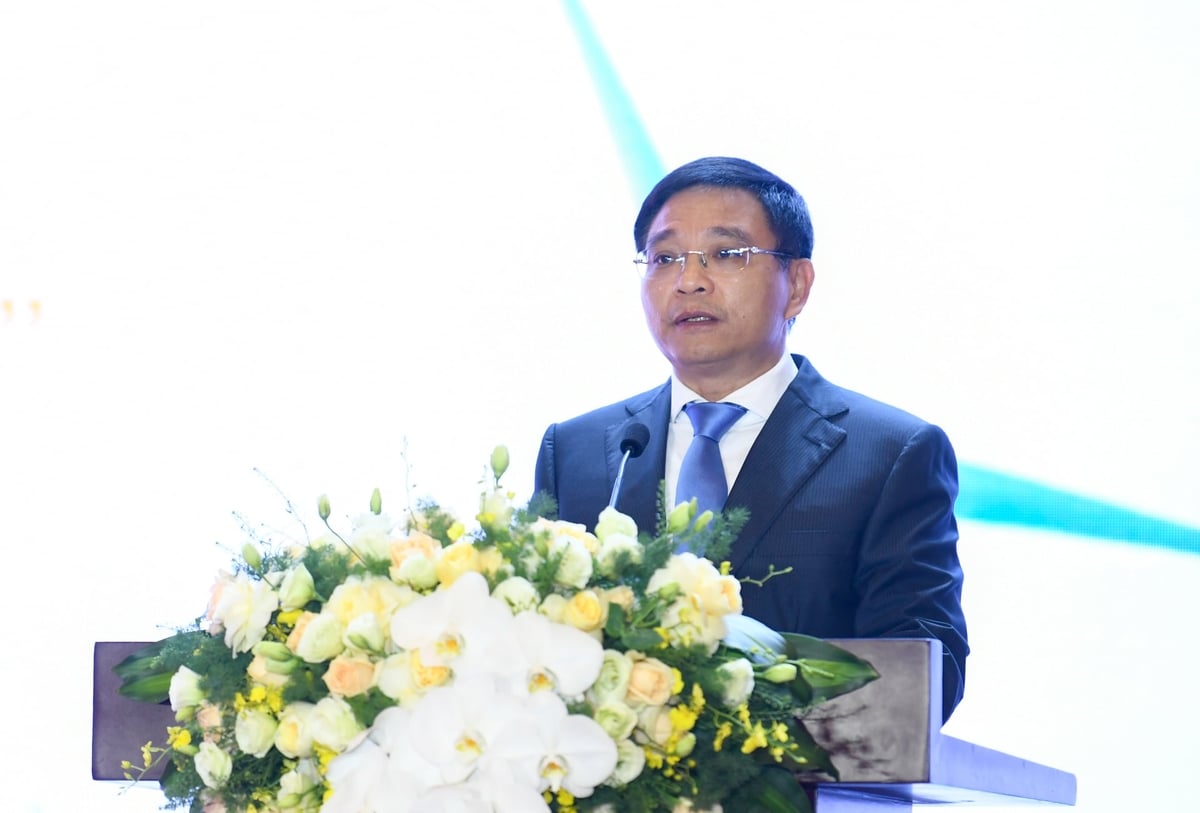
Deputy Prime Minister Nguyen Van Thang addresses the forum. Photo: Nhu Y.
During the plenary session, leaders from central government agencies outlined key institutional and policy directions to translate Viet Nam's net-zero emissions commitment into concrete action. Speakers agreed that ensuring energy security and advancing the green transition are not competing objectives but complementary priorities that must be pursued in parallel. Achieving both requires a modern energy system with diversified energy sources, more efficient use of resources, and a stronger role for science, technology, innovation, and the private sector.
According to VCCI Vice President Nguyen Quang Vinh, Net Zero is emerging as a new benchmark for national competitiveness. This trend is reflected in the reshaping of global investment flows, supply chain structures, international trade, and corporate development strategies.
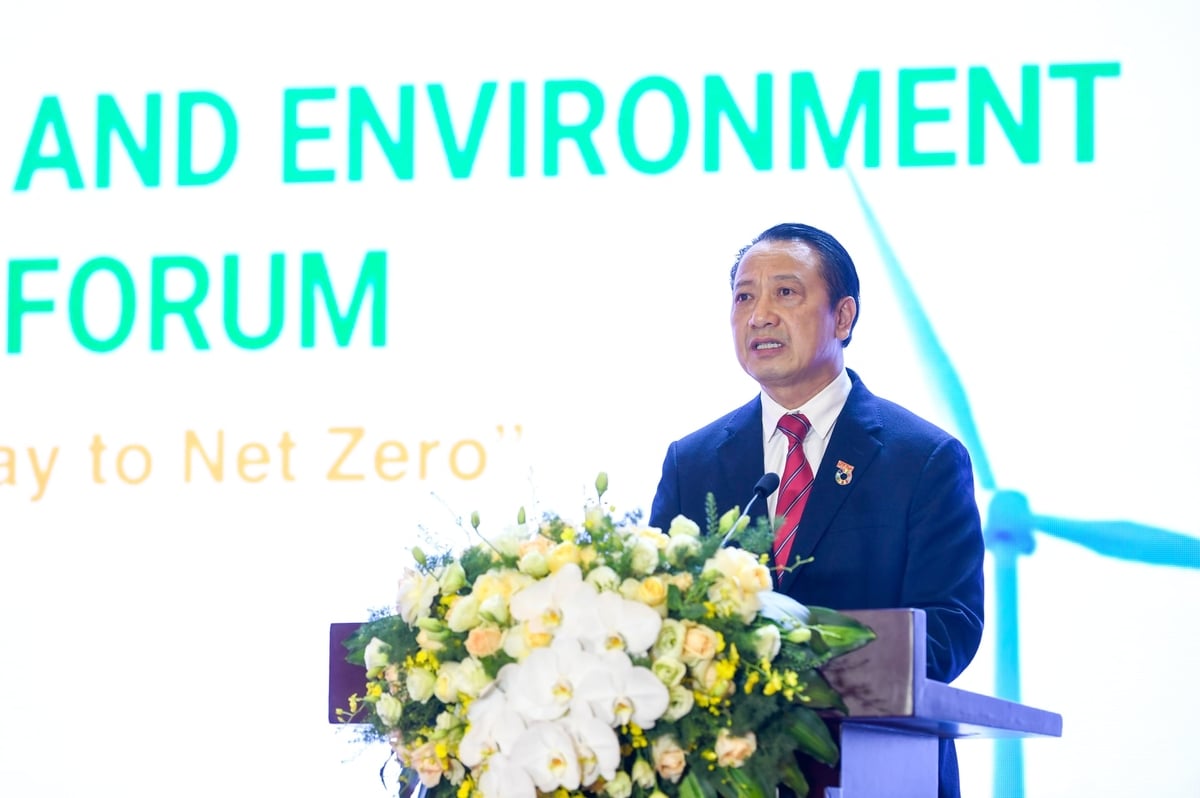
VCCI Vice President Nguyen Quang Vinh speaks at the forum. Photo: Nhu Y.
Viet Nam is entering a transformative phase in its economic development. The country's commitment to achieving Net Zero emissions by 2050 is no longer merely an international pledge but is being translated into an increasingly comprehensive policy framework. Most recently, the National Assembly adopted a resolution on mechanisms and policies for national energy development for the 2026–2030 period, providing an important institutional foundation for promoting investment, technological innovation, and long-term energy security. At the same time, Viet Nam is pursuing its goal of becoming a high-income developed country by 2045.
The Government has also set the objective of maintaining double-digit economic growth in the coming years. While the Government provides the institutional framework, businesses are expected to lead the implementation of sustainable development goals. From large corporations to small and medium-sized enterprises, the Vietnamese business community is increasingly adopting green production models, circular economy practices, energy-efficient technologies, ESG governance, and carbon emissions reduction measures.
According to Mr. Nguyen Quang Vinh, the journey to Net Zero is unprecedented. Many businesses, particularly small and medium-sized enterprises, continue to face significant challenges related to financing, technology, human resources, emissions data, and ESG management capacity. As a result, the green transition cannot rely solely on the efforts of businesses; it requires coordinated action by the Government, the private sector, financial institutions, local authorities, international partners, and society as a whole.
Addressing the forum, Deputy Minister of Agriculture and Environment Le Cong Thanh noted that immediately after Viet Nam pledged to achieve Net Zero emissions by 2050 at COP26, the Government and the Prime Minister directed comprehensive reforms in institutions, strategies, planning, and implementation. These efforts have established an initial legal framework, removed key bottlenecks, and created the conditions necessary to advance the green transition and the development of a low-carbon economy. The roadmap for achieving Net Zero has also been clearly defined for each stage, in line with the country's broader development objectives.
The Deputy Minister emphasized that, moving forward, stakeholders should focus on five strategic priorities to achieve net-zero emissions by 2050: completing the institutional framework; developing the carbon market; ensuring energy security alongside a sustainable green energy transition; accelerating green transformation across all economic sectors; and strengthening the role of natural ecosystems in carbon sequestration and storage.
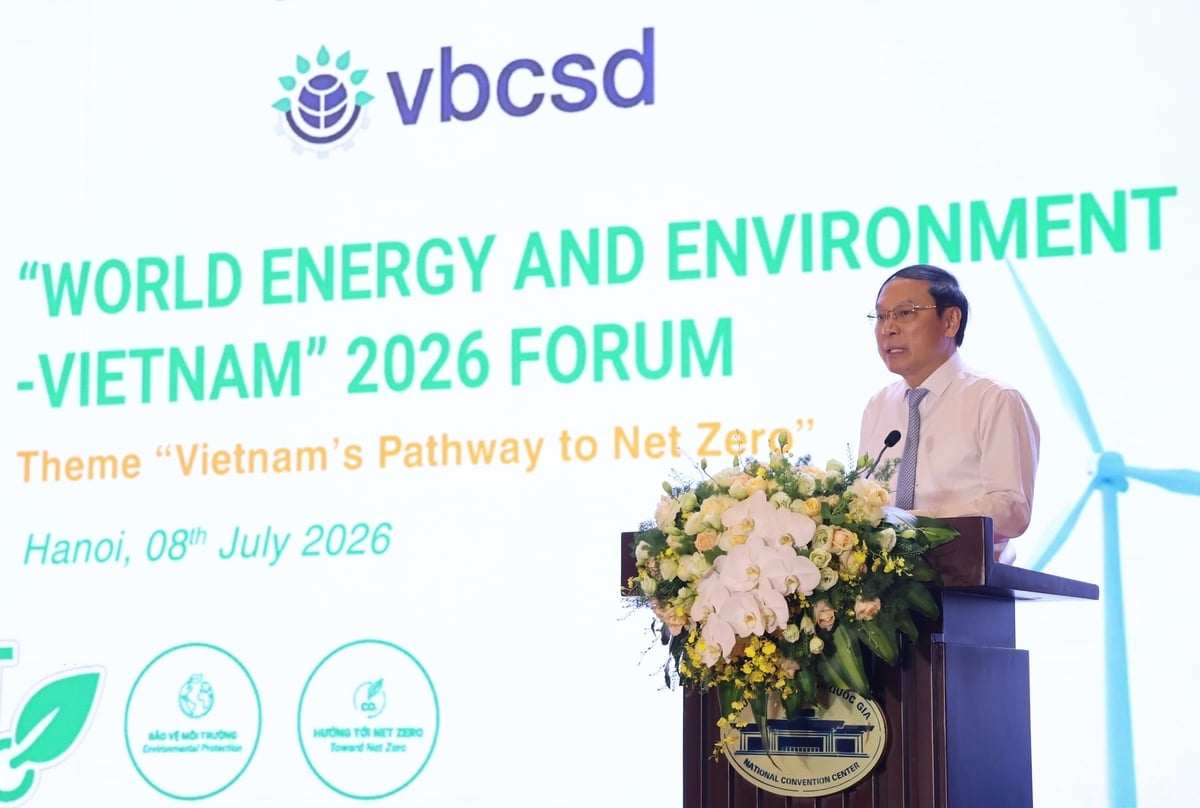
Deputy Minister Le Cong Thanh addresses the forum. Photo: Trung Nguyen.
In particular, the development of the carbon market represents a key step in creating an economic instrument to support greenhouse gas emissions reductions while unlocking social investment for the green transition. It is also an essential condition for helping Vietnamese businesses adapt to emerging trends and requirements in international markets. At the same time, the carbon market will provide important price signals to encourage green investment, technological innovation, and more efficient energy use.
The Ministry of Agriculture and Environment has piloted the allocation of greenhouse gas emissions allowances to 110 facilities in the thermal power, iron and steel, and cement industries for the 2025 and 2026 compliance periods. On June 29, 2026, Viet Nam's domestic carbon trading exchange officially commenced operations, laying the foundation for trading greenhouse gas emissions allowances and carbon credits.
In his keynote address, Deputy Prime Minister Nguyen Van Thang outlined several key priorities for advancing Viet Nam's pathway to Net Zero.
First, Viet Nam will pursue an energy transition based on an appropriate, efficient, and sustainable roadmap. The Government will continue refining policies and regulatory frameworks to develop an integrated energy system, diversify energy sources, accelerate renewable energy deployment, and promote energy efficiency. At the same time, traditional energy sources will not be phased out abruptly; instead, they will be used more efficiently, supported by advanced technologies to better control emissions while their share in the energy mix is gradually reduced according to the national roadmap.

The forum brought together more than 500 participants. Photo: Nhu Y.
Reaffirming the principle of not sacrificing the environment for economic growth, Viet Nam will continue to implement comprehensive and decisive measures to protect the environment, effectively address sources of pollution, and restore natural ecosystems. The Government will also accelerate the transition to a circular economy and promote green production and consumption models to build a low-emissions economy. Greenhouse gas emissions reductions must go hand in hand with economic growth model transformation and the enhancement of the environmental, social, and governance (ESG) standards of Vietnamese products within global supply chains.
The Government considers green finance a key driver for mobilizing both domestic and international resources. Viet Nam will continue to improve the legal framework, integrate environmental criteria into public budget management, develop green capital markets, including green bonds and green credit, and introduce preferential tax policies for green projects. At the same time, the country will strengthen cooperation with international financial institutions to mobilize concessional financing and advanced technologies. The Government will also continue to operate and further develop the domestic carbon trading exchange to establish a transparent and effective carbon pricing mechanism.
The Deputy Prime Minister emphasized that businesses across all sectors of the economy will play the decisive role in determining the success of Viet Nam's Net Zero journey. Companies should take the lead in developing emissions reduction roadmaps, integrating ESG principles into their long-term strategies, and investing in clean technologies.
He also called on local authorities, particularly those with significant renewable energy potential, to take a proactive approach to planning, improve the investment climate, and streamline administrative procedures to create the best possible conditions for green projects.
"The Government will always stand alongside local authorities and businesses, listening to their concerns and working to remove obstacles they encounter," the Deputy Prime Minister said.
Translated by Phuong Linh

(VAN) Viet Nam's forestry sector is shifting from resource extraction to the development of strategic ecological infrastructure, opening new drivers for the green economy and the carbon market.
![Scientists' strength: [8] Fairness and creative motivation](https://t.ex-cdn.com/nongnghiepmoitruong.vn/608w/files/content/2026/07/16/pgsts-dang-van-dong-cham-soc-hoa-lay-on-103239_191-082039.jpg)
(VAN) Scientists must enjoy proportionate benefits from the intellectual products they create.

(VAN) The sugarcane industry is shifting its focus from expanding cultivation area to improving the quality of raw material zones in order to build sustainable competitive advantage.
![HCMC fisheries complies with the law: [Final] Technology fills the gaps](https://t.ex-cdn.com/nongnghiepmoitruong.vn/608w/files/huytd/2026/07/17/1455-3-133654_171.jpg)
(VAN) Through smart vessel positioning solutions and the digitalization of fishing logbooks, HCMC is proactively tightening control of inactive fishing vessels, closing management loopholes from shore.
![Scientists' strength: [7] Waiting for a broad mechanism](https://t.ex-cdn.com/nongnghiepmoitruong.vn/608w/files/anhntk/2026/06/23/1119-dsc00323-nongnghiep-081103.jpeg)
(VAN) Besides developing new rice varieties, scientists also have to worry about finances, resources, and research aspirations.
![Scientists' strength: [6] Need a medicine strong enough](https://t.ex-cdn.com/nongnghiepmoitruong.vn/608w/files/benlc/2026/07/12/1618-chatgpt-image-12_15_17-10-thg-7-2026-122814_896.jpeg)
(VAN) Retaining scientists requires not only income but also a conducive research environment, a meritocratic mechanism, and trust.
![Scientists' strength: [5] Heavy burden of livelihood](https://t.ex-cdn.com/nongnghiepmoitruong.vn/608w/files/chinq/2026/07/17/2452-dsc_0566-081739_259-065506.jpg)
(VAN) Behind the research projects lies the arduous life of scientists, those who persistently cling to their profession amidst the pressure of making a living.
