July 21, 2026 | 19:08 GMT +7
Hotline: 0913.378.918

July 21, 2026 | 19:08 GMT +7
Hotline: 0913.378.918
On July 9, the Viet Nam Agency of Seas and Islands, in coordination with the Viet Nam Chamber of Commerce and Industry (VCCI), held a workshop on developing special, breakthrough incentive and support mechanisms and policies to promote sustainable marine economic development in Viet Nam. The workshop served as a forum to gather input from the business community to refine policy for the draft revised Law on Marine and Island Natural Resources and Environment, which is expected to be submitted to the National Assembly in 2026.
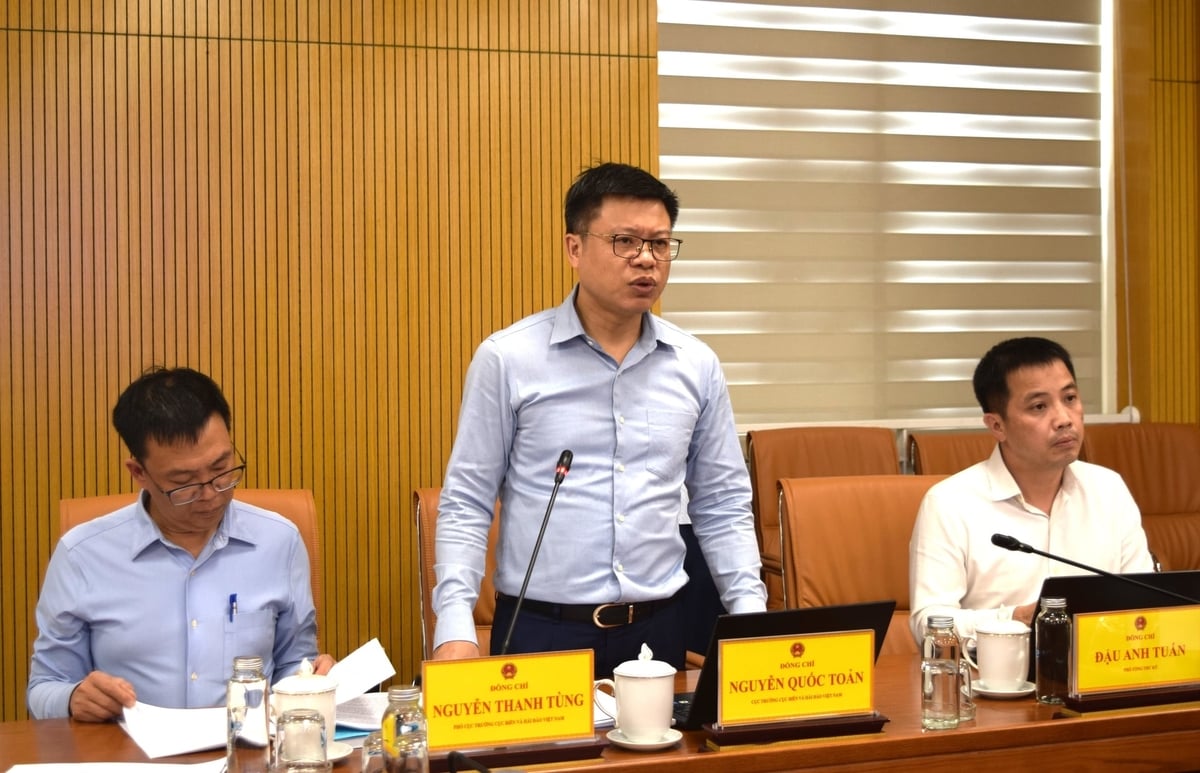
Nguyen Quoc Toan said he hopes to hear input from the business community to refine incentive and support mechanisms that are grounded in practical realities and ensure feasibility during implementation. Photo: Truong Giang.
Speaking at the workshop, Nguyen Quoc Toan, director of the Viet Nam Agency of Seas and Islands, said that on July 8 the government issued Resolution No. 182/NQ-CP approving the policy framework for the draft revised Law on Marine and Island Natural Resources and Environment. This provides an important basis for the Ministry of Agriculture and Environment to continue refining the draft law before submitting it to the National Assembly Standing Committee in September.
According to Toan, one of the central elements of the draft is the policy on developing special, breakthrough incentive and support mechanisms to promote sustainable marine economic development. This is regarded as a breakthrough step to give concrete form to the Party's guidelines on marine economic development, while creating a legal framework strong enough to effectively harness marine potential in the new period.
Toan said revising the law is a difficult task because Viet Nam's maritime space is vast and multilayered, and is governed by numerous specialized laws, including the Petroleum Law, the Geology and Minerals Law, the Maritime Code and the Fisheries Law. The draft law must therefore ensure consistency across the legal system while also addressing new issues arising in marine economic development.
According to the Viet Nam Agency of Seas and Islands, in the first six months of 2026 the marine economy continued to make an important contribution to growth in 21 coastal provinces and cities. However, the current legal framework still contains many gaps and has not created a strong enough incentive to mobilize social resources for investment in new marine economic sectors.
Presenting new provisions in the draft law, Nguyen Thanh Tung, deputy director general of the Viet Nam Agency of Seas and Islands, said the ministry is proposing a number of breakthrough policies to unlock resources for marine economic development involving businesses.
Notably, the draft adds provisions on the rights of organizations and individuals allocated, leased or registered to use marine areas. Under these provisions, organizations and individuals allocated or leased marine areas within internal waters and territorial waters could transfer, lease, contribute as capital or mortgage their rights to use the marine area and any associated assets, provided they meet conditions set out in law.
The draft also establishes a mechanism for converting the purpose of marine area use, and adds provisions on the conditions and cases under which rights to use marine areas may be transferred, contributed as capital, leased or mortgaged, ensuring consistency with the legal regime of each maritime zone while safeguarding national defense, security, sovereignty and sovereign rights.
In addition, the ministry is proposing a range of special incentive and support mechanisms for projects in the green marine economy, circular economy, high technology, marine special economic zones, coastal free trade zones, land-reclamation urban development, dual-use infrastructure, multipurpose offshore structures, marine logistics, marine biotechnology, marine ecosystem restoration and blue carbon absorption activities.
The ministry is also proposing mechanisms and policies to streamline and simplify administrative procedures and strengthen interagency coordination to shorten the time required to carry out offshore investment projects.
At the workshop, Dau Anh Tuan, deputy secretary general of VCCI, said that although Viet Nam has more than 3,200 kilometers of coastline and considerable advantages for marine economic development, its potential remains underexploited. He said one important reason is institutional bottlenecks.

Dau Anh Tuan proposed that incentive policies be genuinely superior, transparent and stable, while calling for completing the mechanism for establishing property rights at sea, reforming administrative procedures and building an effective interagency coordination mechanism. Photo: Tung Dinh.
A VCCI representative said many businesses investing in offshore wind power, high-tech marine aquaculture, marine tourism and land reclamation still face difficulties because property rights over marine areas have not been clearly established. When the right to use a marine area does not yet meet the conditions for transfer, capital contribution or mortgage, businesses find it difficult to access credit and raise capital for projects with lifespans of several decades.
Tuan proposed that incentive policies be genuinely superior, transparent and stable, and called for completing the mechanism for establishing property rights at sea, reforming administrative procedures and building an effective interagency coordination mechanism.
Drawing on practical experience, many associations and businesses also recommended adding sector-specific provisions. Bui Tuan Anh, a representative of the Viet Nam Mariculture Association, called for synchronized planning of infrastructure serving the mariculture industry, simplified procedures for long-term allocation of marine areas, and the prompt issuance of standards, technical regulations, and insurance and financing mechanisms for the mariculture sector.
A representative of the Viet Nam Ship Agents and Brokers Association called for prioritizing maritime space for international shipping, resolving obstacles related to procedures for disposing of dredged material, and simplifying the process for maintenance dredging of shipping channels.
A representative of Sun Group proposed adding provisions on islands formed through land reclamation, establishing priority mechanisms for land-reclamation urban development projects, and studying mechanisms to allow businesses to take part in managing and conserving certain marine protected areas in accordance with the law.

Delegates agreed that, alongside investment incentive policies, further administrative procedure reform, stronger interagency coordination and clearly established property rights over marine areas are needed. Photo: VAN.
Delegates agreed that, alongside investment incentive policies, further administrative procedure reform, stronger interagency coordination and clearly established property rights over marine areas are needed.
A representative of Nghi Son Trading and Services Co., Ltd. called for harmonizing marine spatial planning to avoid overlapping uses, broadening the permitted purposes of marine area use to improve exploitation efficiency, reducing marine area leasing costs, and providing support policies for port and logistics infrastructure similar to those available for onshore investment projects.
Input from the workshop will be compiled and studied by the Viet Nam Agency of Seas and Islands to further refine the draft revised Law on Marine and Island Natural Resources and Environment, with the aim of building a transparent, stable legal framework capable of driving breakthroughs in sustainable marine economic development and contributing to Viet Nam's goal of becoming a strong and prosperous maritime nation.
Translated by Linh Linh

(VAN) Viet Nam's forestry sector is shifting from resource extraction to the development of strategic ecological infrastructure, opening new drivers for the green economy and the carbon market.
![Scientists' strength: [8] Fairness and creative motivation](https://t.ex-cdn.com/nongnghiepmoitruong.vn/608w/files/content/2026/07/16/pgsts-dang-van-dong-cham-soc-hoa-lay-on-103239_191-082039.jpg)
(VAN) Scientists must enjoy proportionate benefits from the intellectual products they create.

(VAN) The sugarcane industry is shifting its focus from expanding cultivation area to improving the quality of raw material zones in order to build sustainable competitive advantage.
![HCMC fisheries complies with the law: [Final] Technology fills the gaps](https://t.ex-cdn.com/nongnghiepmoitruong.vn/608w/files/huytd/2026/07/17/1455-3-133654_171.jpg)
(VAN) Through smart vessel positioning solutions and the digitalization of fishing logbooks, HCMC is proactively tightening control of inactive fishing vessels, closing management loopholes from shore.
![Scientists' strength: [7] Waiting for a broad mechanism](https://t.ex-cdn.com/nongnghiepmoitruong.vn/608w/files/anhntk/2026/06/23/1119-dsc00323-nongnghiep-081103.jpeg)
(VAN) Besides developing new rice varieties, scientists also have to worry about finances, resources, and research aspirations.
![Scientists' strength: [6] Need a medicine strong enough](https://t.ex-cdn.com/nongnghiepmoitruong.vn/608w/files/benlc/2026/07/12/1618-chatgpt-image-12_15_17-10-thg-7-2026-122814_896.jpeg)
(VAN) Retaining scientists requires not only income but also a conducive research environment, a meritocratic mechanism, and trust.
![Scientists' strength: [5] Heavy burden of livelihood](https://t.ex-cdn.com/nongnghiepmoitruong.vn/608w/files/chinq/2026/07/17/2452-dsc_0566-081739_259-065506.jpg)
(VAN) Behind the research projects lies the arduous life of scientists, those who persistently cling to their profession amidst the pressure of making a living.
