July 21, 2026 | 21:57 GMT +7
Hotline: 0913.378.918

July 21, 2026 | 21:57 GMT +7
Hotline: 0913.378.918
Recently, the Directorate of Fisheries and Surveillance convened expert consultation sessions on the project outline for developing Viet Nam standards for industrial ocean aquaculture. The meeting was chaired by Director General Tran Dinh Luan and brought together representatives from government agencies, research institutes, businesses, and international organizations.
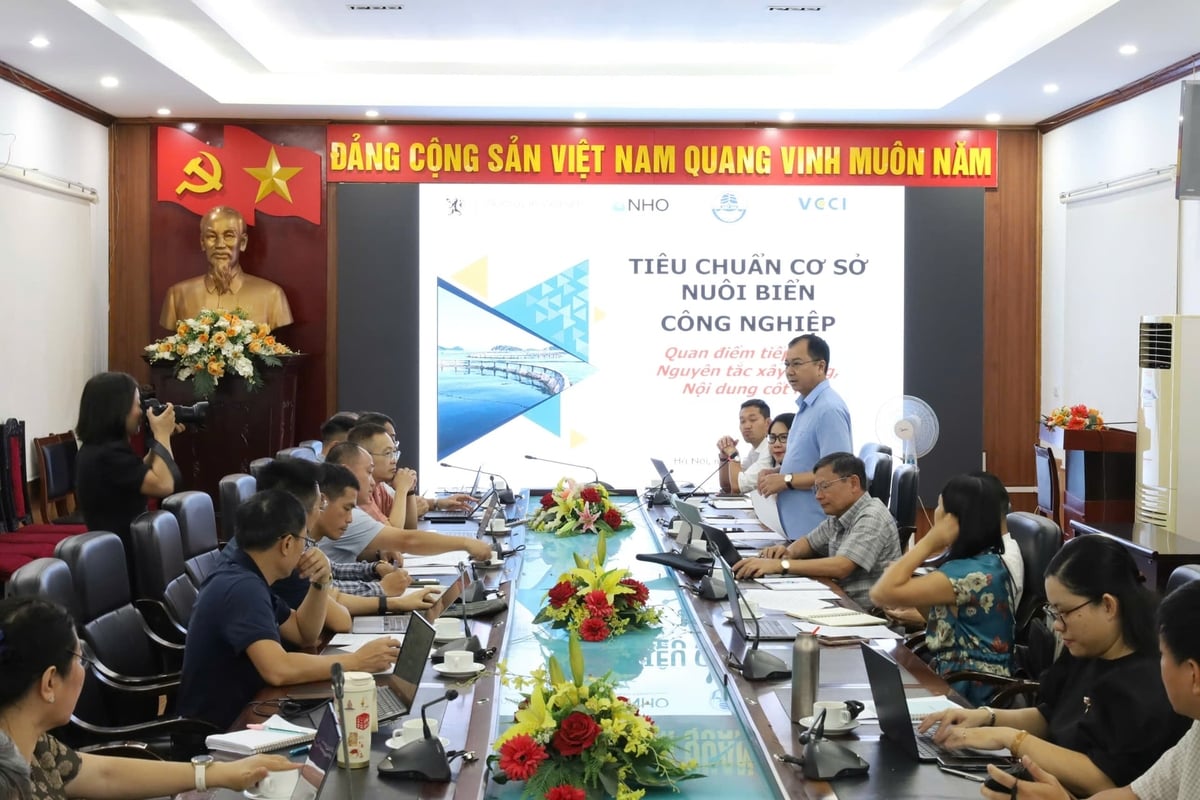
Overview of the expert consultation meeting held by the Directorate of Fisheries and Surveillance on June 26. Photo: Hong Ngoc.
In his opening remarks, Director General of the Directorate of Fisheries and Surveillance Tran Dinh Luan emphasized that Viet Nam's marine aquaculture sector is entering a critical transition period, shifting from small-scale production to modern industrial farming. He stressed that developing a comprehensive set of Viet Nam standards is an urgent priority to address the current lack of technical guidelines.
Mr. Tran Dinh Luan also underscored the importance of practicality, noting that the standards must be tailored to Viet Nam's natural conditions. He called for the draft standards to be transparent, scientifically sound, and based on measurable, readily verifiable criteria.

Director General of the Directorate of Fisheries and Surveillance Tran Dinh Luan chairs the workshop and delivers the opening remarks. Photo: Hong Ngoc.
Building on existing regulations, the drafting committee introduced three innovative approaches: a systems-based approach, a project life cycle approach, and a risk management approach. Rather than focusing solely on technical specifications for HDPE cages, the proposed standards will cover the entire production chain, from site assessment and design to installation, operation, and maintenance.
To effectively embed risk management from the outset, the draft sets out stringent requirements for the systematic collection of oceanographic data. Assessing five key environmental parameters, water depth, tides, waves, currents, and wind is considered a prerequisite before establishing any marine fish farm. Among these, water currents are identified as the most critical factor, with the greatest potential to affect mooring system performance and the overall safety and stability of farm infrastructure.
Another key feature of the proposed standards is their emphasis on environmentally sustainable marine aquaculture. The draft recommends using modeling software to assess the environmental carrying capacity of farming areas. Based on parameters such as feed input, nutrient absorption, and waste discharge, management authorities can determine the appropriate number of cages and stocking density for each marine zone, ensuring that economic development is balanced with environmental protection.
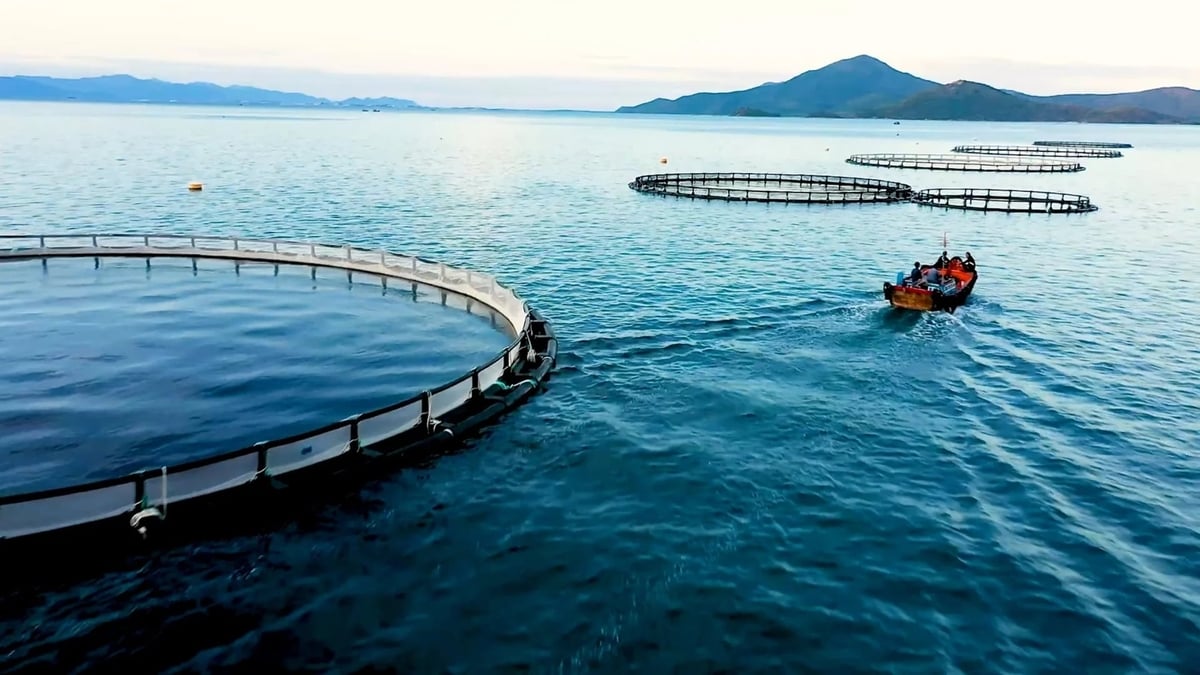
Assessing environmental carrying capacity helps determine appropriate cage farming densities, supporting the sustainable development of industrial marine aquaculture. Photo: Duy Hoc.
During the workshop, experts emphasized that introducing the standards at this stage is both timely and essential. To maximize their effectiveness, they recommended that the drafting committee conduct more field surveys across Vietnam's diverse marine areas to ensure that the proposed parameters not only enable effective management but also facilitate business operations.
From a risk management perspective, Mr. Luu Van Huy, Acting Director of the Fishing Vessel Registration Center under the Directorate of Fisheries and Fisheries Surveillance, described the standards as the "key" to establishing inspection, certification, and insurance mechanisms for offshore cage farming systems.
According to Mr. Huy, the standards should be developed in alignment with marine spatial planning to ensure harmony between marine aquaculture and other marine uses, including shipping, tourism, environmental protection, and national defense and security. He also suggested that the draft include provisions on the minimum distance between cages, the clearance between cage bottoms and the seabed, waste management, and supporting infrastructure to minimize environmental impacts.
Mr. Huy noted that the current lack of technical standards and regulations remains a major obstacle to expanding insurance coverage and investment support for industrial marine aquaculture. Without clear technical benchmarks to assess the safety of cage systems and marine farms, insurers and financial institutions have little basis for underwriting insurance policies or financing aquaculture projects.
Representatives of the STP Group echoed these views, recommending that the standards be introduced through a flexible roadmap, initially focusing on core requirements to encourage farmers to transition to HDPE cages as early as possible. The company also expressed hope that the standards would pave the way for the development of integrated multi-trophic aquaculture, combining finfish, seaweed, and shellfish farming with marine tourism and experiential activities.
According to the implementation plan, the project to develop Viet Nam's national standards for industrial marine fish farming will be carried out and finalized during the 2026 - 2027 period. The early issuance of these standards is expected to establish a robust legal framework, standardize investment and operational practices, and enable Vietnam's marine fish farming industry to develop more professionally while enhancing its international competitiveness.
Translated by Kieu Chi

(VAN) International resource mobilization for energy transition investment projects has yet to keep pace with Vietnam’s efforts to improve its energy policy framework.
(VAN) Viet Nam's forestry sector is shifting from resource extraction to the development of strategic ecological infrastructure, opening new drivers for the green economy and the carbon market.
![Scientists' strength: [8] Fairness and creative motivation](https://t.ex-cdn.com/nongnghiepmoitruong.vn/608w/files/content/2026/07/16/pgsts-dang-van-dong-cham-soc-hoa-lay-on-103239_191-082039.jpg)
(VAN) Scientists must enjoy proportionate benefits from the intellectual products they create.

(VAN) The sugarcane industry is shifting its focus from expanding cultivation area to improving the quality of raw material zones in order to build sustainable competitive advantage.
![HCMC fisheries complies with the law: [Final] Technology fills the gaps](https://t.ex-cdn.com/nongnghiepmoitruong.vn/608w/files/huytd/2026/07/17/1455-3-133654_171.jpg)
(VAN) Through smart vessel positioning solutions and the digitalization of fishing logbooks, HCMC is proactively tightening control of inactive fishing vessels, closing management loopholes from shore.
![Scientists' strength: [7] Waiting for a broad mechanism](https://t.ex-cdn.com/nongnghiepmoitruong.vn/608w/files/anhntk/2026/06/23/1119-dsc00323-nongnghiep-081103.jpeg)
(VAN) Besides developing new rice varieties, scientists also have to worry about finances, resources, and research aspirations.
![Scientists' strength: [6] Need a medicine strong enough](https://t.ex-cdn.com/nongnghiepmoitruong.vn/608w/files/benlc/2026/07/12/1618-chatgpt-image-12_15_17-10-thg-7-2026-122814_896.jpeg)
(VAN) Retaining scientists requires not only income but also a conducive research environment, a meritocratic mechanism, and trust.
