June 4, 2026 | 07:30 GMT +7
Hotline: 0913.378.918

June 4, 2026 | 07:30 GMT +7
Hotline: 0913.378.918
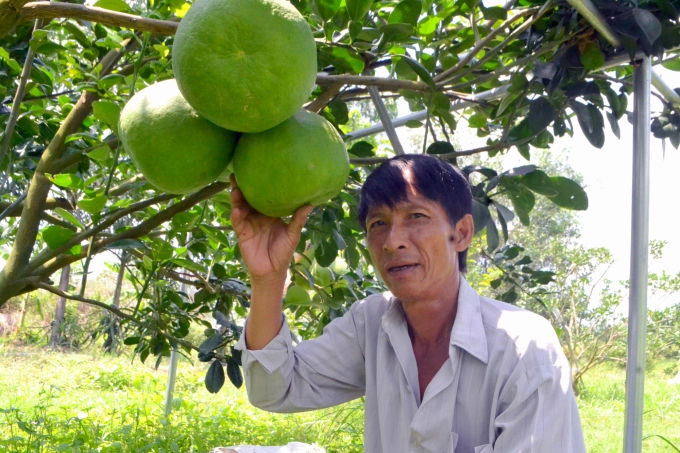
Farmer Dao Van Minh is happy to hear that local grapefruit would be in OCOP programme. Photo: Tran Trung.
The southern province of Binh Duong considered One Commune-One Product (OCOP) programme as a measure to improve its farming products’ quality, promote trade and services, said a provincial official.
Vice head of the province’s Rural Development Division Van Phuoc Hau said that OCOP was also expected to make a breakthrough in the development of rural areas in the province.
In April this year, the province People’s Committee issued Decision 1166/QD-UBND approving the project on OCOP during the period 2018-2020 with the vision to 2025.
Accordingly, the provinces targeted to develop four products to meet 4-star standard, 30 products to meet 3-star standard and 75 products to meet 1 or 2-star standard.
The province approved the funding of VND68 billion for the project, of which, VND28 billion is mobilised from non-State sources.
This year, the province planned to evaluate at least 30 products. Two districts of Ben Cat and Bac Tan Uyen together with Tan Uyen Town have completed evaluation procedures for the first time.
The three localities would evaluate potential products for the second time this month.
Hau said that almost all key products of localities in the province joined the OCOP programme.
“The implementation of OCOP programme will help boost restructuring in rural labour, take advantages of human resource, protect the environment and achieve sustainable socio-economic development,” he said.
As one of candidate OCOP product, Binh Duong grapefruit is expected to help local farmers go prosperous.
A 60-year-old farmer Dao Van Minh of Thuong Tan Commune, Bac Tan Uyen District said that four generations of his family lived there, seeing grapefruits grow well on this land.
Minh’s grandfather told him that since the early 19th century, people flocked to the Dong Nai River Delta with fertile alluvial soil for reclamation. They brought along with many fruit trees but the only grapefruit could grow well.
Minh said that for the last few years, many local farmers went prosperous thanks to grapefruit. However, prices of the fruits are still mainly decided by wholesalers.
In Bach Dang Commune, Tan Uyen Town, VietGAP standards are applied in nearly 400 ha of grapefruit, providing safe products to market.
Trinh Minh Thanh, director of Dong Thuan Phat Agriculture Co-operative in Bac Tan Uyen District said that Binh Duong grapefruit is small, each grapefruit weighs about 1 kg but it has a thin peel, a lot of water and it is sweet and tasty.

Trinh Minh Thanh, director of Đong Thuan Phat Agriculture Co-operative (left) visits a grapefruit farm of a member of the co-operative. Photo: Tran Trung.
Thanh said that in the past, the grapefruit was cheap because growers usually abused plant protection products.
For the last few years, local grapefruit growers have applied organic farming technologies.
“Wholesalers are interested in organic products. Thus, our grapefruit can be sold at better stable prices,” Minh said.
He said that once the grapefruit was recognised as an OCOP product, local farmers and his co-operative would have more opportunities to introduce their fruit and access new markets.
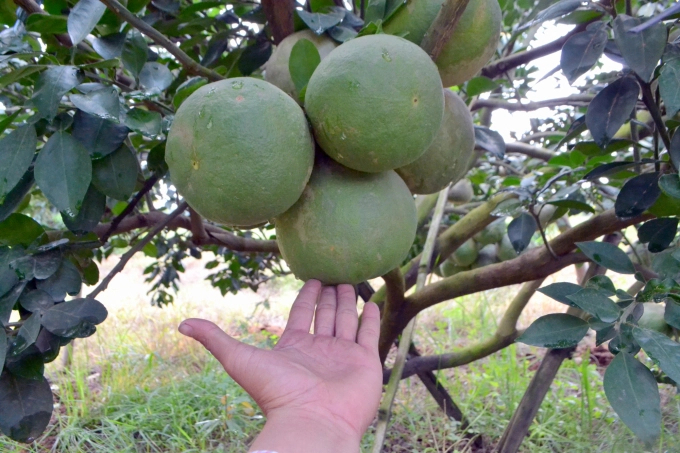
As one of candidate OCOP product, Binh Duong grapefruit is expected to help local farmers go prosperous. Photo: Tran Trung.
Authors: Tran Trung - Hong Thuy. Translated by Minh Quang. Edited by Tran Doanh.
/2026/06/03/2038-2-111633_44.jpg)
(VAN) Disease outbreaks, competitive pressures, and market requirements force banana exporters to change production methods, invest in technology, and improve the quality of growing areas to sustain export momentum.

(VAN) Agricultural and aquatic products of Can Tho City will increase in value and gain wider access to the South Korean market.
![Transforming through Resolution 57: [2] Businesses lead the way](https://t.ex-cdn.com/nongnghiepmoitruong.vn/608w/files/chinq/2026/06/03/1033-chuyen-minh-tu-nghi-quyet-57-bai-2-doanh-nghiep-dan-loi-152034_231.jpg)
(VAN) Businesses are bringing technology to the fields of Ho Chi Minh City to achieve a modern, green, and sustainable agricultural model.
![Transforming through Resolution 57: [1] ‘Digital farms’ in the heart of a megacity](https://t.ex-cdn.com/nongnghiepmoitruong.vn/608w/files/chinq/2026/06/02/4327-113a0791-210633_906-210635-183212.jpg)
(VAN) From hydroponic vegetables grown in membrane houses to tissue-cultured orchids, Ho Chi Minh City is reshaping agriculture through digital technologies.

(VAN) At Vietnam Dairy 2026, Nestle Viet Nam shared its digital transformation experience, contributing to food safety enhancement, and value chain transparency across the dairy industry.

(VAN) Dong Nai is accelerating the development of high-tech agriculture by attracting business investment and scaling up green, smart, and sustainable farming models.

(VAN) Many shrimp farming areas in Vinh Long are applying digital technologies to save energy, control carbon emissions, and meet the requirements of export markets.
