June 5, 2026 | 07:41 GMT +7
Hotline: 0913.378.918

June 5, 2026 | 07:41 GMT +7
Hotline: 0913.378.918

A separate chicken farm to ensure disease safety in Binh Phuoc province. Photo: Tran Trung.
According to the Department of Animal Health (Ministry of Agriculture and Rural Development – DAH/MARD), Vietnam currently has 2,210 disease-free facilities and areas in 55 provinces and cities with 4,125 certificates for 20 diseases. To be specific, there are 1,687 disease-free certificates for poultry production facilities and areas; 2,386 disease-free certificates for pig production facilities and areas; 52 certificates for other cattle raising establishments and areas.
It is worth noting that the majority of disease-free livestock production facilities and areas are currently concentrated in the Southeast region – the key livestock production area of the country. Every province in the Southeast has a poultry disease-free poultry area. The provinces and cities in the Southeast region have built 959 disease-free poultry production facilities and issued valid certificates for one or more diseases (avian influenza, Newcastle).
As for pig production, provinces and cities in the Southeast region have built 579 disease-free pig farming facilities with certificates that still remain valid for one or more diseases such as foot-and-mouth disease, classical swine fever, and African swine fever. 264 pig farming facilities in particular are considered safe for African swine fever, 6 district-level disease-free areas for foot-and-mouth disease and classical swine fever, including 4 districts of Binh Duong province and 2 districts of Ba Ria - Vung Tau province.
The Southeast has also established many disease-free livestock production chains for domestic consumption and export purposes. Binh Phuoc can serve as a prime example as it already has a disease-free chicken meat chain for export owned by CPV Food Co., Ltd.
Japfa Comfeed Vietnam has also initially established a disease-free pork production chain that aims toward export in this province. Japfa Comfeed currently has a total of 33 farms (8 hatcheries and 25 meat farms) operating in Binh Phuoc with a total herd of approximately 111,280 heads. The company is building a pig slaughterhouse with a capacity of 374,400 heads/year and an animal feed factory with a capacity of 40,000 tons/month.
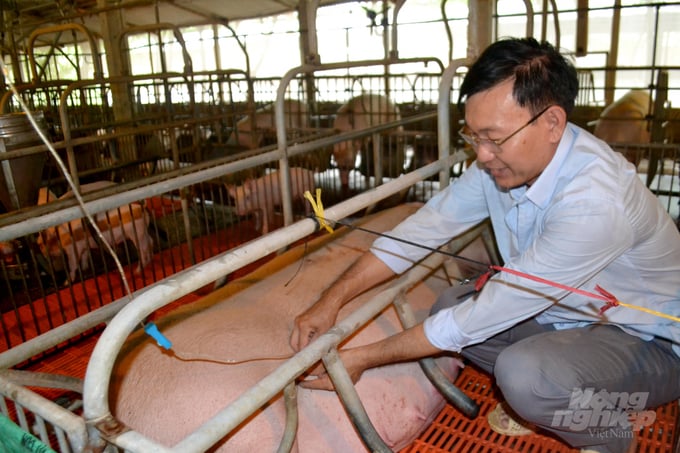
Pig farming on industrial farm scale in the Southeast. Photo: Tran Trung.
In order to successfully build disease-free areas, close attention and direction from the leaders of the provinces are the first requisites. According to the Chairwoman of Binh Phuoc People's Committee Tran Tue Hien, the Resolution of the 11th Congress of Binh Phuoc Party Committee, term 2020-2025 oriented agricultural development with three main export products, which are livestock products (pigs, chickens), cashew, and wood products. On September 7, 2022, Binh Phuoc People's Committee issued Decision No. 1633/QD-UBND approving the 2021-2030 Scheme for developing disease-free livestock production areas in Binh Phuoc.
"Binh Phuoc has been coordinating with the Ministry of Agriculture and Rural Development and the Department of Animal Health since 2019 to develop disease-free poultry chain and production area for export. Up to now, there have been 6 districts, towns and cities in the province that have been assessed and recognized by the Department of Animal Health as disease-free areas for avian influenza and Newcastle disease, including Dong Phu, Dong Xoai, Chon Thanh, Hon Quan, Binh Long and Bu Dang," said the Chairwoman of Binh Phuoc People's Committee.
Aiming to build a district-level disease-free area for foot-and-mouth disease and classical swine fever, an experience of successful localities in Binh Phuoc is to organize the establishment of foundation (livestock households, livestock farms) that meet disease safety requirements (phase I), then build commune-level disease-free facilities (phase II), and finally turn the whole district into a disease-free production area (phase III).
In order to build a disease-free pig farming area for export, the Ministry of Agriculture and Rural Development has asked Binh Phuoc People's Committee to direct relevant departments, branches and authorities at all levels to coordinate with the Department of Animal Health to effectively organize the implementation of the plan to build pig farming chains and areas (first at the district level, then at the provincial level) to be disease-free according to the regulations of OIE and Vietnam.
Through actual survey and based on the general status of the country’s pig farming, DAH/MARD proposes Binh Phuoc People's Committee prioritize the implementation in Bu Dang district (specifically Dang Ha commune and neighboring communes). Businesses such as Japfa Comfeed Vietnam and GreenFeed Vietnam are also requested to cooperate in the process of making Bu Dang district a disease-free pork production area to serve export.
Translated by Samuel Pham
/2026/06/04/5514-0-124633_818.jpg)
(VAN) With the largest rubber area nationwide, VRG is stepping up efforts to create green value from rubber forests, playing a vital role in sustainable development.

(VAN) As a pioneering enterprise in developing large-scale production zones, strengthening farmer partnerships, standardizing production practices, and enhancing traceability, PAN Group is elevating the value and global competitiveness of Vietnamese rice.
/2026/06/03/2038-2-111633_44.jpg)
(VAN) Disease outbreaks, competitive pressures, and market requirements force banana exporters to change production methods, invest in technology, and improve the quality of growing areas to sustain export momentum.

(VAN) Agricultural and aquatic products of Can Tho City will increase in value and gain wider access to the South Korean market.
![Transforming through Resolution 57: [2] Businesses lead the way](https://t.ex-cdn.com/nongnghiepmoitruong.vn/608w/files/chinq/2026/06/03/1033-chuyen-minh-tu-nghi-quyet-57-bai-2-doanh-nghiep-dan-loi-152034_231.jpg)
(VAN) Businesses are bringing technology to the fields of Ho Chi Minh City to achieve a modern, green, and sustainable agricultural model.
![Transforming through Resolution 57: [1] ‘Digital farms’ in the heart of a megacity](https://t.ex-cdn.com/nongnghiepmoitruong.vn/608w/files/chinq/2026/06/02/4327-113a0791-210633_906-210635-183212.jpg)
(VAN) From hydroponic vegetables grown in membrane houses to tissue-cultured orchids, Ho Chi Minh City is reshaping agriculture through digital technologies.

(VAN) At Vietnam Dairy 2026, Nestle Viet Nam shared its digital transformation experience, contributing to food safety enhancement, and value chain transparency across the dairy industry.
