December 12, 2025 | 11:04 GMT +7
Hotline: 0913.378.918

December 12, 2025 | 11:04 GMT +7
Hotline: 0913.378.918
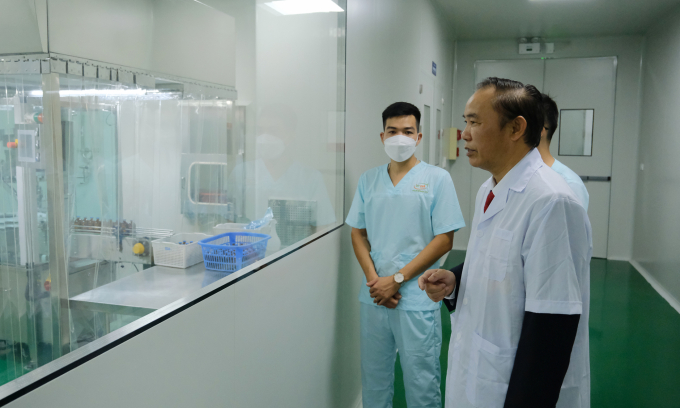
Deputy Minister Phung Duc Tien visiting the factory and the vaccine production line belonging to Invet Company. Photo: Ba Thang.
On May 12, Deputy Minister of Agriculture and Rural Development Phung Duc Tien attended the inauguration ceremony for a veterinary - aquatic medicine factory meeting GMP-WHO standards belonging to Invet Group Joint Stock Company (Invet Company) in Van Lam, Hung Yen.
Deputy Minister Phung Duc Tien said that the veterinary sector and localities have implemented many effective measures to prevent and control animal diseases in 2021. However, the first few months of 2022 are peak times for re-herding livestock as well as starting a new aquaculture season. The high density of livestock along with the shift in seasonal weather cause animal diseases to easily develop.
Deputy Minister Phung Duc Tien emphasized that vaccines are still the most effective solution to actively and synchronously prevent and control animal diseases.
There are currently 61 factories producing veterinary drugs meeting the requirements of "Good Manufacturing Practices" (GMP). Regarding veterinary vaccines, Vietnam has successfully produced 107 types of vaccines from 7 factories and registered them for circulation, proactively sourcing vaccines for animal disease prevention and control.
This is a premise to help Vietnam successfully produce many important preventive vaccines including: the Avian influenza vaccine in 2012; the Blue-ear vaccine in 2015 and the ASF vaccine to be announced in 2022.
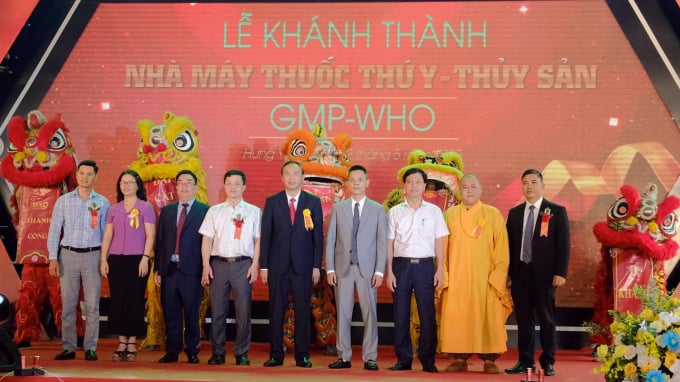
Deputy Minister of Agriculture and Rural Development Phung Duc Tien (center) and delegates attending, cutting the ribbon to inaugurate the factory. Photo: Ba Thang.
Deputy Minister Phung Duc Tien assessed that domestically produced veterinary medicines are meeting over 70% of the domestic market's demand. Many companies have started to seek out export markets. According to the Department of Animal Health, Vietnam is currently exporting nearly 1,000 veterinary medicines to over 40 countries, including fastidious markets such as the Netherlands, Belgium, and Russia.
These achievements generate momentum for companies such as Invest Company to boldly invest in modern factories, equipment in anticipation of the increasing number of exported veterinary drugs in the coming years.
Mr. Nguyen Van Nam, Chairman of Invet Company, shared that the unit currently has over 300 products that are licensed by the Department of Animal Health to circulate on the market, contributing to the protection and development of livestock, poultry farming in the country.
The veterinary - aquatic medicine factory of Invet Company has just been inaugurated and received synchronous investment for 6 GMP-WHO production lines; 3 production lines of probiotics, nutrition, antiseptic - disinfectant, etc. with the capacity to meet the requirements of many markets. Along with production, Invest Company also promotes marketing with nearly 500 distribution agents.
Translated by Nguyen Hai Long

(VAN) With high automation, large capacity, and a green development orientation, the Hai Duong Plant Branch is becoming an important anchor for the animal feed market.
/2025/12/01/2936-2-222331_70.jpg)
(VAN) Mortgaging his house and giving up a pharmaceutical management career, Mr. Nguyen Quang Duy succeeded in bringing Khanh Hoa's sea grapes to demanding markets such as Japan and the U.S.

(VAN) The large-scale agroforestry investment project aims to develop a leading sustainable agro-industrial center in Angola.
/2025/11/28/3433-1-212821_213.jpg)
(VAN) Many localities across the coconut land of Vinh Long are replicating emission-reducing models in production and daily life, contributing to the targets for emission reduction and green economic development.

(VAN) The green transition is an inevitable path for collective economy to achieve balanced growth and align with global trends.

(VAN) The TH Group is not only Vietnam’s leading clean-milk producer; it is also leaving a strong mark on sustainable development as it pursues the goal of carbon neutrality.
/2025/11/27/3830-1-152901_403.jpg)
(VAN) Dong Nai is developing its key crop areas, expanding planting area codes, and applying high technology to increase the value of agricultural products, aiming at a green and sustainable agriculture.
