July 21, 2026 | 16:23 GMT +7
Hotline: 0913.378.918

July 21, 2026 | 16:23 GMT +7
Hotline: 0913.378.918
Mr. Lo Trung Vien, Head of Minh Noi Village in Gia Hoi Commune, Lao Cai Province, together with Mr. Lo Van So, a respected elder in the community, guided us to the village's headwater area.

The clean water system in Minh Noi Village draws water from a mountain spring more than 2 km from the residential area. Photo: Thanh Nga.
From the residential area, our group followed narrow field embankments, forded two streams, and continued walking. After nearly 40 minutes of hiking, we finally reached the foot of the mountain. Pointing toward the mountainside ahead, Mr. Lo Trung Vien said that the village's water storage tank was still a long way off. The distance we had covered was only about one-third of the journey to the headwater.
In the highlands, local residents rely primarily on stream water and natural springs in the forest for their domestic water supply. Storage tanks are typically built at higher elevations to collect water from the source before channeling it through a pipeline system to the residential area below.
The clean water supply system in Minh Noi Village was built with state investment in 1998. Nearly three decades later, the system continues to provide domestic water for approximately 50 households. At the time of construction, the entire village contributed labor for more than ten days to dig trenches and install the pipeline from the mountain spring to the village.
Pointing to sections of the water supply pipeline running across the surface, Mr. Vien said that after many years of use, combined with farming activities, several parts of the pipeline have emerged from the ground, making them more vulnerable to damage. Many sections have been repaired with new pipe segments, leaving clearly visible joints. "The pipeline is long and passes through fields, streams, and hills, so whenever there's a break, we have to track down the exact location. Sometimes only one section has come loose, but it still takes half a day of walking to reach it," Mr. Vien said.
Heavy rain earlier had affected the water pipeline. Since early morning, Ngan Van Chinh and Mr. Nong Van Hung, two members of the village's water self-governing group, had gone to the spring source to inspect and repair the system.
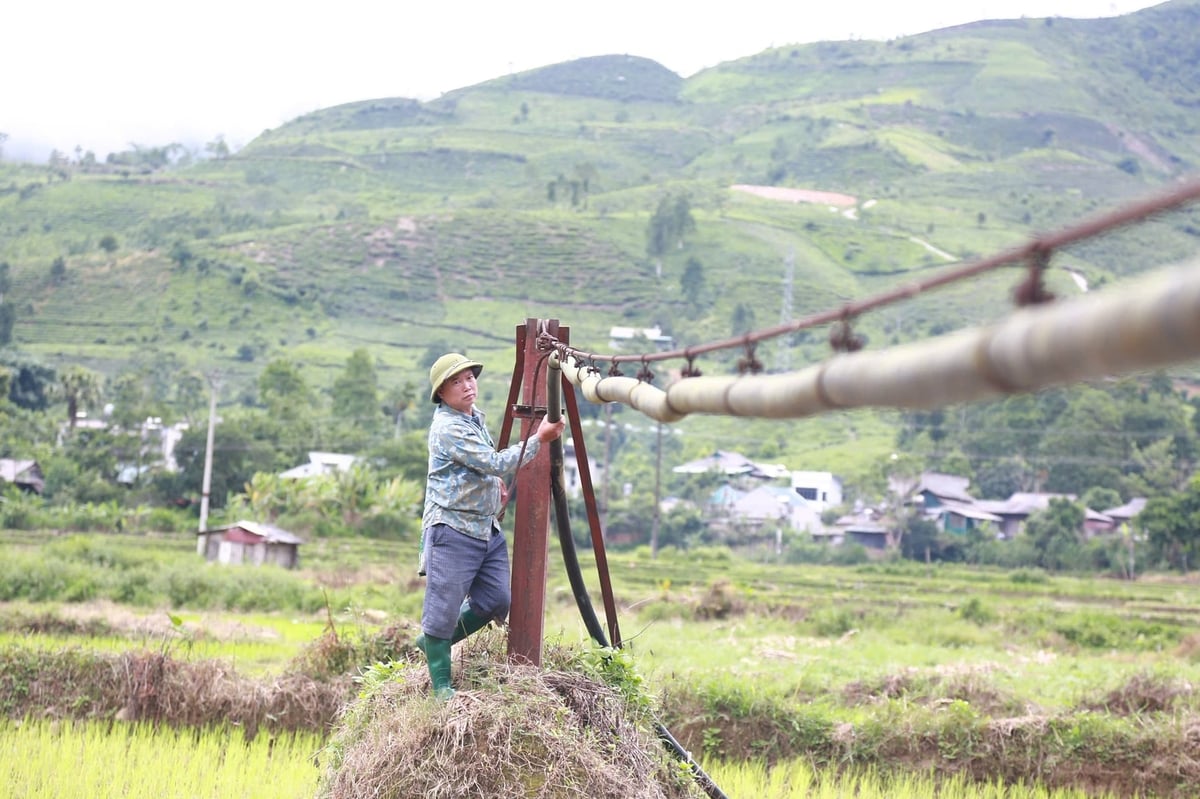
Many sections of the water pipeline crossing the fields have deteriorated. Photo: Thanh Nga.
To ensure the village's domestic water supply, Minh Noi has established a two-member self-governing group responsible for operating and protecting the water supply system. Ngan Van Chinh and Mr. Nong Van Hung have carried out this work for more than five years. Like other villagers, they work in the fields, but whenever the pipeline becomes clogged, breaks, or the water flow weakens, they set aside their own work to inspect and repair the system.
The job is especially demanding after heavy rains. Torrents often wash soil, rocks, tree branches, and debris into the streams, clogging the water intake or damaging the pipeline. Many breakdowns occur deep in the forest, far from the village. The two men have to carry tools, replacement pipes, and food before setting out on foot to carry out the repairs.

Ngan Van Chinh returns after inspecting the mountain water pipeline. Photo: Thanh Nga.
To support the operation of the self-governing group, each household using the water contributes VND 15,000/month. With around 50 households, the village collects more than VND 700,000 monthly, which is used to cover inspection and repair work and purchase replacement materials when needed.
According to Mr. Lo Trung Vien, some households initially considered the contribution too high. The village head had to explain that the money was not only used to pay for the two operators but also to purchase pipes and other replacement materials. "When only a few sections of the pipeline are damaged, the fund is sufficient. But if multiple sections break at the same time, the village has to hold a meeting and ask residents to contribute more. Without repairs, the whole village would be left without water," Mr. Vien said.
Recalling the inspection they had just completed, Mr. Nong Van Hung said the path to the spring source is narrow and slippery, with dense vegetation along many stretches. During the rainy season, in addition to the risk of slipping, those making the trip are often bitten by jungle leeches.
According to Mr. Hung, the monthly allowance does not reflect the amount of time and effort the work requires. Even so, his family, like every other household in the village, depends on the same water source, so he has continued doing the job. "My family needs water, and so does everyone else in the village. Even though the forest trek is difficult and the allowance is modest, we keep doing it. Whenever the pipeline is damaged, we have to repair it so the water can flow again," Mr. Hung said.
According to Mr. Lo Van So, a respected elder in Minh Noi Village, water is often scarce during the first months of the year. Many households have to wake before dawn or stay up late at night to collect water for daily use.

Mr. Lo Trung Vien, Head of Minh Noi Village, and Mr. Lo Van So, a respected elder in the village encouraged members of the self-governing group after an inspection of the forest water pipeline. Photo: Thanh Nga.
When water flow is low, households located at lower elevations or at the end of the pipeline are usually the most affected. The village therefore regularly encourages residents to use water sparingly and not to divert water to ponds or fields without authorization. "We encourage villagers to protect the forest, safeguard the water source, and share it fairly. From February to May each year, after using water, households should turn off their taps so that water can continue flowing to homes further downstream," Mr. So said.
According to Mr. So, most villagers understand and comply with the community's shared regulations. When water supplies run low, households proactively shorten their water use, collect only enough for their daily needs, and then turn off the tap so water can continue flowing to other homes. Villagers also recognize the importance of protecting the upstream forest. If the forest is cleared, soil and rocks can easily wash into the streams, muddying the water and clogging the pipelines, directly affecting the village's water supply.
Minh Noi residents understand that although the water supply system was built with state investment, it cannot operate sustainably without people to look after it, repair it, and protect it together. In addition to the self-governing group, households are also responsible for reporting leaks or damaged sections of the pipeline. Gia Hoi Commune currently has 14 centralized water supply works serving residents' domestic needs. Of these, six are operating effectively, three are operating with limited effectiveness, and five have either fallen into disrepair or ceased operation.
Experience has shown that building a water supply system is only the first step. In mountainous areas where pipelines stretch across forests, streams and upland fields, post-construction management and maintenance determine whether a water supply can be sustained over the long term.
In Minh Noi Village, water continues to flow to every household thanks to the collective efforts of the community and the quiet dedication of those who follow the pipeline whenever problems arise. However, as many sections of the pipeline have deteriorated, the system now requires further repairs and upgrades to ease the burden on the self-governing group and ensure a stable domestic water supply for residents in the coming years.
$1 = VND 26,450 - Source: Vietcombank
Translated by Thu Huyen

(VAN) Recently, the Lao Ministry of Agriculture and Environment delegation visited, worked, and signed a pact with the Vietnam Academy of Agricultural Sciences.

(VAN) Da Nang steps up free rabies vaccination in mountainous communes, delivering vaccines directly to villages to build an immunity shield.

(VAN) Native honeybee farming in Ha Tinh grew strongly, providing stable incomes and promoting sustainable rural economic development.
/2026/07/20/3847-3-113606_381.jpg)
(VAN) The global spread of the SAT-1 FMD virus strain underscores the need for Viet Nam to proactively enhance surveillance and develop response scenarios well in advance.

(VAN) Agricultural by-products are being recognized as resources that can generate new economic value, reduce emissions, and create new opportunities for green growth in circular agriculture.

(VAN) The project aims to help ethnic minority women strengthen their agricultural processing skills, develop climate-resilient livelihoods, and improve their incomes.

(VAN) The BLOOM project, funded by the Government of Canada, aims to restore ecosystems while improving livelihoods for ethnic minority women in Dak Lak.
