July 21, 2026 | 17:05 GMT +7
Hotline: 0913.378.918

July 21, 2026 | 17:05 GMT +7
Hotline: 0913.378.918
On a scorching day in late May, we traveled to Quoi Thien Islet in Vinh Long Province to deliver water storage tanks and household water filtration systems to disadvantaged families. At each home, the team not only provided guidance on how to use the equipment but also listened to residents' stories and the challenges they face in their daily lives on the island commune.
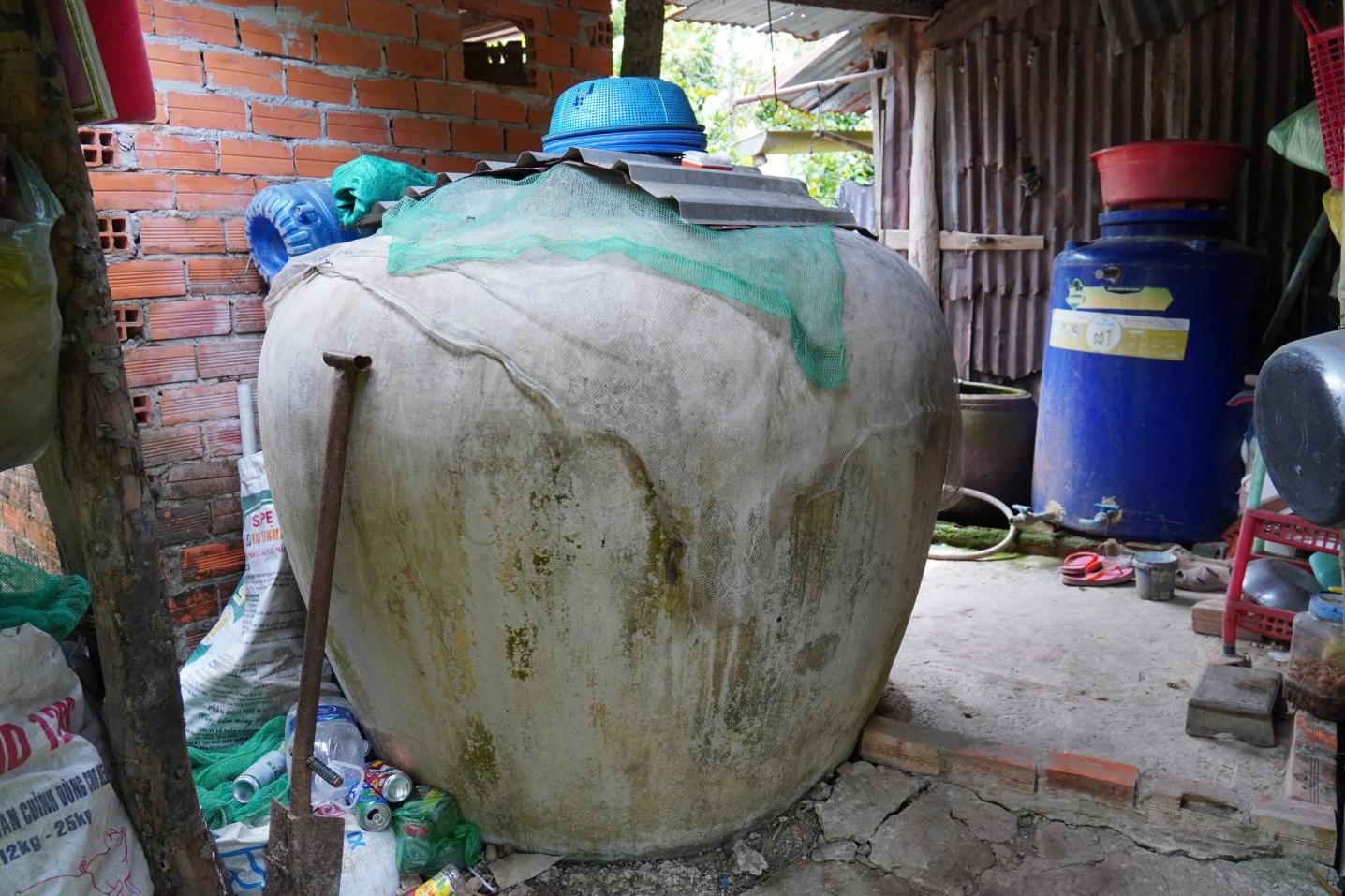
For many low-income households on Quoi Thien Islet, large earthen jars remain the primary means of storing water for daily use. Photo: Ho Thao.
As soon as we stepped off the ferry, the concrete road gave way to a rough gravel path. The vehicle jolted over the uneven ground while dust swirled under the blazing sun, leaving everyone exhausted. Yet the journey offered a vivid glimpse into life on the river islet, where access to clean water for everyday use has long remained a challenge.
At the end of a narrow path barely wide enough for a motorbike, surrounded by lush orchards and crisscrossed by canals, sits the modest home of Truong Thi Hien in Thai Binh Hamlet. These days, the house is quiet in the absence of her husband. With no farmland to cultivate and her husband hospitalized with severe diabetes, Hien supports both her elderly mother and the family through a small trading business.
Looking at the winding path leading to her house, one member of the delegation wondered how such a large plastic water tank could possibly be transported there. A project engineer smiled as he wiped the sweat from his brow and explained that bringing clean water solutions to every household required hiring more than 10 workers to maneuver the tanks through narrow garden paths, lift and pull them across small canals, and carefully carry them into place - a process that demanded considerable time and effort.
Thanks to that determination, Hien now has a reliable source of fresh water right outside her home. "It used to be very difficult," she said. "We had to rely on my mother's water supply. The groundwater from our well often smelled strongly of chemicals, but we had no choice except to use it. Now, with this large storage tank and a clean water filtration system, I'm so happy. I no longer have to worry about running out of clean water for daily use."
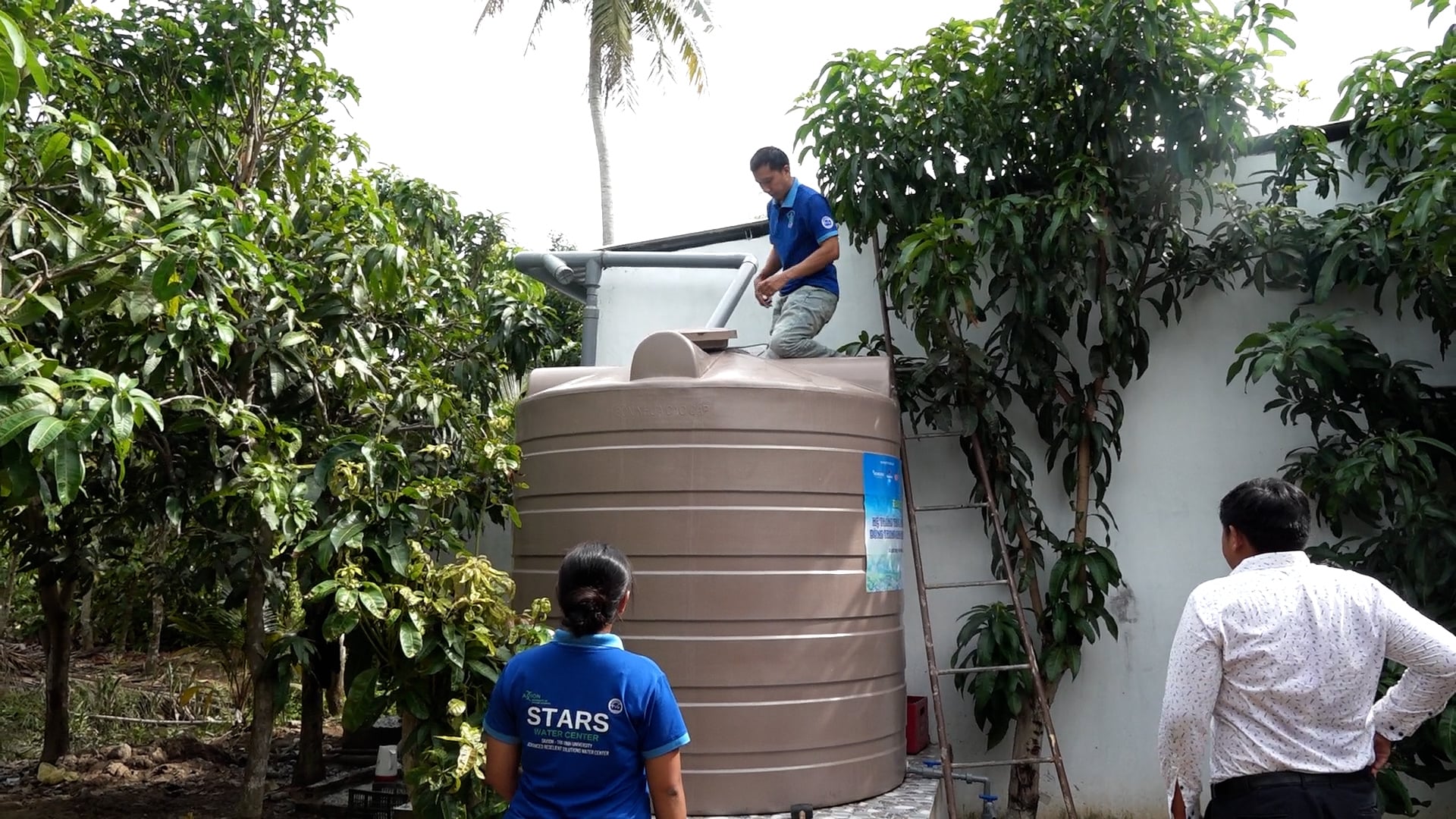
Technical staff install a rainwater harvesting system for a local household. Photo: Ho Thao.
Leaving Hien's home, the delegation continued on foot along a narrow path before walking more than 200 meters down a dirt track to reach the modest house of Thach Thi So Na, a poor Khmer ethnic minority resident of the commune. For years, her family's only means of storing water had been an old cement jar.
"For years, we've depended on rainwater for drinking and cooking, while using river water for bathing and washing. During the dry season, when the rainwater runs out and saltwater intrusion worsens, I have to buy bottled drinking water whenever I can afford it. If I don't have the money, I collect water from the canal, let the sediment settle, boil it, and drink it. There's simply no other choice," Na said.
As a modern rainwater filtration system and a large-capacity storage tank were securely installed beside her house, the Khmer woman's face lit up with joy.
"This tank is so big," she said with a smile. "The water we store this year will probably last well into next year. I've always seen other families using tanks like this and could only dream of having one. Now that we finally do, I can sleep soundly."
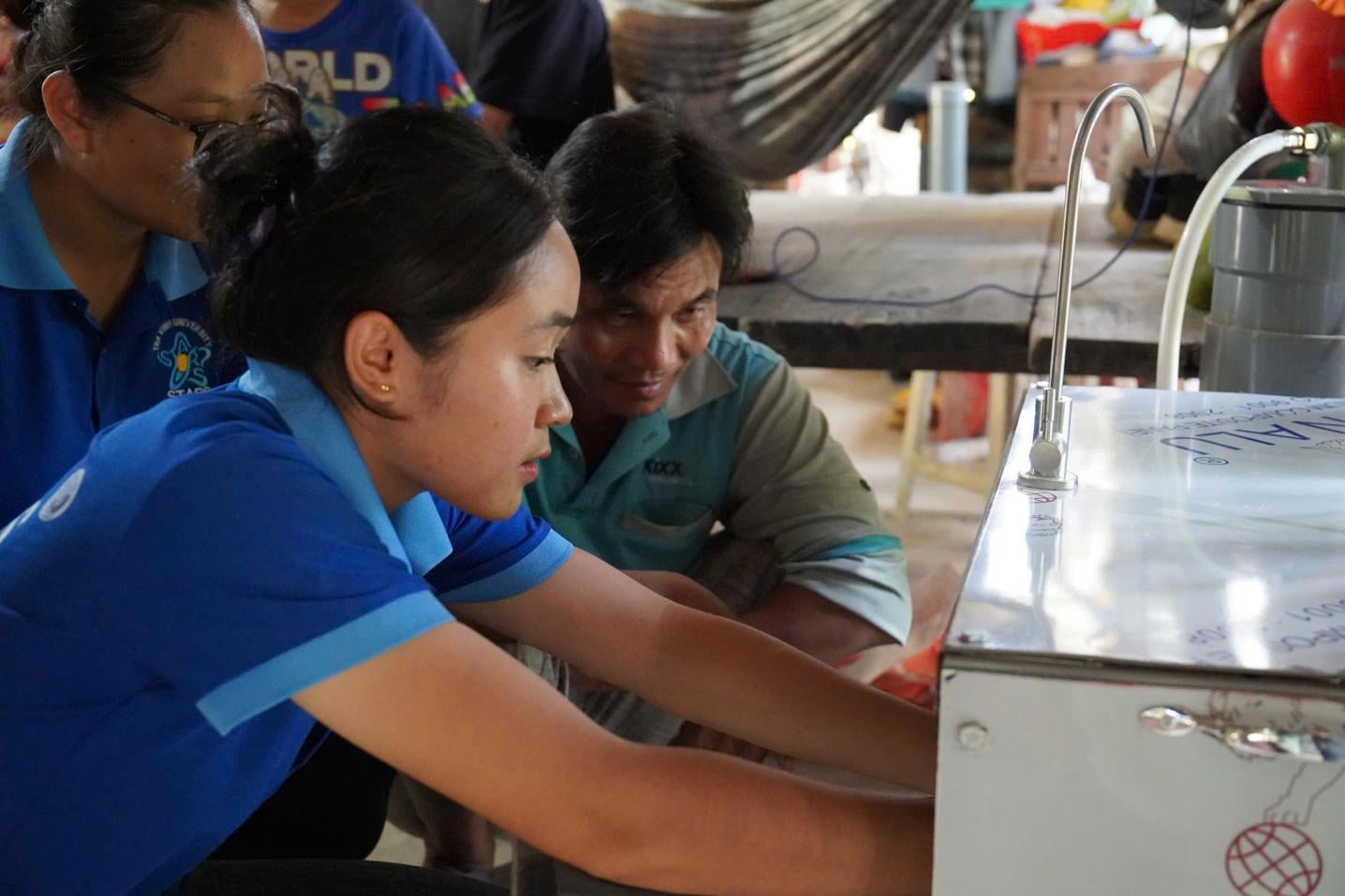
Staff from the Center for Water and Climate Change instruct local residents on how to use the rainwater harvesting and treatment system. Photo: Ho Thao.
The effort to bring clean water to Quoi Thien, an area frequently affected by drought and saltwater intrusion, is more than an emergency response. It is part of a long-term initiative built on a "three-way partnership" model, bringing together a corporate sponsor, scientific experts, and local authorities.
Under the program, HEINEKEN Viet Nam Brewery Ltd. sponsors the initiative in collaboration with the Center for Water and Climate Change at Tra Vinh University, which is responsible for developing and installing low-cost, climate-resilient rainwater harvesting and treatment systems.
The program aims to ensure reliable access to safe, clean water for vulnerable communities on Quoi Thien Islet. It also seeks to reduce residents' dependence on external water sources, lower household water costs, and strengthen community resilience to drought and saltwater intrusion through technical training and public awareness activities.
Nguyen Huu Hoang, Head of Sustainable Development at HEINEKEN Viet Nam, said protecting water resources and nature is one of the company's core priorities under its "For a Better Viet Nam" sustainability strategy.
"We are not only providing solutions that suit local conditions, such as rainwater harvesting and direct drinking water treatment systems, but more importantly, we are equipping local people with the knowledge and skills to operate and maintain these systems themselves through training activities," Hoang said. "This helps ensure the systems remain effective over the long term and enhances the project's sustainability. Seeing the joy on people's faces when they finally have access to clean water during the dry season gives us even greater confidence to continue this journey."
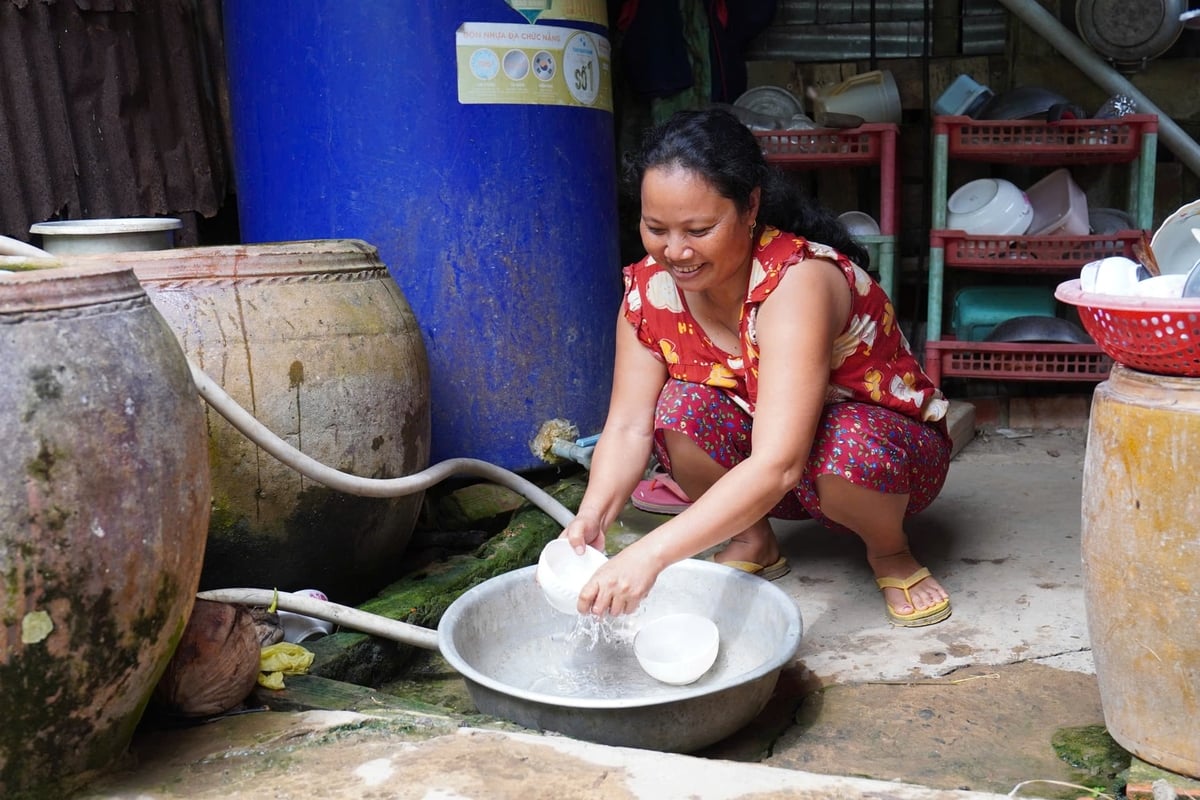
Na's joy after receiving a rainwater storage tank and filtration system, providing her family with clean water for daily use. Photo: Ho Thao.
According to leaders of Quoi Thien Commune, the joint efforts of the private sector, scientific institutions, and local authorities have delivered more than just clean water to this downstream community. They have also fostered a spirit of solidarity and compassion, helping local residents better adapt to the increasingly severe impacts of climate change.
Translated by Phuong Linh

(VAN) Recently, the Lao Ministry of Agriculture and Environment delegation visited, worked, and signed a pact with the Vietnam Academy of Agricultural Sciences.

(VAN) Da Nang steps up free rabies vaccination in mountainous communes, delivering vaccines directly to villages to build an immunity shield.

(VAN) Native honeybee farming in Ha Tinh grew strongly, providing stable incomes and promoting sustainable rural economic development.
/2026/07/20/3847-3-113606_381.jpg)
(VAN) The global spread of the SAT-1 FMD virus strain underscores the need for Viet Nam to proactively enhance surveillance and develop response scenarios well in advance.

(VAN) Agricultural by-products are being recognized as resources that can generate new economic value, reduce emissions, and create new opportunities for green growth in circular agriculture.

(VAN) The project aims to help ethnic minority women strengthen their agricultural processing skills, develop climate-resilient livelihoods, and improve their incomes.

(VAN) The BLOOM project, funded by the Government of Canada, aims to restore ecosystems while improving livelihoods for ethnic minority women in Dak Lak.
