December 30, 2025 | 14:56 GMT +7
Hotline: 0913.378.918

December 30, 2025 | 14:56 GMT +7
Hotline: 0913.378.918
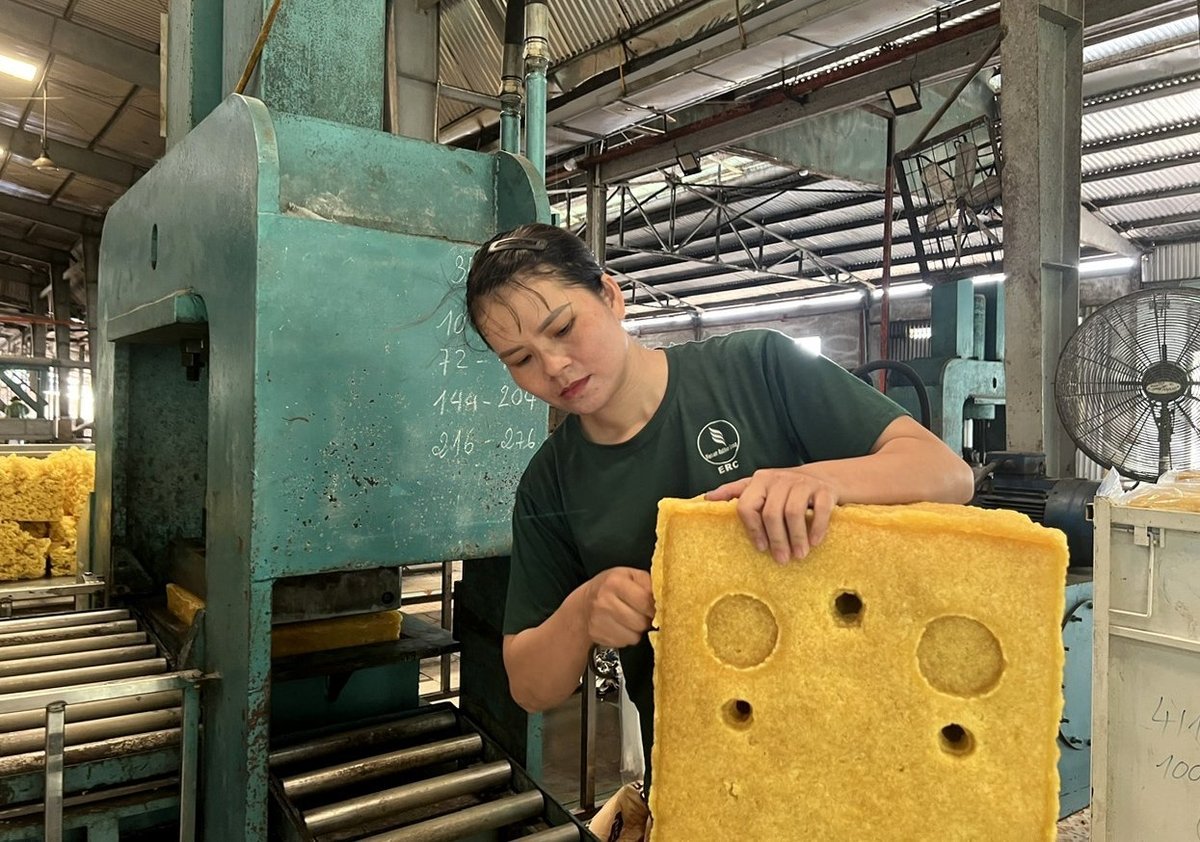
Rubber processing at a VRG facility. Photo: Son Trang.
Although the United States is one of Vietnam's top 10 rubber export markets, its market share is still relatively small. Vietnam exported 29,000 tonnes of rubber to the United States in 2024, valued at USD 52 million. This amount represents only 1.3% of the total rubber export revenue and 1.5% of the export volume.
In early 2025, shipments to the United States increased while rubber exports to Vietnam's three greatest markets, China, India, and South Korea, decreased in volume. To be more precise, Vietnam exported 8,000 tonnes of rubber to the United States in the first four months of the year, a 6% increase from the same period in 2024.
However, U.S. trade policies have had an impact on the global rubber market. The introduction of reciprocal tariffs on trading partners by the administration of former President Donald Trump had a substantial impact on global rubber prices.
The Agency of Foreign Trade - Ministry of Industry and Trade, reported that rubber prices experienced their lowest level in a year in April. The global rubber prices have experienced a significant rebound since early May, following a de-escalation agreement between the United States and China.
This highlights the potential impact of the formal implementation of reciprocal tariffs by the United States on the global rubber market, which in turn affects Vietnam's rubber exports and businesses.
The Vietnam Rubber Group's (VRG) General Director, Mr. Le Thanh Hung, stated that the U.S. tariff measures would have an impact on the Vietnamese rubber industry. VRG's production and operations will be at least somewhat affected by the moderate overall impact.
Market diversification is indispensable for mitigating the consequences of reciprocal tariffs. The Vietnam Rubber Association (VRA) has advised its member enterprises to utilize free trade agreements (FTAs) to diversify and expand their export markets actively.
Enterprises are also encouraged to concentrate on critical markets, investigate emerging destinations, and decrease their dependence on any single market. This approach enhances their resilience against the emergence of technical trade barriers and protectionism.
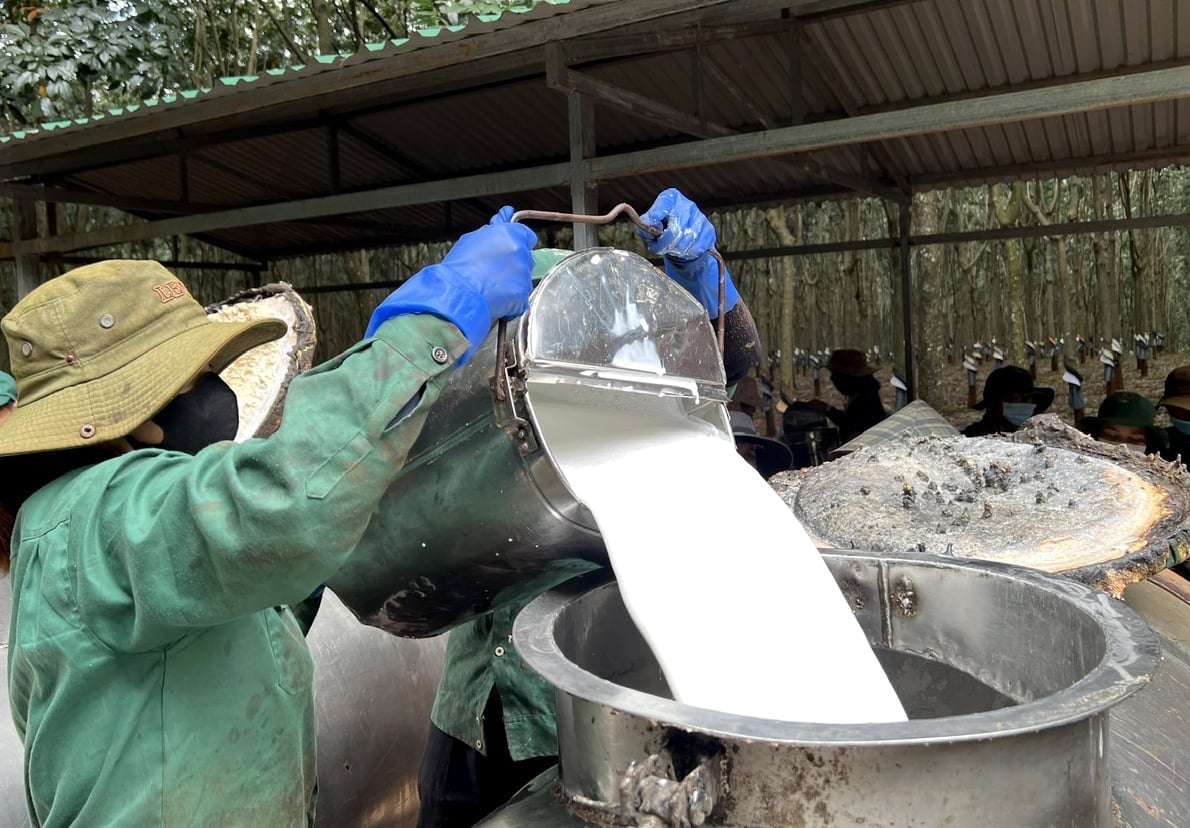
A VRG employee collects rubber latex. Photo: Son Trang.
Vietnam's rubber industry must capitalize on its greatest export partner, China, as its most critical market. Since the start of 2025, China has dramatically increased its imports of rubber. China imported 2.95 million tonnes of rubber worth USD 5.79 billion in the first four months of 2025, a 22% increase in volume and a 51% increase in value year-over-year, according to the General Administration of Customs of China.
This surge is a result of the increasing demand in the automotive tire manufacturing sector of China. In the initial four months of the year, the China Association of Automobile Manufacturers (CAAM) reported that vehicle production and sales exceeded 10 million units. During the same period, China produced roughly 386 million rubber tires, a 3.7% increase from 2024.
It is important to note that Vietnam's exports to China have decreased, regardless the fact that Chinese rubber imports have increased. Vietnam's General Department of Customs reported that cumulative exports to China in the first four months totaled 324,000 tonnes, a 1.9% decrease from the same period in 2024, despite robust development in April.
This trend highlights the need for a new approach in the Chinese market. The VRA considers China to be a critical player in the global rubber trade due to its substantial import demand. There is an expectation that demand for tire-grade rubber will increase as China develops its electric and hybrid vehicle sectors.
Vietnam has been the second-largest rubber supplier to China for a long time; however, the majority of its exports are natural rubber mixtures and semi-processed products, which contain minimal value-added content. Consequently, the VRA recommends that Vietnamese exporters increase the proportion of value-added rubber products in their exports to China in order to enhance profitability.
To avoid trade defense measures, rubber enterprises should also ensure traceable origins and maintain a consistent supply of raw materials. Furthermore, in order to diversify value-added rubber products, they should enhance their adaptability to market fluctuations by restructuring production, optimizing costs, reducing prices, enhancing competitiveness, and increasing investment in research and development.
Vietnam is also experiencing substantial development in its rubber exports to Indonesia and Malaysia. Exports to Malaysia increased by 341% year-over-year to 12,000 tonnes in the first four months of 2025, while exports to Indonesia also increased by 99% to 12,000 tonnes.
Translated by Linh Linh
/2025/12/29/2812-1-182339_699.jpg)
(VAN) The price of mangrove forest carbon credits is high because this forest type not only delivers significant environmental value but also plays a crucial role in addressing other issues.
/2025/12/29/5840-0-115141_514.jpg)
(VAN) From 2026, many EU markets will require shrimp to be electrically stunned before ice immersion, forcing exporters to change technologies to retain market share.
/2025/12/28/4951-2-104623_113.jpg)
(VAN) Rubber exports are forecast to remain under downward pressure in the coming period, as global rubber consumption shows signs of slowing, according to ANRPC's projections.
/2025/12/28/5120-1-093308_94.jpg)
(VAN) Many agricultural products are of sufficient quality to join global supply chains, yet fail to pass the first gateway when entering international markets due to packaging and information in English.
/2025/12/27/2453-2-172141_426.jpg)
(VAN) The sharp decline in the number of EU warnings in 2025 is regarded as a positive signal for the future orientation of Viet Nam’s agricultural exports.
/2025/12/27/1547-2-220434_536.jpg)
(VAN) For many businesses, exporting is a costly trial. But for those choosing a long-term path, small orders are a way to keep markets and learn the rules.
/2025/12/27/2522-1-090748_662.jpg)
(VAN) The 'Large-Scale Rice Field' project has been implemented in An Giang across a total area of more than 5,582 ha, comprising 73 large-scale fields and attracting the participation of 2,027 farmer households.
