December 16, 2025 | 22:07 GMT +7
Hotline: 0913.378.918

December 16, 2025 | 22:07 GMT +7
Hotline: 0913.378.918
Viet Nam's seafood industry stands at a historic threshold with the expectation of hitting the USD 10.7 billion mark in 2025. Yet, behind these ambitious growth figures lies a "mandate" from the ocean: Green transformation is essential for survival and global expansion. VAN News held an in-depth dialogue with Mr. Vu Thai Truong, Head of Climate Change, Energy, and Environment at UNDP Viet Nam, regarding this critical issue.
In the agricultural economic landscape, seafood is consistently likened to a sturdy pillar. At the Conference on Environmental Protection in Fishery Activities 2025, held on November 26, 2025, Deputy Minister of Agriculture and Environment Phung Duc Tien affirmed that the seafood sector remains a cornerstone of the economy. In the first 10 months of 2025 alone, export turnover reached USD 9.5 billion, representing a 16% increase compared to the same period last year.
This figure is expected to reach USD 10.7 billion by the end of 2025, accounting for 27-28% of the total value of the agriculture, forestry, and fisheries sector. This achievement attests to the sustained efforts and aspirations of millions of Vietnamese fishermen to venture further out to sea.
However, climate change, accompanied by extreme weather phenomena, is creating invisible barriers to production. More seriously, the marine environment itself is being compromised by pollution. Data indicates that Viet Nam generates approximately 1.8 million tons of plastic waste annually, with about 0.73 million tons discharged into the sea, directly threatening the purity and sustainability of every shrimp and fish.

Plastic waste such as nylon bags, plastic bottles, and styrofoam floats densely litter the coast of Vung Ro Bay. Photo: LD.
Addressing this reality, Mr. Vu Thai Truong shared that the UNDP has observed numerous positive shifts and results in the implementation of the 2020 Law on Environmental Protection and circular economy plans. Some localities have strengthened environmental monitoring and restored mangroves, while enterprises have begun applying circular technologies and recycling by-products.
However, Truong emphasized that the transition remains uneven and primarily exists on a pilot scale. The UNDP recommends that the fisheries sector accelerate the integration of the circular economy throughout the entire value chain to reduce emissions, enhance competitiveness, and meet new international requirements such as the EU's Carbon Border Adjustment Mechanism (CBAM).
During the implementation of international environmental standards, the UNDP representative in Viet Nam identified three major bottlenecks the industry faces. These include a shortage of technical capacity and a lack of a standardized data system; the burden of investment costs while green capital flows remain effectively untapped; and intersectoral coordination that lacks a consistent rhythm and synchronization.

Mr. Vu Thai Truong, Head of Climate Change, Energy, and Environment (UNDP Vietnam), discusses green transformation solutions and ocean protection. Photo: HN.
To resolve resource difficulties for seafood enterprises, Mr. Vu Thai Truong proposed the necessity of designing an effective green finance mechanism based on building a diverse green financial ecosystem, ranging from preferential credit and environmental funds to international climate capital flows.
Specifically, this mechanism needs to prioritize emission reduction and circular economy projects while linking with the carbon market to generate carbon credits. Truong noted the importance of prioritizing investment projects labeled "blue carbon." He emphasized that encouraging these investments not only generates economic profit but also protects, restores, and enhances marine and coastal ecosystems such as mangroves, seagrass beds, and tidal wetlands.
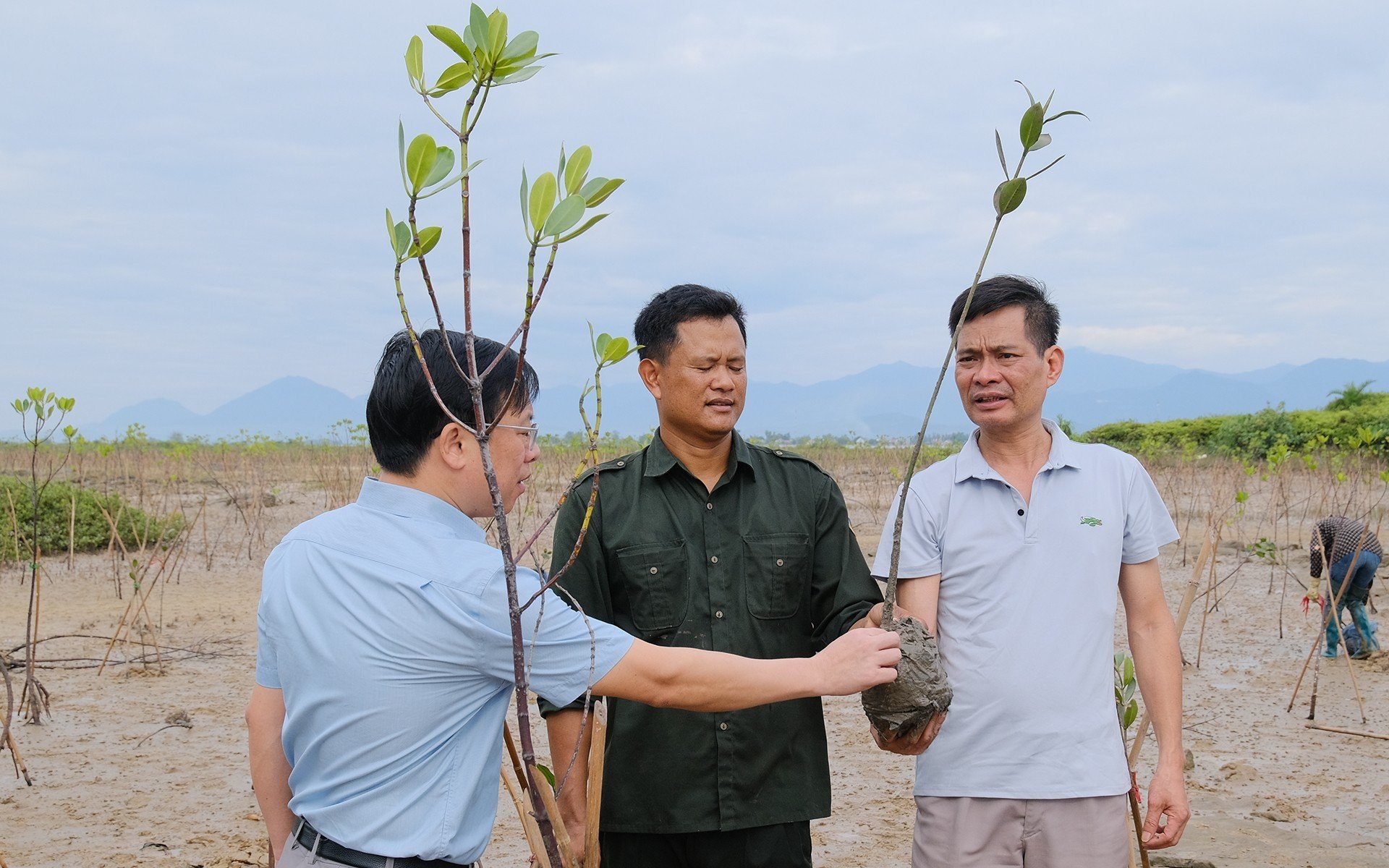
Mangroves serve not only as storm shields but also as assets generating carbon credits. Photo: NNMT.
To realize this, administrative procedures need to be simplified to serve as a launchpad for small and medium-sized enterprises to easily access resources. In the digital era, trust in international markets is built on a data foundation. The UNDP recommends that Viet Nam create a unified MRV (Measurement, Reporting, and Verification) system.
Truong suggested a specific direction where piloting should begin at a specific location or region, such as the Mekong Delta for shrimp and the Red River Delta for pangasius, before expanding nationwide. Applying digital technology and transparent emission data is the path for Vietnamese seafood to enter the most demanding markets confidently.
In the context of heading toward COP30, Mr. Vu Thai Truong affirmed the message that there is no climate solution without action on the ocean.
Currently, the UNDP is deploying many critical support programs. A prime example is the "Smart Coastal Communities Adapting to Climate Change" (VN-CSCC) project funded by the Canadian Government, along with environmental projects aimed at minimizing plastic waste, including ocean plastic, restoring mangroves and coral reefs, and promoting community-based resource management models.
Practical results show that currently, 20 communities are jointly managing over 7,000 hectares of marine ecosystems, and 26 coastal communes are deploying ocean plastic reduction waste management models. Additionally, the UNDP provides support through the BIOFIN project, the Global Environment Facility's Small Grants Programme (GEF/SGP), and the Marine Spatial Planning project funded by Norway.
Mr. Vu Thai Truong affirmed that the UNDP commits to continuing to accompany Vietnam in updating and building the implementation plan for the Nationally Determined Contributions (NDC) 3.0, the Kunming-Montreal Global Biodiversity Framework, and post-COP30 commitments. The goal is to protect marine ecosystems and ensure sustainable livelihoods for millions of people, leaving no one behind.
*USD 1 = VND 26.334 (Vietcombank, December 16, 2025)
Translated by Linh Linh

(VAN) Exports of ornamental fish generate nearly USD 15 million annually for Ho Chi Minh City, affirming the sector's position as a distinctive economic component of the city's modern urban agriculture structure.

(VAN) Lang Son agricultural products are upgrading planting-area standards, increasing deep processing, and expanding linkages to move toward sustainable exports.

(VAN) Despite numerous challenges, Vietnam's key seafood products are maintaining strong momentum, setting the stage for full-year exports to potentially reach USD 11 billion.

(VAN) The signing of a protocol between Viet Nam and China on the export of fresh jackfruit represents a significant milestone in agricultural trade cooperation between the two countries.

(VAN) On November 27, the Ninh Binh Department of Agriculture and Environment and the Institute for Green Growth Research organized a training course on greenhouse gas inventory for businesses.

(VAN) China’s cooking oil is suddenly flooding into India. It all comes down to a soybean surplus that Beijing doesn’t quite know what to do with.
