June 4, 2026 | 05:50 GMT +7
Hotline: 0913.378.918

June 4, 2026 | 05:50 GMT +7
Hotline: 0913.378.918
In recent years, Thanh Hoa province has made significant progress in the management and protection of wildlife. The number of violations has dropped considerably, and many individuals have been rescued and returned to their natural habitats, contributing to biodiversity conservation and the balance of ecosystems.
Despite these positive changes, some localities still witness the illegal hunting, transportation, captivity, consumption, and advertising of wild species and their products. In particular, the trapping, trading, and transporting of wild and migratory birds continue to occur, posing risks to the environment and biosecurity.
To meet the requirements of natural resource protection and strict enforcement of the law, the Thanh Hoa Provincial People’s Committee has issued a directive to relevant departments, agencies, and local authorities to strengthen prevention, tighten management, and protect endangered, precious, and rare wildlife species. The directive also calls for robust measures to control and address, from the source, the illegal trapping and trading of wild and migratory birds in the province.
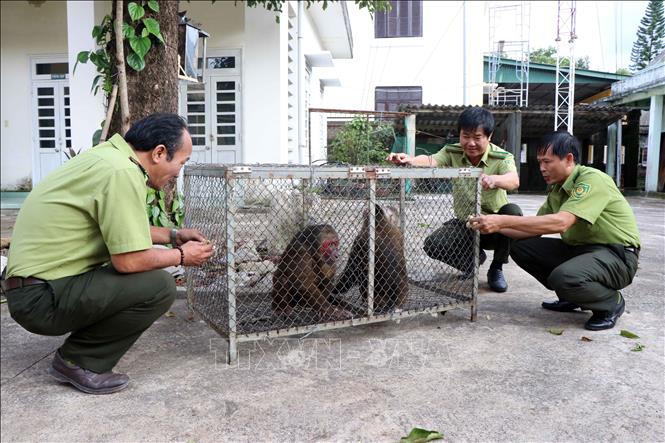
Some localities still witness the illegal hunting, transportation, captivity, consumption, and advertising of wild species. Photo: VNA.
The Chairman of the Provincial People’s Committee has tasked the Department of Agriculture and Environment with directing the forces of Forest Protection, Veterinary, and Fisheries Inspection to intensify inspections and supervision, strictly punish violations, and coordinate closely with other sectors to detect and stop offenses early and from a distance. Additionally, these agencies must closely monitor wildlife populations and migratory birds to prevent the outbreak and spread of diseases that could originate from them.
The provincial police will lead the implementation of plans to prevent and combat crimes related to biodiversity, in coordination with forest rangers and local authorities to promptly address violations, especially trapping and trading wild birds. They will also inspect and handle cases of illegal wildlife advertising and sales on the internet.
All relevant departments, sectors, and units have been instructed to step up public communication and education campaigns on biodiversity protection. These campaigns should target officials, local residents, and businesses, especially in areas considered at high risk for wildlife violations. Moreover, these agencies must proactively propose practical solutions aimed at improving the efficiency of wildlife conservation efforts.
Communal and ward-level People’s Committees must closely monitor restaurants, markets, business establishments, and tourist areas; control the transport and trade of wildlife along key routes, especially near special-use and protection forests; and firmly deal with the trapping and sale of wild birds. They will be held accountable if “hot spots” of violations arise in their jurisdictions.
The Provincial People’s Committee requires all sectors and localities to promptly and seriously implement these measures and to report any difficulties or obstacles to the Department of Agriculture and Environment, which will compile and submit them to the Chairman of the Provincial People’s Committee.
Translated by Kieu Chi

(VAN) The Viet Nam Association of National Parks and Nature Reserves (VNPPA) has warned of the risk of ecological fragmentation if management is divided along administrative boundaries.

(VAN) The IUU inter-agency working group met to agree on regulations, build transparent coordination and boost database digitization.
/2026/06/02/2436-2-211902_630.jpg)
(VAN) The rural tourism development plan for the 2026–2030 period aims to create sustainable livelihoods, increase incomes, and promote the value of indigenous culture and resources.

(VAN) The delegation from MAE exchanged experiences on Extended Producer Responsibility (EPR), Deposit Return Systems (DRS), and the circular economy during a working visit to Germany and Norway.
/2026/05/30/1359-3-130327_621.jpg)
(VAN) Green transition requires a '4-party' linkage ecosystem to reduce capital pressure on enterprises, maximize social resources, and form a green value chain network.

(VAN) The Ministry of Agriculture and Environment is developing an implementation plan for three strategic technology task groups covering the 2026 - 2030 period, in accordance with Prime Ministerial Decision 808/QD-TTg.
/2026/05/26/4722-3-123409_745.jpg)
(VAN) During Viet Nam's pilot phase for the domestic carbon market, enterprises allocated greenhouse gas emission quotas will be allowed to trade on the carbon exchange.
