December 16, 2025 | 23:56 GMT +7
Hotline: 0913.378.918

December 16, 2025 | 23:56 GMT +7
Hotline: 0913.378.918
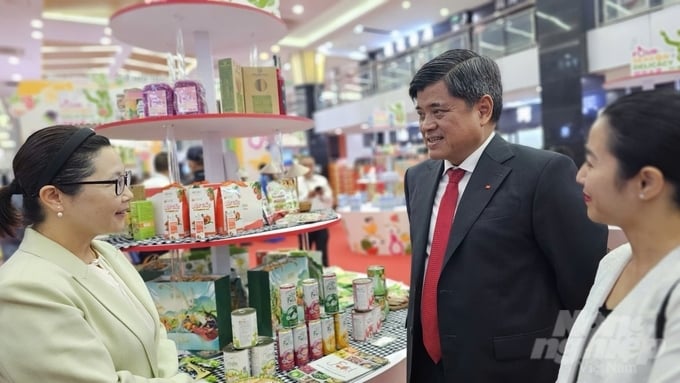
Deputy Minister of Agriculture and Rural Development Tran Thanh Nam discusses with Chinese businesses at the first Vietnam Fruit Festival, held in Beijing, China. Photo: Van Viet.
"Us fruit sellers are able to recognize Vietnamese fruits from that of other Southeast Asian countries, such as Malaysia, Thailand, and Laos. Nevertheless, the majority of consumers in Beijing and other regions consider it tropical fruits. Vietnamese products are the highest quality. This reality is unfortunate," stated Mr. Gu Zhaoxue, Deputy General Director of Xinfadi Agricultural Wholesale Market.
Xindifa is not only the "agricultural cart" of Beijing, but also the "representative" of the Chinese agricultural sector and the Chinese brand.
China appears to be a significant agricultural market due to its swift economic growth rate, as per Gu. in which Beijing serves as a major agricultural consumption "market."
"Beijing is not hesitant to purchase expensive goods, but it is hesitant to purchase those of poor quality. In the larger picture of our trade, the mere mention of Vietnamese products naturally implies exceptional quality. I believe that the Vietnamese should come up with strategies to increase the awareness of their agricultural products among Chinese consumers", Mr. Gu, the Deputy General Director of Beijing's largest agricultural wholesale market, stated, "With fruits this good, you need to ensure that even when Beijingers are commuting, they think about savoring Vietnamese fruits, and when they sleep, they dream of Vietnamese fruits."
He also emphasized that promotion efforts must be both "online and offline." From an "offline" perspective, Mr. Gu suggested that events like the Vietnam Fruit Festival, which took place for the first time in Beijing on September 29, should be held at least once a year. On the "online" platform, he noted that Vietnamese businesses seem to lack sufficient attention in this area.
Working in the field of agricultural trade for nearly 30 years, Mr. Gu admitted that he's hardly seen any systematic advertisements for Vietnamese fruits.
"I am uncertain as to the reason. Maybe I have not read much. But what I continue to think is why the general public continues to refer to these delectable fruits as tropical fruits, without realizing that they originate from Vietnam", said Gu.
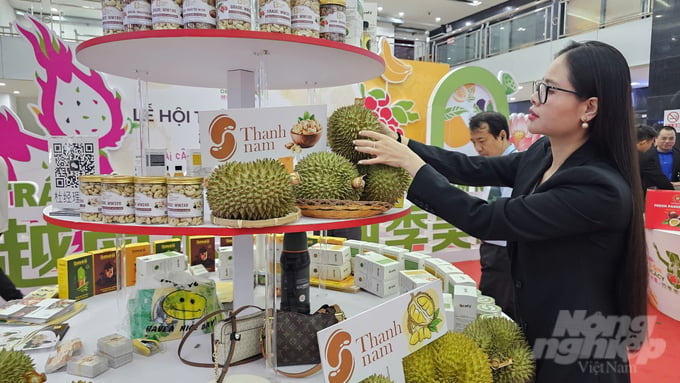
Vietnamese businesses display durian—one of the fruits favored by the people of Beijing. Photo: Van Viet.
Mr. Gu believes that the "increasingly fierce competition" among countries to establish a presence in China's competitive domestic market is one of the reasons Vietnamese agricultural products are not yet the preferred choice of Beijing consumers.
For instance, Laos has been conducting exhibitions at the Xinfadi Market in order to promote its agricultural products for the past few years. On September 28, Malaysia initiated an additional extensive promotional campaign for durians in Beijing.
Mr. Gu stated that labor costs in Laos are among the lowest in Southeast Asia, at approximately 20 yuan (approximately 80,000 VND) according to his own research. "In terms of unique fruits, Laos may not yet match Vietnam, but with cheap labor and a good supply of fruits, it might become a competitor to your market."
Furthermore, Guangxi's cultivation of dragon fruit and durian, two of Vietnam's most significant crops, is also underway. Mr. Gu emphasized that this is a matter that Vietnamese farmers and enterprises should consider.
Tropical fruits are not the only items on display at Xinfadi; temperate countries also contribute their products. Over the past few years, even Central and South American nations have progressively begun to establish their presence in Beijing.
Mr. Gu recalled that about fifteen years ago, people in Beijing began to become familiarized with dragon fruit and durian. Currently, the majority of Beijingers associate both of these fruits with Thailand or Malaysia.
"Vietnamese businesses should conduct exhibitions or a similar event in Beijing or other provinces at least once annually. Beijing, Shanghai, and Guangzhou are, of course, the most prominent premium markets. Furthermore, numerous other markets hold geographical advantages. Why are Vietnamese enterprises not adopting this approach, while countries such as Chile, which is located at quite a distance, continue to import their agricultural products?", Mr. Gu offered his opinion.
Translated by Linh Linh

(VAN) The seafood industry is aiming for an export goal of USD 10.7 billion in 2025. However, resolving bottlenecks regarding data and green finance is an urgent requirement.

(VAN) Exports of ornamental fish generate nearly USD 15 million annually for Ho Chi Minh City, affirming the sector's position as a distinctive economic component of the city's modern urban agriculture structure.

(VAN) Lang Son agricultural products are upgrading planting-area standards, increasing deep processing, and expanding linkages to move toward sustainable exports.

(VAN) Despite numerous challenges, Vietnam's key seafood products are maintaining strong momentum, setting the stage for full-year exports to potentially reach USD 11 billion.

(VAN) The signing of a protocol between Viet Nam and China on the export of fresh jackfruit represents a significant milestone in agricultural trade cooperation between the two countries.

(VAN) On November 27, the Ninh Binh Department of Agriculture and Environment and the Institute for Green Growth Research organized a training course on greenhouse gas inventory for businesses.

(VAN) China’s cooking oil is suddenly flooding into India. It all comes down to a soybean surplus that Beijing doesn’t quite know what to do with.
