September 29, 2025 | 13:13 GMT +7
Hotline: 0913.378.918

September 29, 2025 | 13:13 GMT +7
Hotline: 0913.378.918
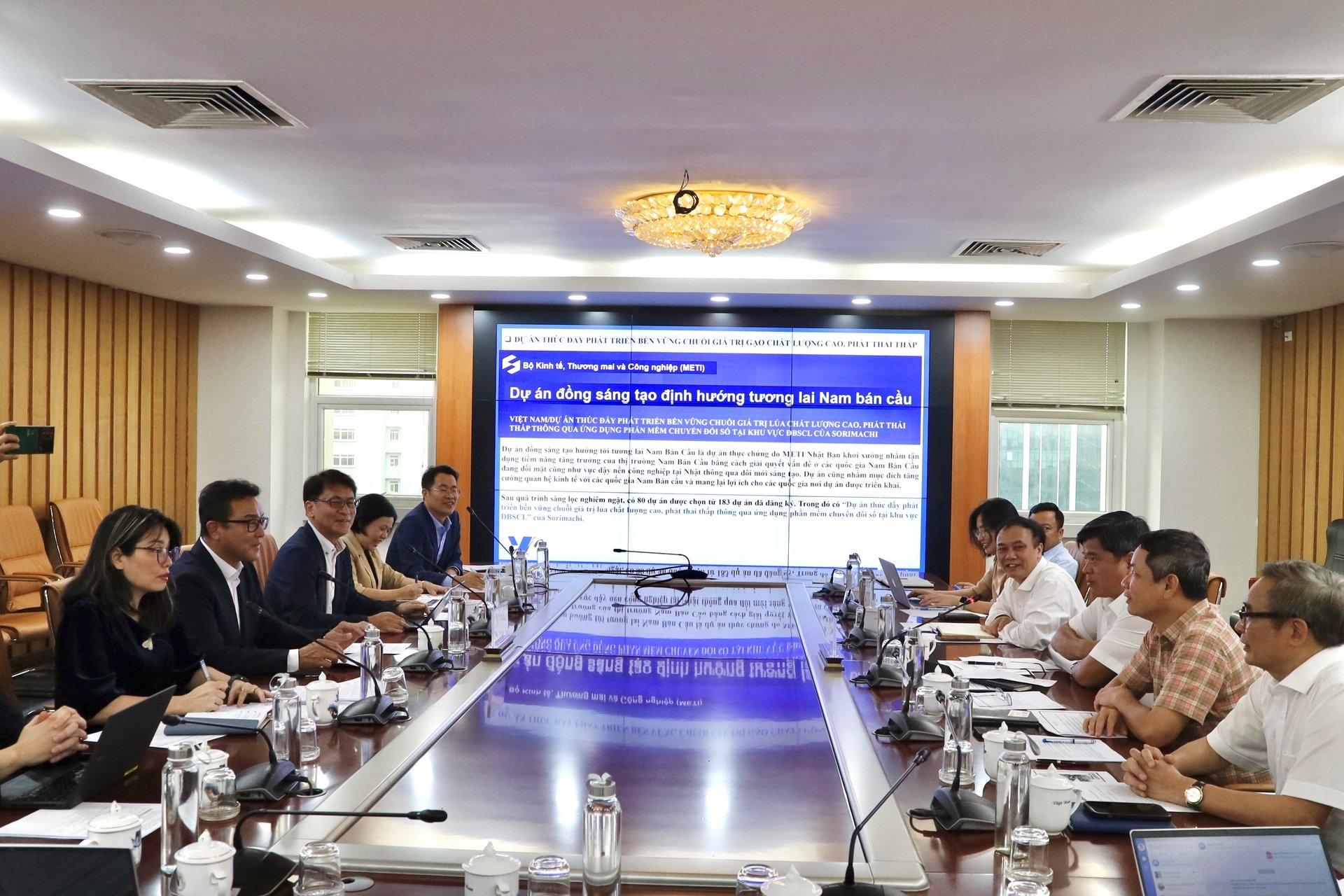
Deputy Minister of Agriculture and Environment Tran Thanh Nam worked with a Japanese delegation. Photo: Phuong Linh.
Currently, many countries around the world, including the JA (Japan Agricultural Cooperatives) system in Japan, have successfully developed nationwide shared technology platforms to manage production, finance, service provision, and agricultural distribution, with consulting support from Sorimachi.
According to Mr. Nguyen Thanh Mong, Market Development Director of Sorimachi Vietnam Co., Ltd., building a national-scale shared digital platform for agricultural cooperatives will help optimize costs, standardize processes, and enhance connectivity and transparency in cooperative operations. It will also support cooperatives in achieving digital transformation standards and improving their competitiveness in meeting market demands.
Based on this vision, Sorimachi Vietnam Co., Ltd. and Sorimachi Japan Joint Stock Company wish to collaborate with the Ministry of Agriculture and Environment, through the Department of Cooperatives and Rural Development, to support the development of a shared digital data platform (Big Data) for managing production and product distribution for agricultural cooperatives.
Sorimachi Vietnam is actively participating in key programs and initiatives led by the Ministry to support agricultural cooperatives in adopting WACA and FaceFarm software. These efforts include involvement in major initiatives such as the "1 Million hectares of high-quality rice" project, the Raw material zones initiative, the OCOP program, and the Ministry’s plans for developing agricultural cooperatives as part of the agricultural restructuring and new rural development strategy.
Notably, the company has recently received approval from the Ministry of Agriculture and Environment for participation in the project “Promoting the development of low-carbon, high-quality rice value chains in the Mekong Delta.” This project is funded by Japan’s Ministry of Economy, Trade and Industry and will be implemented in Vietnam in 2025, with the goal of contributing effectively to the "1 Million hectares of rice" initiative.

According to Mr. Sorimachi Hideki, Chairman of Sorimachi Japan Joint Stock Company, the company is researching and piloting advanced digital technology models from Japan. Photo: Phuong Linh.
Mr. Sorimachi Hideki, Chairman of Sorimachi Japan Joint Stock Company, stated that the company is currently researching and piloting advanced digital technology models from Japan. The focus is on collecting data from production areas, building integrated information systems, and applying artificial intelligence (AI) to analyze and support decision-making for effective rice farming and management.
Deputy Minister Tran Thanh Nam expressed his appreciation for the contributions of Sorimachi Vietnam Co., Ltd. and Sorimachi Joint Stock Company (Japan), and welcomed the company's implementation of the next phase of the project “Promoting the development of low-carbon, high-quality rice value chains in the Mekong Delta.”
Deputy Minister Tran Thanh Nam further noted that many international organizations and Japanese enterprises are currently interested in the “1 Million hectares of high-quality rice” project. However, they still lack detailed information about the program’s content, direction, and implementation methods. Therefore, he proposed that Sorimachi support the organization of a seminar in Japan with the theme: “Transforming rice production toward low emissions, green and sustainable practices.” This event not only provides information about the “1 Million hectares of high-quality rice” project but also highlights the cooperative relationship between the two countries in advancing green and sustainable agriculture.
The seminar is expected to be co-hosted by the Ministry of Agriculture and Environment of Vietnam together with the Ministry of Agriculture, Forestry and Fisheries of Japan.
Regarding the proposal to expand the application of digital technology beyond the scope of the “1 Million hectares of high-quality rice” project, Deputy Minister Tran Thanh Nam requested that Sorimachi initially focus on agricultural cooperatives in the Mekong Delta region, including cooperatives not involved in rice production, and then gradually extend the application to cooperatives in other localities and sectors.
At the same time, he assigned the Department of Cooperatives and Rural Development to develop a detailed implementation plan, considering this region as a key area, and then to scale up the model to other regions.

Deputy Minister Tran Thanh Nam highly appreciated the contributions of Sorimachi Vietnam Co., Ltd. and Sorimachi Joint Stock Company of Japan. Photo: Phuong Linh.
At the working session, Deputy Minister Tran Thanh Nam emphasized the importance of developing OCOP products with close connections among cooperatives, enterprises, individuals, and organizations throughout the entire production – processing – consumption chain. In this spirit, the Deputy Minister hopes that Sorimachi Vietnam Co., Ltd. will act as a bridge, coordinating to organize many specialized seminars, creating a space to share experiences, knowledge, and connect businesses from both countries within the OCOP product ecosystem.
“Through these programs, it is necessary to promote the role and position of women in rural economic development, considering this as one of the sustainable drivers to retain local people, especially the younger generation, in rural economic development.
Additionally, I hope that Sorimachi, with its good cooperative relationships with many major Japanese mechanization corporations, will collaborate to develop programs to enhance mechanization capacity for farmers in the Mekong Delta region, contributing to increased labor productivity and reduced production costs,” Deputy Minister Tran Thanh Nam noted.
In addition to cooperatives, the Deputy Minister proposed that Sorimachi expand the training audience to include agricultural extension officers, so that they can become a core force in guiding and promoting farmers to apply new technical and technological advances.
Listening to Deputy Minister Tran Thanh Nam’s suggestions, Sorimachi committed to contributing to enhancing the capacity of rural women through OCOP product development programs. “We will consider organizing training courses specifically for women, guiding them to apply digital technology to manage cooperative information. Data entry and analysis not only help effective management but also provide opportunities for women to learn, improve their organizational and leadership skills, and actively develop their economic activities,” said Chairman Sorimachi Hideki.
Sorimachi Vietnam expressed the desire for the National Agricultural Extension Center and relevant agencies under the Ministry to facilitate the implementation of the JICA Project (Enhancing the safe value chain in 7 northern provinces of Vietnam) and training programs on the application of digital transformation software in agricultural extension activities at grassroots and community levels, aiming to serve the Ministry of Agriculture and Environment’s key initiatives.
“Sorimachi Vietnam Co., Ltd. is committed to actively cooperating with institutes, universities, and colleges under the Ministry, as well as nationwide training organizations affiliated with the Ministry, to expand the scale of training programs and practical applications of digital technology in agricultural education and production,” said Mr. Mong.
Translated by Phuong Linh

(VAN) The Kien Giang World Biosphere Reserve is formed by three important core areas...

(VAN) Typhoon Bualoi (locally referred Typhoon No. 10) is currently advancing across the inland regions of Nghe An and Ha Tinh provinces, with sustained winds of force 9 and surges exceeding force 11.

(VAN) The center of Typhoon Bualoi (locally referred Typhoon No. 10) relocated to the region between Ha Tinh and North Quang Tri late on September 28. Initial reports showed 1 dead, 4 missing.

(VAN) Eighty years have been a difficult but pride-filled journey for the agriculture and environment sector.

(VAN) Viet Nam is mobilizing all available resources to complete emergency preparations before Typhoon Bualoi makes landfall late on September 28.

(VAN) Developing OCOP products on a digital platform provides producers with opportunities to expand Mekong Delta OCOP products further, connecting the region domestically and internationally.

(VAN) The event reaffirms the Cat Ba Archipelago’s special role in global nature conservation while creating new momentum for sustainable economic development.
