July 21, 2026 | 16:44 GMT +7
Hotline: 0913.378.918

July 21, 2026 | 16:44 GMT +7
Hotline: 0913.378.918
The Viet Nam Green Building Council (VGBC) held a workshop titled "Greening Industrial Parks in Viet Nam" in Ho Chi Minh City, aimed at updating trends in green industrial park development and promoting connections among stakeholders in the sustainable construction ecosystem.

Phan Thu Hang said green transformation has become a condition for industrial parks to strengthen competitiveness and participate in global supply chains. Photo: Le Binh.
According to Phan Thu Hang, chairwoman of VGBC's board of directors, green transformation is no longer just a trend; it has become a condition for industrial parks to strengthen their competitiveness and participate in global supply chains. Beyond location, infrastructure, and cost, investors are placing increasing weight on ESG criteria, carbon emissions, renewable energy, and climate resilience.
"Green is no longer an added advantage; it is becoming a condition for entering the game," Hang said.
According to Hang, a green industrial park must do more than save energy or cut carbon emissions; it must also apply green infrastructure and nature-based solutions to strengthen resilience against climate change.
To support this process, VGBC has developed the LOTUS IP green industrial park rating system, which aims to establish a common set of criteria to help businesses, infrastructure developers, and financial institutions transparently assess the green and sustainability of an industrial park. The system is currently being piloted across several industrial parks and is expected to become a market reference standard.
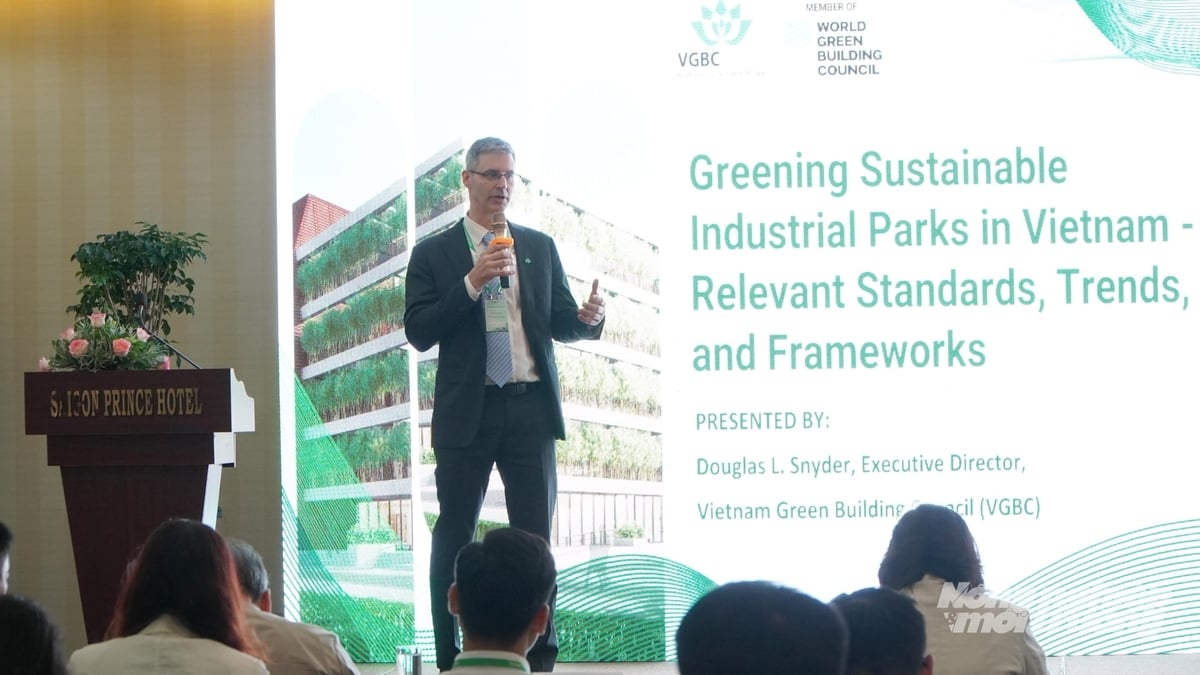
Douglas Snyder emphasized the role of ESG and climate resilience in attracting green investment. Photo: Le Binh.
Hang also said that greening industrial parks cannot be the effort of a single company; it requires joint action from the state, the private sector, financial institutions, and the business community.
Douglas Snyder, executive director of VGBC, said developing green industrial parks requires a comprehensive approach that combines environmental, governance, social responsibility and economic efficiency factors to meet market requirements and gain access to green financing.
"Today, the story of green and finance is the best path to scaling up ecological development activities. Eco-industrial parks are very well suited to ESG criteria," Snyder said.
According to Snyder, climate resilience must become a core criterion in industrial park planning. Solutions for energy, water and waste management, biodiversity conservation and green infrastructure need to be integrated from the outset to reduce risks from disasters and extreme weather.
Snyder also pointed to one of the current barriers: industrial park management boards still find it difficult to access emissions and operational data from individual businesses within the parks.
"Industrial park management boards today still cannot access the operational data of the businesses inside them. This is no small challenge, and it will certainly need to be resolved over the next five to ten years," he said.
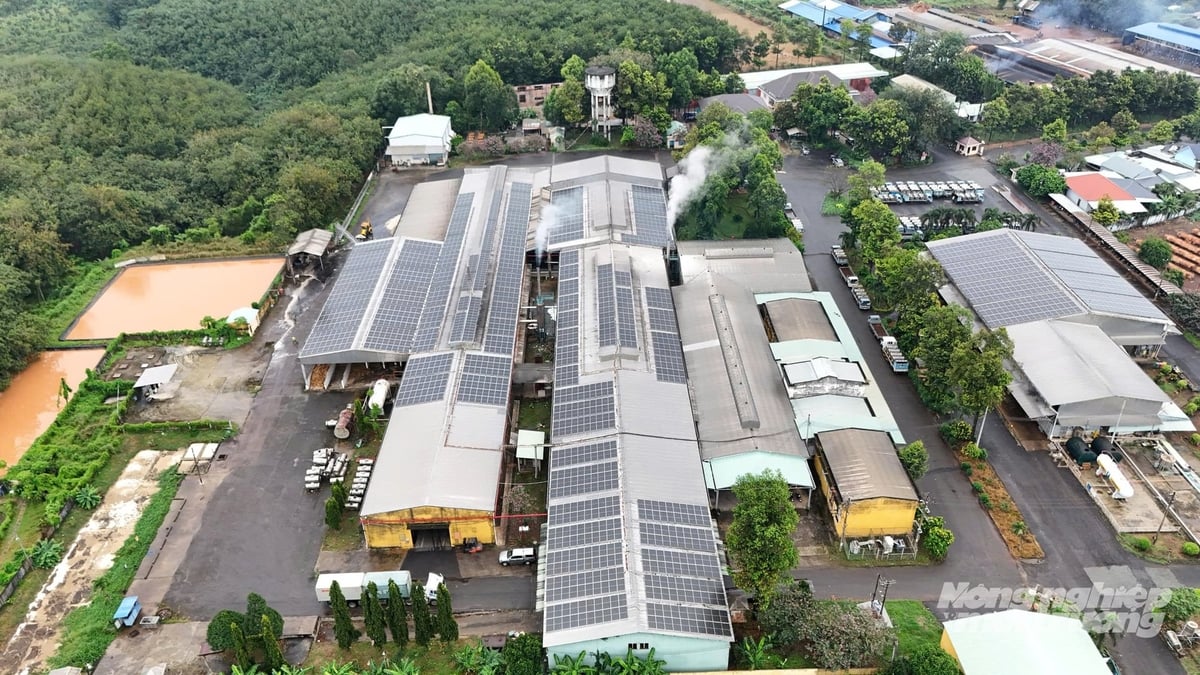
Green industrial parks are planned for efficient resource use, reduced emissions and stronger climate resilience, meeting sustainable development standards and global supply chain requirements. Photo: Le Binh.
According to Snyder, developing eco-industrial parks will help Viet Nam work toward its net-zero emissions target by 2050, while also meeting increasingly stringent international market requirements such as the Carbon Border Adjustment Mechanism (CBAM). If Vietnamese businesses are slow to transform, they risk losing competitiveness and missing opportunities within global supply chains.
At the workshop, experts also introduced a range of models, standards and solutions for green industrial park development, helping to strengthen connections among regulators, investors and businesses, and working toward building a sustainable industrial park ecosystem aligned with international standards.
Translated by Linh Linh
/2026/07/20/1547-1-180442_204.jpg)
(VAN) A farmer in Can Tho has found the secret to raising giant water bugs that produce intensely aromatic essence, earning annual profits of hundreds of millions of dong.

(VAN) From crop conversion to deep processing, Ba Che Commune in Quang Ninh Province is building a comprehensive cinnamon value chain that creates sustainable livelihoods while strengthening the local forestry economy.

(VAN) The ACIAR-SunRice public-private partnership, rooted in science and sustainable development, is expected to support rice farmers in the Mekong Delta.

(VAN) Linking the shrimp, rice, and coffee sectors through a circular economy model is opening up a new pathway for Viet Nam's agriculture.

(VAN) HCMC is accelerating the transition to circular industry by transforming industrial parks into eco-industrial zones, fostering industrial symbiosis, and expanding international partnerships for green manufacturing.
(VAN) The digital map of raw material zones is expected to resolve overlapping investments, ensure production transparency, and accelerate deep processing in the coconut industry.
(VAN) Transforming barren hills once dedicated only to acacia and cassava, the Anh Mai Medicinal Plant Cooperative has found a new direction with red turmeric, opening up sustainable livelihoods for local residents.
