December 30, 2025 | 16:25 GMT +7
Hotline: 0913.378.918

December 30, 2025 | 16:25 GMT +7
Hotline: 0913.378.918
According to the report “Lychee Market Size & Share Analysis – Growth Trends and Forecasts during the 2023–2028 period” by Research and Markets, the global lychee market is experiencing robust growth, with its value projected to surge from USD 6.73 billion in 2023 to USD 8.79 billion by 2028. This represents a compound annual growth rate (CAGR) of 5.5% during this period.
This notable growth trend reflects the global taste for fresh, nutritious fruits and the expanding use of lychees across various sectors.
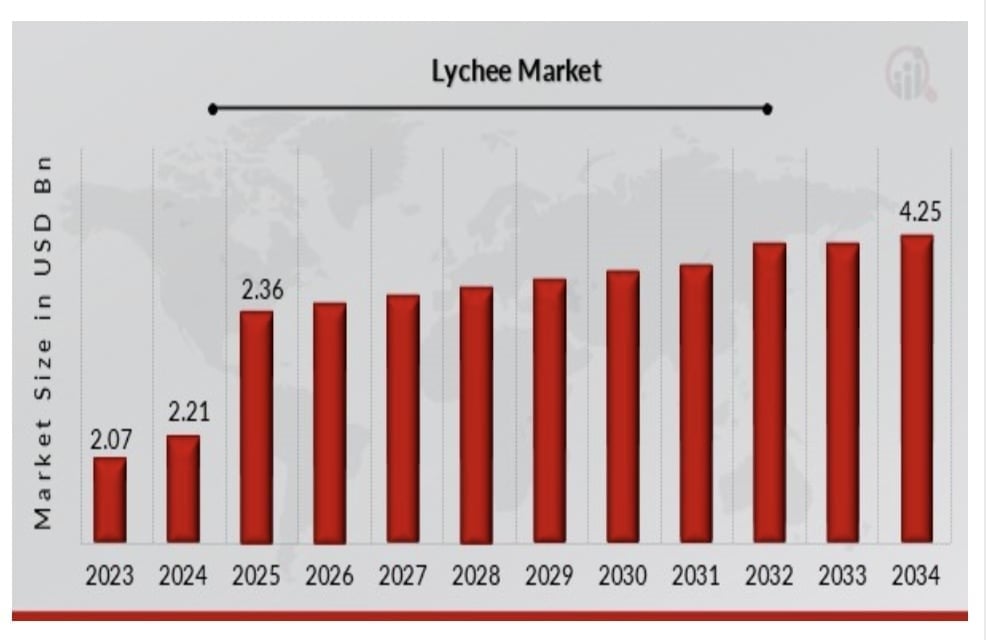
Lychee market size from 2023 to 2034. Chart: Marketresearchfuture.
As global awareness of health and diets continues to rise, a range of powerful drivers is promoting the lychee market. Consumers in developing and emerging economies are showing increasing demand for fresh, nutritious foods, thereby expanding the scale of the lychee market.
In addition, government initiatives and growing commercial activities, particularly from major producing countries, are playing a key role in supporting the market expansion.
Beyond the fresh fruit segment, lychee is being expanded and favored in processed products such as jams, juices, canned fruits, and dried lychees. This trend highlights the fruit’s increasing flexibility and consumer appeal.
With major markets stretching across Asia, Europe, and the U.S., international demand for this “superfruit” shows no sign of slowing down. In Europe, lychees are recognized as a “sweet and nutritious” fruit, promoting strong exports to countries like the Netherlands and the United Kingdom. The rising export volume, combined with a global shift toward healthier food choices, has contributed to sustaining the stable growth momentum of the lychee market.
China is the world's largest producer and exporter of lychees, with annual output reaching approximately 2 million tons. Major growing regions include Guangdong (accounting for 65% of the national production), Fujian, and Hainan.
Chinese lychees are exported to major international markets, including the U.S., Canada, Europe, Hong Kong, Singapore, Indonesia, the Philippines, and Malaysia. China’s lychee industry has seen rapid growth due to the development of new varieties, the application of advanced agricultural technologies, and government support for logistics.
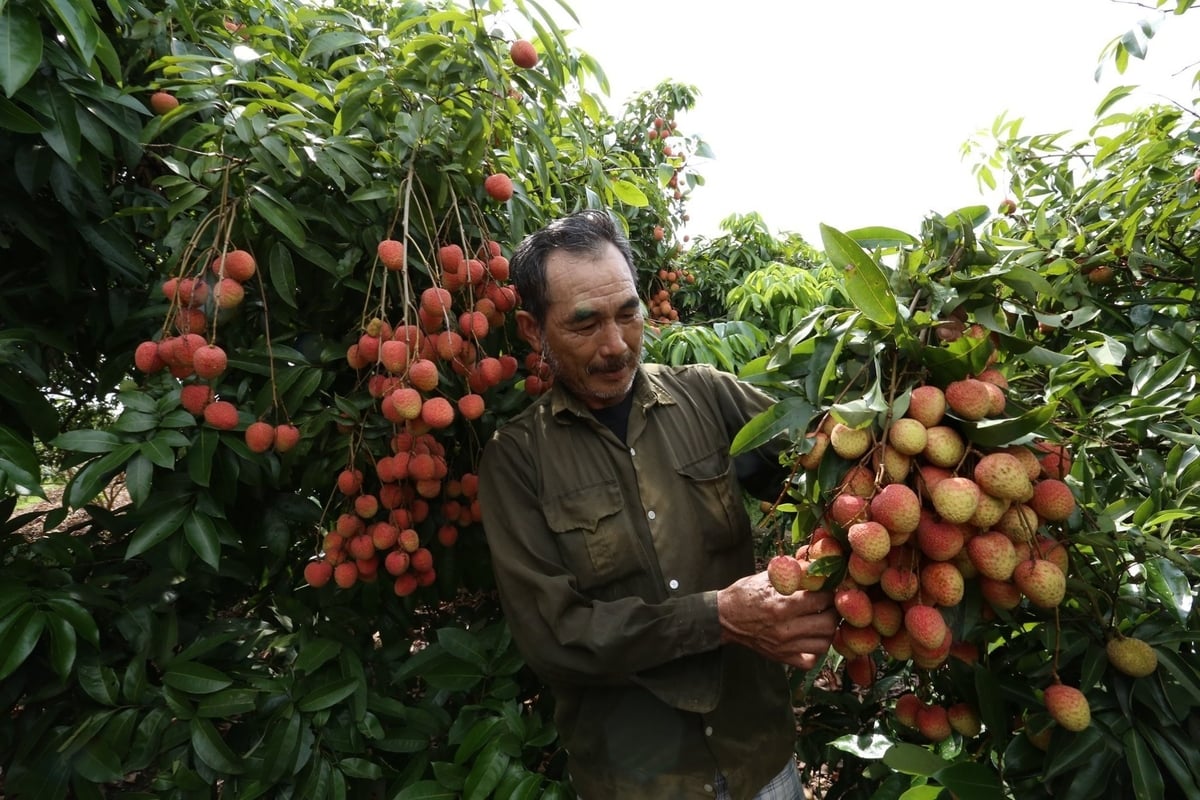
Vietnam's lychee harvest is expected to reach 303,000 tons in 2025. Photo: H.T.
Vietnam holds the second position and is continuously strengthening its position in the global lychee market. The country's lychee harvest is expected to reach 303,000 tons in 2025, marking a 30% increase compared to 2024. Key production areas include Bac Giang and Hai Duong provinces. Vietnamese lychees are certified under VietGAP, GlobalGAP, and organic standards, meeting the requirements of consumption markets.
Vietnam's major export markets include China, the U.S., Japan, and the EU. Vietnam is making substantial investments in quality improvement and logistics to enhance its competitiveness in the global market.
India is also among the world’s largest lychee producers, with an estimated output of 726,000 tons during the 2021–2022 period. The main growing region is Bihar. However, the vast majority of Indian lychees (about 98–99%) are consumed domestically. Despite that, India’s export potential is on the rise, particularly to Middle Eastern markets.
Madagascar has emerged as the leading lychee exporter to the European Union (EU), thanks to its strict quality control and efficient cold logistics system. The country exports more than 20,000 tons of lychees annually to the EU, with France and Germany as its key markets.
In addition, lychees are also cultivated in Thailand, Indonesia, and the Philippines, contributing to regional supply and participating in international trade.
According to EastFruit, lychees, with their subtle floral aroma, vibrant color, and juicy flesh, have conquered millions of consumers worldwide. Derived from Southeast Asia, this “eye-catching on Instagram” fruit has moved far beyond its position as a local specialty to become a key export commodity for countries such as China, India, Madagascar, and Vietnam.
Translated by Thu Huyen
/2025/12/29/2812-1-182339_699.jpg)
(VAN) The price of mangrove forest carbon credits is high because this forest type not only delivers significant environmental value but also plays a crucial role in addressing other issues.
/2025/12/29/5840-0-115141_514.jpg)
(VAN) From 2026, many EU markets will require shrimp to be electrically stunned before ice immersion, forcing exporters to change technologies to retain market share.
/2025/12/28/4951-2-104623_113.jpg)
(VAN) Rubber exports are forecast to remain under downward pressure in the coming period, as global rubber consumption shows signs of slowing, according to ANRPC's projections.
/2025/12/28/5120-1-093308_94.jpg)
(VAN) Many agricultural products are of sufficient quality to join global supply chains, yet fail to pass the first gateway when entering international markets due to packaging and information in English.
/2025/12/27/2453-2-172141_426.jpg)
(VAN) The sharp decline in the number of EU warnings in 2025 is regarded as a positive signal for the future orientation of Viet Nam’s agricultural exports.
/2025/12/27/1547-2-220434_536.jpg)
(VAN) For many businesses, exporting is a costly trial. But for those choosing a long-term path, small orders are a way to keep markets and learn the rules.
/2025/12/27/2522-1-090748_662.jpg)
(VAN) The 'Large-Scale Rice Field' project has been implemented in An Giang across a total area of more than 5,582 ha, comprising 73 large-scale fields and attracting the participation of 2,027 farmer households.
