July 21, 2026 | 21:44 GMT +7
Hotline: 0913.378.918

July 21, 2026 | 21:44 GMT +7
Hotline: 0913.378.918
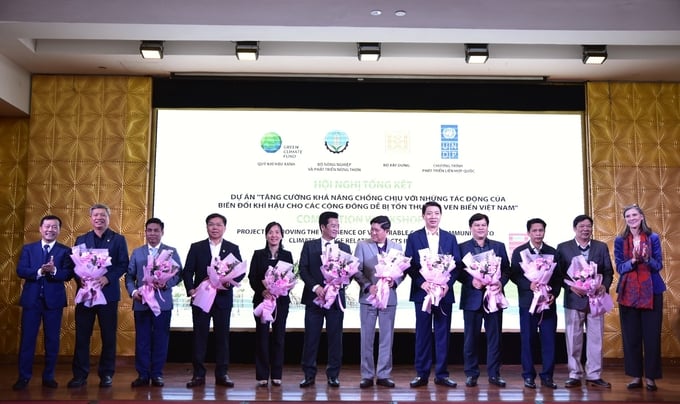
The completion workshop of the project "Enhancing Resilience to Climate Change Impacts for Vulnerable Coastal Communities in Vietnam" (UNDP/GCF project) took place in Hanoi. Photo: Kieu Chi.
On the morning of December 17th, the Department of Dike Management and Disaster Prevention (Ministry of Agriculture and Rural Development) coordinated with the United Nations Development Programme (UNDP) to organize the completion workshop of the project "Enhancing Resilience to Climate Change Impacts for Vulnerable Coastal Communities in Vietnam" (UNDP/GCF project).
Implemented from 2017 to 2024, the project aims to protect and support vulnerable communities through integrated solutions such as building safe houses, restoring mangrove forests, and strengthening disaster risk information systems in 7 coastal provinces vulnerable to climate change, including Nam Dinh, Thanh Hoa, Quang Binh, Thua Thien Hue, Quang Nam, Quang Ngai, and Ca Mau.
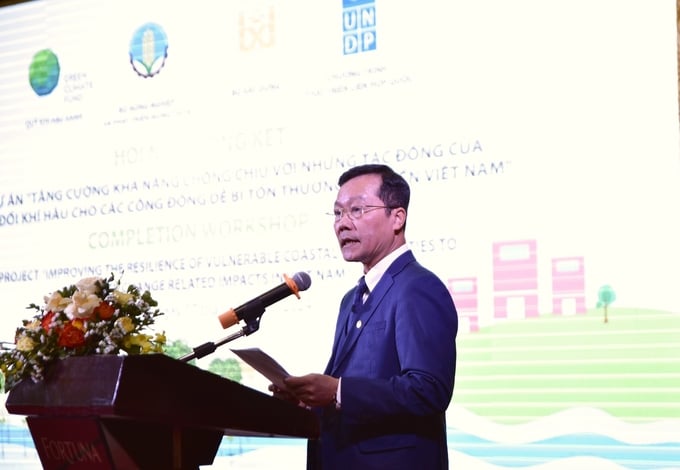
Mr. Nguyen Van Tien, Deputy Director of the Department of Dike Management and Disaster Prevention, delivered the opening speech at the project closing conference. Photo: Kieu Chi.
Speaking at the conference, Mr. Nguyen Van Tien, Deputy Director of the Department of Dike Management and Disaster Prevention, Project Director, emphasized "The GCF project is clear evidence of active participation of the community and the close coordination among stakeholders, overcoming many difficulties to achieve encouraging results. The construction of 4,966 safe houses for coastal residents and the restoration of 4,028 hectares of mangrove forests are impressive outcomes of the project".
The Deputy Director of the Department of Dike Management and Disaster Prevention hopes that UNDP and international organizations will continue to collaborate to scale up this initiative nationwide, bringing safety and sustainability to the Vietnamese people amid increasingly severe natural disasters.
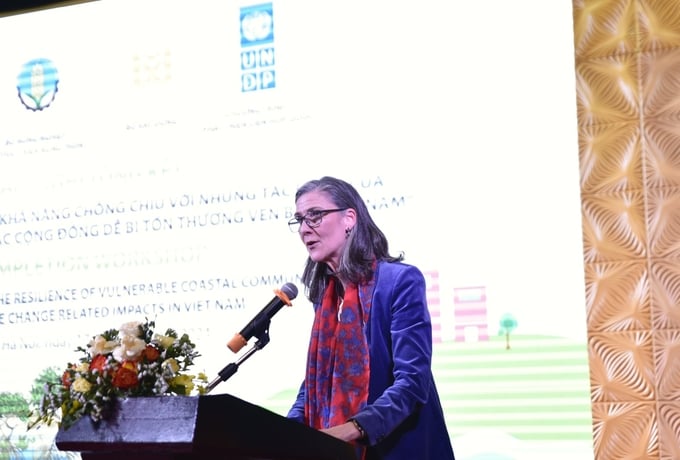
UNDP remains committed to accompanying Vietnam in building sustainable communities, ensuring that no one is left behind in the fight against climate change. Photo: Kieu Chi.
According to Ms. Ramla Khalidi, Resident Representative of UNDP in Vietnam, at the conclusion of this project, we are reminded that Vietnam's coastal communities are facing increasingly severe impacts of climate change. The project has demonstrated that resilience is not just a goal but can be achieved through collaboration, innovation, and the unwavering commitment of all stakeholders.
She also affirmed, "UNDP remains committed to accompanying Vietnam in building sustainable communities, ensuring that no one is left behind in the fight against climate change".
Specifically, the project has built 4,966 resilient houses, providing secure shelter for more than 25,000 people in areas frequently affected by storms and floods in 2020. These houses not only safeguard lives and provide solid homes for residents but have also become models integrated into the National Target Program on Sustainable Poverty Reduction.
In addition, 4,028 hectares of mangrove forests have been restored, serving as "natural shields" to protect communities from storm surges and sea tides while absorbing over 1.1 million tons of CO2, positively contributing to Vietnam's commitment to reducing greenhouse gas emissions and creating resilient buffer zones.
Moreover, the project has supported the development of sustainable livelihood models, such as honeybee farming in Thanh Hoa, helping people increase their income while promoting mangrove forest protection. In the field of disaster risk management, the project has established early warning systems in 24 high-risk communes and organized training for over 62,000 officials and residents, of whom nearly 50% are women.
The programs under the GCF project contribute to enhancing community capacity and awareness in responding to natural disasters, helping to minimize damages in emergency situations, while fully meeting environmental, social standards, and gender equality.
Translated by Kieu Chi

(VAN) Viet Nam is actively preparing to participate in GREEN EXPO 2027 to promote its image as a green, sustainable, and innovative nation on the global stage.

(VAN) Lai Chau is passing by in a hurried rhythm at this time. Everyone is working tirelessly against the clock, devoting all efforts to overcoming the aftermath of the disaster.

(VAN) Some countries consider agriculture a public service, so the state must invest in it, according to Ass. Prof Dr. Dao The Anh, former Deputy Director of the Viet Nam Academy of Agricultural Sciences.

(VAN) The Minister of Agriculture and Environment of the Lao PDR recognizes the VRG's significant contributions over two decades of investment and operations in Laos.

(VAN) The VNMHA held a conference to review its work over the first six months of the year and set out priority directions and tasks for the second half of 2026.

(VAN) Khanh Hoa Sea Festival 2026, themed ‘Colors of the Ocean - Reaching International Scale,’ conveys a message of green marine economic development, integration, and Khanh Hoa's rising position.

(VAN) Viet Nam and the Food and Agriculture Organization of the United Nations (FAO) have launched a project to strengthen water resources management, reduce pollution and restore water quality in the Gulf of Tonkin.
