July 21, 2026 | 21:57 GMT +7
Hotline: 0913.378.918

July 21, 2026 | 21:57 GMT +7
Hotline: 0913.378.918
At the workshop “Climate Smart Agriculture” held on June 24, experts, policymakers, and businesses discussed solutions to accelerate green transformation in agriculture, promote digital technologies, and develop production models resilient to climate change.
The event was jointly organized by Action on Poverty (AOP), the Center for Agrarian Systems Research and Development (CASRAD), Avalve Company, and partner organizations.
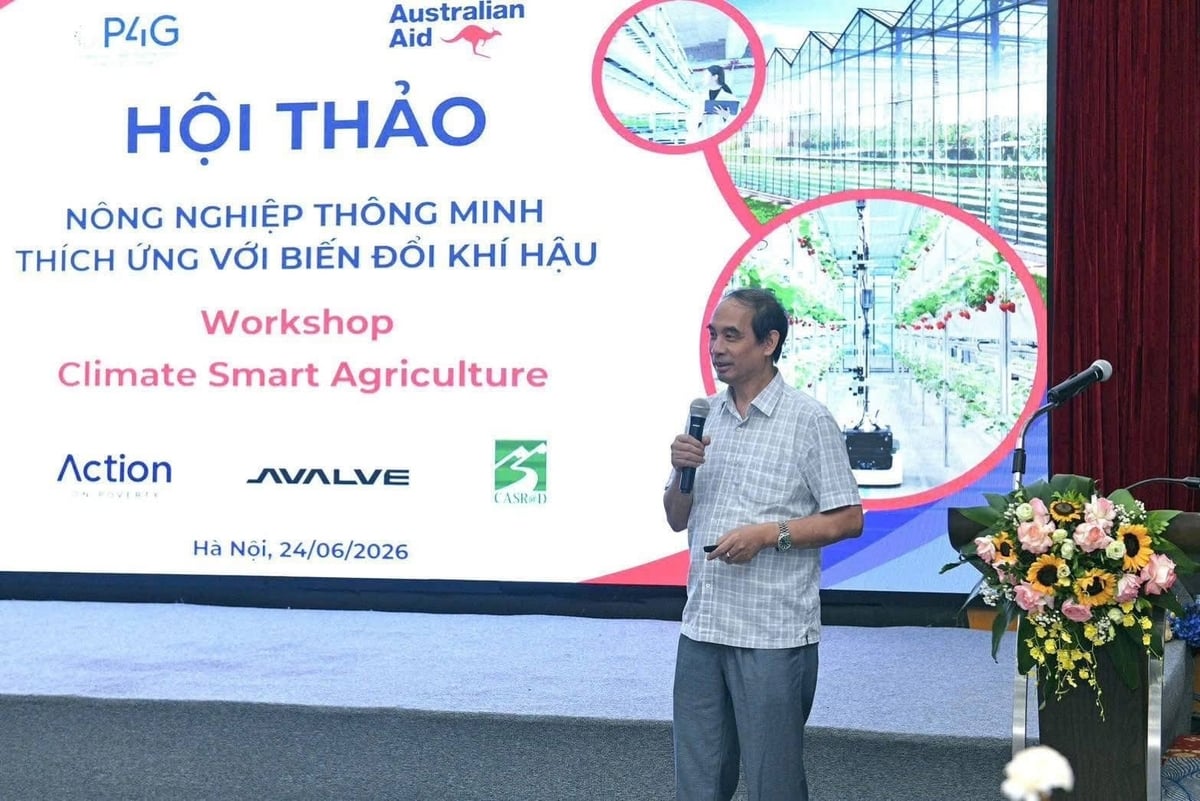
Assoc. Prof. Dr. Dao The Anh, Chairman of the Viet Nam Rural Development Science Association (PHANO), speaks at the workshop. Photo: PHANO.
According to experts, after years of growth driven by production expansion and resource exploitation, Viet Nam’s agricultural sector is facing multiple challenges, including land degradation, pressure on water resources, biodiversity loss, and greenhouse gas emissions. At the same time, extreme weather events such as droughts, saltwater intrusion, and disease outbreaks are increasingly affecting agricultural production.
Assoc. Prof. Dr. Dao The Anh, Chairman of the Viet Nam Rural Development Science Association (PHANO), said the sector must simultaneously achieve three key objectives: ensuring food security, increasing farmers’ incomes, and minimizing environmental impacts. This requires a transition from conventional farming to ecological, circular, and high-tech agricultural systems.
According to Dr. Anh, green transformation goes beyond reducing agricultural inputs or expanding organic production. It requires restructuring the entire production system to use resources more efficiently, strengthen resilience to climate change, and generate sustainable added value.

Smart cucumber cultivation using Israeli technology at the Terrasol farm in Ha Noi. Photo: Viet Dung.
In practice, many models have already delivered positive results. In An Giang Province, cooperatives participating in the project to develop one million hectares of high-quality, low-emission rice in the Mekong Delta have adopted measures such as reducing seeding rates, applying alternate wetting and drying irrigation, and implementing integrated pest management. These practices have significantly cut greenhouse gas emissions and production costs while maintaining yields.
In Ha Noi, a low-emission rice farming model linked to carbon credits is being piloted in Ung Hoa District. By meeting international standards, farmers can generate additional income through carbon credit trading. Meanwhile, a high-tech strawberry farm in An Khanh Commune uses automated irrigation systems, environmental sensors, and precision nutrient management, helping conserve water, reduce costs, and improve product quality.
Alongside agroecological solutions, digital technologies are seen as a key driver of the transition. Applications of artificial intelligence (AI), the Internet of Things (IoT), big data, and traceability systems are improving production management, optimizing resource use, and helping agricultural products meet increasingly demanding environmental standards in international markets.
However, experts emphasized that technology can only deliver its full potential when implemented within value chains that foster close collaboration among farmers, cooperatives, and businesses. Expanding deep processing, building strong brands, and developing markets will be crucial to enhancing the competitiveness of Vietnamese agricultural products.
Participants at the workshop agreed that climate-smart agriculture is not only an effective response to climate change but also an essential pathway toward a modern, green, and low-emission agricultural sector in the years ahead.
Translated by Minh Hanh

(VAN) Two Da Nang cooperatives were honored with the ‘Cooperative Star’ award for 2026, affirming the effectiveness of a dynamic, adaptable, and sustainably developing collective economic model.

(VAN) Policy credit has empowered many households in Hoa Vang commune to boldly invest in production, build effective economic models, and boost their income.

(VAN) Recently, the Lao Ministry of Agriculture and Environment delegation visited, worked, and signed a pact with the Vietnam Academy of Agricultural Sciences.

(VAN) Da Nang steps up free rabies vaccination in mountainous communes, delivering vaccines directly to villages to build an immunity shield.

(VAN) Native honeybee farming in Ha Tinh grew strongly, providing stable incomes and promoting sustainable rural economic development.
/2026/07/20/3847-3-113606_381.jpg)
(VAN) The global spread of the SAT-1 FMD virus strain underscores the need for Viet Nam to proactively enhance surveillance and develop response scenarios well in advance.

(VAN) Agricultural by-products are being recognized as resources that can generate new economic value, reduce emissions, and create new opportunities for green growth in circular agriculture.
