December 6, 2025 | 19:45 GMT +7
Hotline: 0913.378.918

December 6, 2025 | 19:45 GMT +7
Hotline: 0913.378.918
Recognizing the importance of protecting health, the environment, and the effectiveness of organic farming, Phu Luong district (Thai Nguyen) has integrated organic production into its new rural development program, contributing to the restructuring of local agriculture. This initiative has accelerated the achievement of the new rural development goals for 2024 by over a year compared to the initial plan.
Capitalizing on the potential and value of organic agriculture, Phu Luong district has planned green and organic production zones. Each specialized production area selects key crops to develop high-quality OCOP products.
The silk weaving area of On Luong in Phu Luong district (Thai Nguyen). Photo: Quang Linh.
Mr. Nguyen Quoc Huu, Secretary of the District Party Committee of Phu Luong district, stated that for the agricultural sector, Phu Luong district particularly focuses on developing its key crops such as tea by expanding cultivation areas, enhancing product quality, and promoting organic production linked with marketing and market expansion.
The Resolution of the 24th District Party Congress of Phu Luong district, term 2020-2025, identifies agriculture as the foundation for economic development. Specifically, the local authorities have formulated and implemented the Project to enhance the value of tea products and other local strengths in the period 2021-2025, with a vision towards 2030.
After 4 years of implementing the Project, the district has achieved significant results. Currently, the total tea cultivation area in Phu Luong has exceeded 4,000 ha, producing approximately 47,000 tons of fresh tea buds, with an economic value surpassing VND 1,300 billion per year.
By the end of 2023, there were 111 tea products in the area labelled with QR codes for traceability, surpassing the target of 101 products set for 2025. The market prices of organic products are generally higher than conventionally produced ones, thereby increasing income for local residents practising organic farming methods. This has effectively boosted income levels for local residents, meeting income criteria in building new rural areas.
Furthermore, organic farming contributes to environmental protection. Members of cooperatives are also community members who protect both the agricultural and living environments of their local communities.
Therefore, the development of organic agricultural products plays a crucial role in improving quality, and efficiency, and successfully implementing the National Target Program on New Rural Construction. It efficiently utilizes the potential and strengths of each locality, develops high-quality products according to standards, enhances competitiveness, and meets market demands in the context of international economic integration.
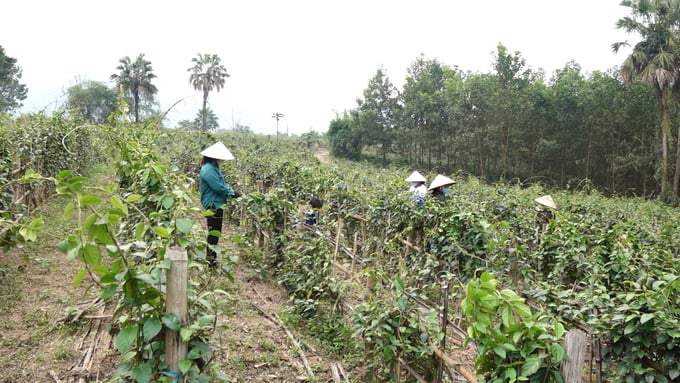
The area of organic medicinal herb cultivation, such as the Thia Canh herb in Phu Luong district (Thai Nguyen). Photo: Quang Linh.
For instance, the area dedicated to growing organic Thia Canh medicinal herbs in Phu Luong district by DK Natural Products Joint Stock Company currently spans 4 hectares, of which 2.1 hectares meet organic standards, with the remaining area transitioning towards organic cultivation.
The company sells nearly 4 tons of dried Thia Canh herbs annually, generating approximately VND 250 million in revenue. This also provides employment for dozens of local workers.
Currently, the company offers 5 packaged dried medicinal herb products, including two products that have achieved 4-star OCOP certification: Thia Canh vine tea and compressed Thia Canh vine tea.
In the future, Phu Luong district will focus on implementing comprehensive solutions to promote the development of organic agriculture, including tea, silk rice, and large-leaf herb vines. This aims to rapidly and sustainably develop the local agricultural sector, continuously improve people's living standards, and modernize the rural landscape towards civilization and modernity.
To date, Phu Luong district has achieved notable results in rural development: all 13 communes have met new rural standards; 3 communes have attained advanced new rural standards (23.07%); 2 communes have achieved exemplary new rural standards (15.38%); and 2 towns have met urban civilized standards. The district has met 5 out of 6 conditions, 3 out of 9 criteria, and 27 out of 36 indicators according to the National New Rural Development Criteria.
The primary objectives of Thai Nguyen province are strategizing the cultivation areas for tea, establishing a renowned national tea brand, standardizing the procedures for tea production and processing, and encouraging the integration of scientific advancements and technology in tea cultivation and processing.
In addition, it will assess tea producing regions associated with the growth of tourism, implement regulations relevant to each region, increase the cultivation of organic and environmentally friendly tea, and improve digitalization, trade promotion, and electronic transactions for tea consumption.
Translated by Hoang Duy

(VAN) As of 2025, the ASEAN region has a total of 69 ASEAN Heritage Parks recognized across its 10 member states. Among them, Viet Nam contributes 15 ASEAN Heritage Parks.

(VAN) Yok Don National Park has high biodiversity with numerous endemic plant and animal species, and it is also the only dipterocarp forest ecosystem conservation area in Viet Nam.

(VAN) Viet Nam and Brunei signed two important MOUs on fisheries and IUU, expanding cooperation in agriculture, the environment, and Halal exports, aiming to substantively implement joint projects.

(VAN) The Viet Nam Coconut Association worked with the International Finance Corporation (IFC) and businesses to promote the supply chain, enhance competitiveness, and develop the coconut industry sustainably.
![Hue aims for Net Zero: [2] Pioneering low-emission tourism](https://t.ex-cdn.com/nongnghiepmoitruong.vn/608w/files/huytd/2025/12/04/0633-dulichzero-4-095634_236-161125.jpg)
(VAN) The ancient capital of Hue has developed Net Zero tourism products and models, aiming to reduce carbon emissions and pioneer the establishment of Viet Nam's green tourism destination.

(VAN) C.P. Viet Nam has announced the successful completion of its goal to plant 1.5 million trees during the 2021-2025 period, a key milestone within company's long-term ESG strategy and its roadmap for emission reduction.

(VAN) This is an initiative of MAE aimed at creating a unified coordination mechanism to implement agricultural cooperation programs with developing countries.
