July 21, 2026 | 21:02 GMT +7
Hotline: 0913.378.918

July 21, 2026 | 21:02 GMT +7
Hotline: 0913.378.918
Mr. Nguyen Van Tuan, from Doa Cu hamlet, Huong Phung commune, Quang Tri province, said that in recent years the movement of coffee cultivation under shade trees has grown strongly in the locality. Instead of monocropping Arabica coffee, local farmers have shifted to growing coffee under shade trees and fruit trees, while using organic fertilizers and biological pesticides. Surprisingly, coffee yields have become more stable, and both selling prices and economic efficiency are significantly higher compared to monoculture coffee farming.
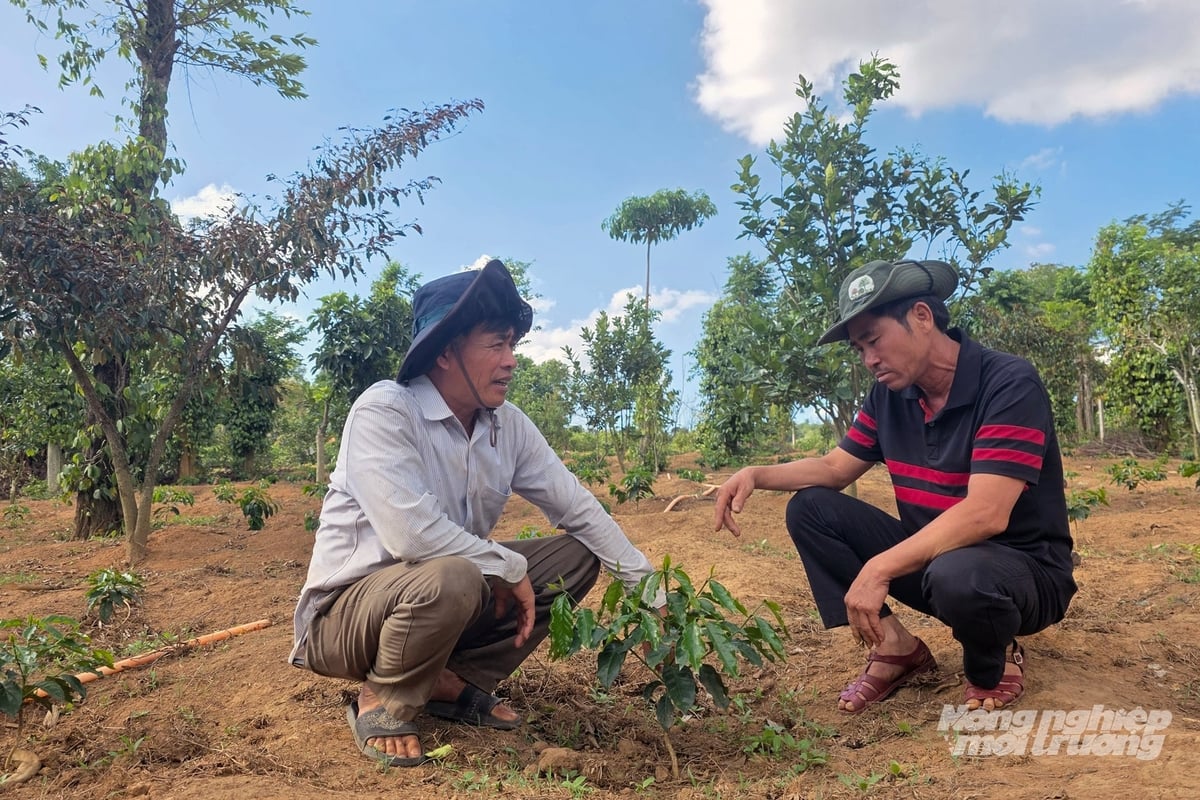
Replanted coffee areas are cultivated under various shade trees. Photo: Vo Dung.
“If there are no shade trees, yields and output become highly unstable. In good years, we harvest 15-17 tons, but in poor years it drops to just 7-10 tons per hectare. Now, with shade trees, yields are more stable. Even in a bad season, my coffee farm still produces 18 tons per hectare; in good seasons, it reaches 20-22 tons per hectare. Coffee grown under shade trees produces riper cherries and sells at higher prices. Without shade trees, the fruit gets sunburned and is only suitable for bulk, low-grade sales,” Mr. Tuan shared.
Ms. Luong Ngoc Tram, Director of Pun Coffee Co., Ltd., said that in recent years the company has tended to purchase high-quality coffee for specialty coffee processing. Coffee grown under forest canopy, with fully red-ripe cherries, is always purchased at prices 5,000-6,000 VND/kg higher than coffee produced using traditional farming methods. Coffee grown under forest shade ripens more slowly, has higher natural sugar content, and benefits from competition with other plants, which enhances flavor complexity and aroma profile.
"Plant density is lower compared to traditional farming methods, so yields in some farms decrease by 5-10%, but they are much more stable. In addition to selling at higher prices, farmers can diversify their income from fruit trees, beekeeping for honey, and more. Most importantly, it is about environmental benefits and agricultural quality; those are the ultimate goals of sustainable agriculture," Ms. Tram said.

Coffee yields and output remain stable thanks to cultivation under forest canopy. Photo: Vo Dung.
Mr. Phan Ngoc Long, Vice Chairman of Huong Phung Commune People’s Committee, said the commune currently has nearly 3,000 hectares of coffee, accounting for 60-70% of the total coffee-growing area of the former Huong Hoa district. To date, 600 households have registered to participate in ecological coffee cultivation and natural forest restoration, with nearly 100 hectares already implemented.
The participation of enterprises through programs and projects will further motivate coffee growers to scale up the model, moving toward higher-value global markets.
“The locality will continue to promote and mobilize farmers to produce coffee in an ecological and organic direction in order to generate more raw materials for export-oriented processing. This is a sustainable path for agriculture in general and for the coffee sector in Huong Phung in particular. In the coming time, we hope programs and projects will continue to provide advanced training and invest in seedlings so that farmers can expand agro-forestry coffee areas,” Mr. Long said.
Ms. Luong Ngoc Tram, Director of Pun Coffee Co., Ltd., said that in response to global demand for traceability and production standards that support natural forest restoration, the company has shifted its mindset since 2022. Instead of purchasing traditionally cultivated coffee for processing, the company has partnered with hundreds of households to develop coffee grown under shade trees. To date, 10,000 shade trees of various species have been planted and integrated into farmers’ coffee gardens.
Many households have shifted from monoculture coffee farming to diversified, multi-layered agroforestry systems to create shade, retain moisture, prevent soil erosion, and reduce pests and diseases. During cultivation, farmers do not use chemical fertilizers or harmful pesticides. Coffee husks, along with by-products, are composted into organic microbial fertilizers and returned to the soil.
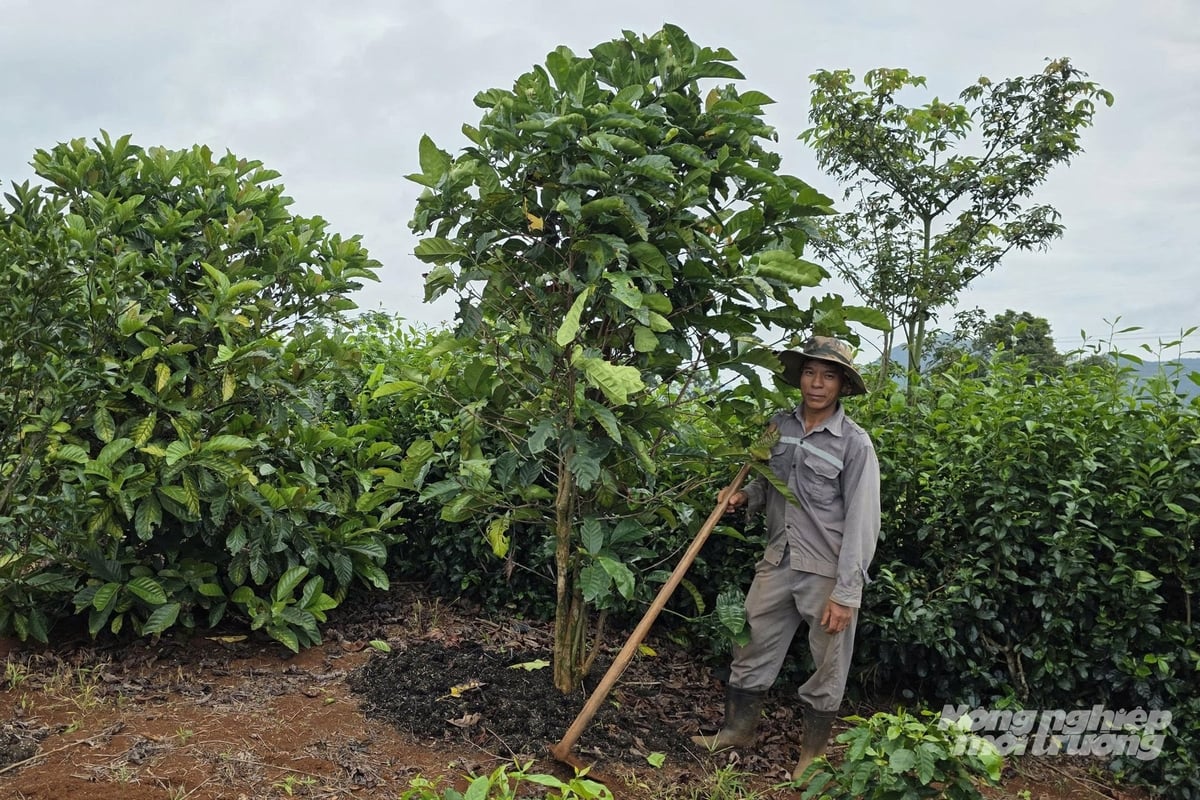
Growing coffee under forest canopy helps farmers diversify their income sources. Photo: Vo Dung.
"We select leguminous plants, native species, or oil-rich trees such as black cassia, Dalbergia tonkinensis, green ironwood, and fragrant re trees. These species improve soil quality and repel coffee pests, and we provide them to farmers for planting. After a period of growing shade trees, farmers can also earn additional income from these trees," Ms. Tram said.
As the movement toward coffee cultivation that does not contribute to deforestation began to take shape, farmers in Huong Phung commune were further encouraged. In 2023, with non-refundable aid from the Danida Green Business Partnership (Denmark), the World Wide Fund for Nature in Viet Nam (WWF-Viet Nam) implemented the project “Ecological Coffee Production and Natural Forest Restoration in Huong Hoa District, Quang Tri Province” (now covering Huong Phung, Khe Sanh, Tan Lap communes, among others), with a total investment of nearly VND 30 billion and implementation from 2023 to 2027. Slow Viet Nam Co., Ltd. has accompanied farmers in building supply chains, ensuring product purchase, and committing to export high-quality Arabica coffee.
The project aims to convert 2,500 hectares of monoculture Arabica coffee into agroforestry systems, protect 18,000 hectares of natural forest, and support 2,000 smallholder households (mainly Bru–Vân Kiều ethnic minorities) in developing sustainable value chains, thereby increasing average household income by 40% among participating farmers.
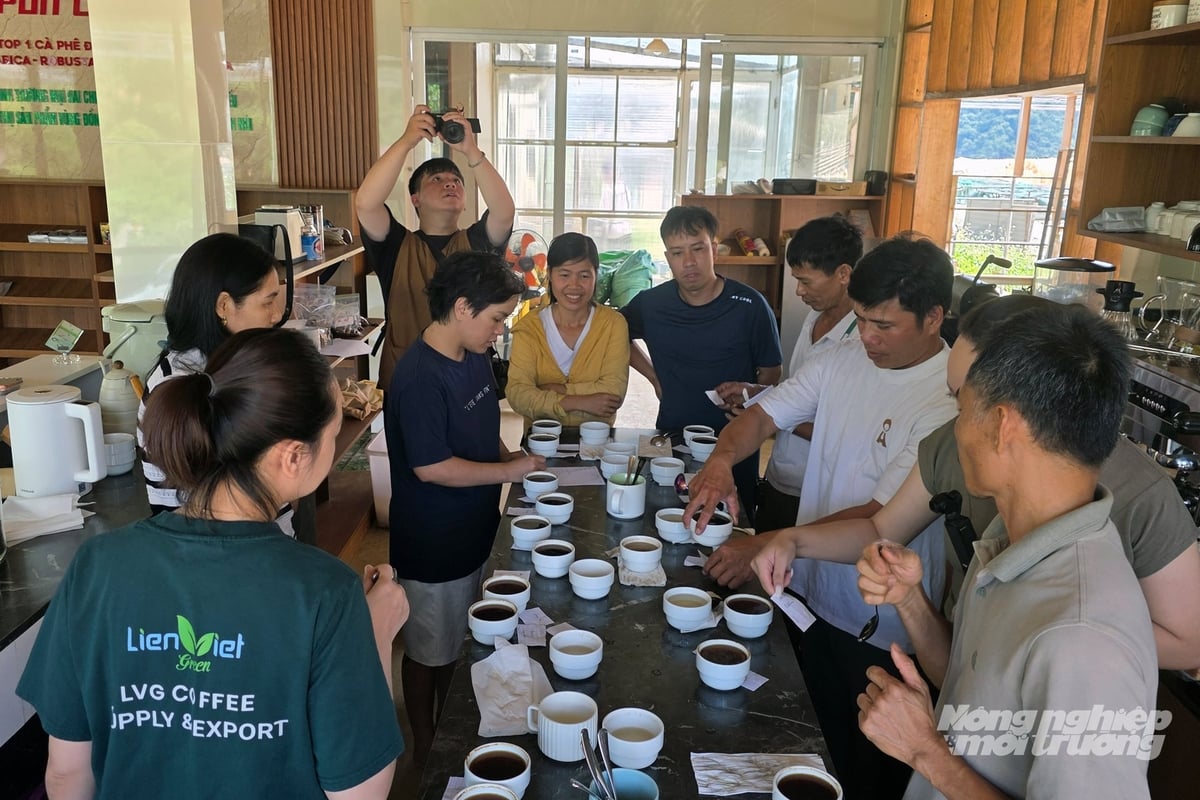
Many enterprises from Hanoi have come to Huong Phung commune to assess the quality of coffee grown under forest canopy. Photo: Vo Dung.
In addition, during its implementation period, the project is expected to produce, process in depth, and export 1,000 tons of high-quality Arabica green coffee. These are practical goals that help coffee growers gradually improve their livelihoods, while enabling Quang Tri’s coffee sector to achieve sustainable growth targets in the future.
"Farmers have realized that growing coffee under forest canopy brings very high efficiency and stable yields year after year. They are becoming increasingly aware of the importance of developing shade-tree cultivation," said Mr. Pham Song Toan, leader of the But Viet Coffee Group in Huong Phung commune.
Programs and projects have contributed to promoting economic development alongside the conservation, management, and restoration of natural forests. Coffee growers have gradually changed both their awareness and farming practices. This is a key factor in helping coffee from Huong Phung, Khe Sanh, and Tan Lap communes in Quang Tri province maintain its specialty brand, enabling deeper integration into international markets.
$ 1 = VND 26,462 - Source: Vietcombank.
Translated by Kieu Chi

(VAN) Two Da Nang cooperatives were honored with the ‘Cooperative Star’ award for 2026, affirming the effectiveness of a dynamic, adaptable, and sustainably developing collective economic model.

(VAN) Policy credit has empowered many households in Hoa Vang commune to boldly invest in production, build effective economic models, and boost their income.

(VAN) Recently, the Lao Ministry of Agriculture and Environment delegation visited, worked, and signed a pact with the Vietnam Academy of Agricultural Sciences.

(VAN) Da Nang steps up free rabies vaccination in mountainous communes, delivering vaccines directly to villages to build an immunity shield.

(VAN) Native honeybee farming in Ha Tinh grew strongly, providing stable incomes and promoting sustainable rural economic development.
/2026/07/20/3847-3-113606_381.jpg)
(VAN) The global spread of the SAT-1 FMD virus strain underscores the need for Viet Nam to proactively enhance surveillance and develop response scenarios well in advance.

(VAN) Agricultural by-products are being recognized as resources that can generate new economic value, reduce emissions, and create new opportunities for green growth in circular agriculture.
