May 30, 2026 | 17:12 GMT +7
Hotline: 0913.378.918

May 30, 2026 | 17:12 GMT +7
Hotline: 0913.378.918
The meeting, held on August 10 in Incheon under the chairmanship of Song Mi Ryung, South Korea’s Minister of Agriculture, Food and Rural Affairs, carried the theme “Building a Sustainable Future: Connect, Innovate, Prosper”. Representing Vietnam, Acting Minister of Agriculture and Environment Tran Duc Thang delivered a keynote address titled “Vietnam’s policies to promote innovation in the agriculture - food system and challenges to be addressed for sharing best practices and achieving common prosperity in the region”.
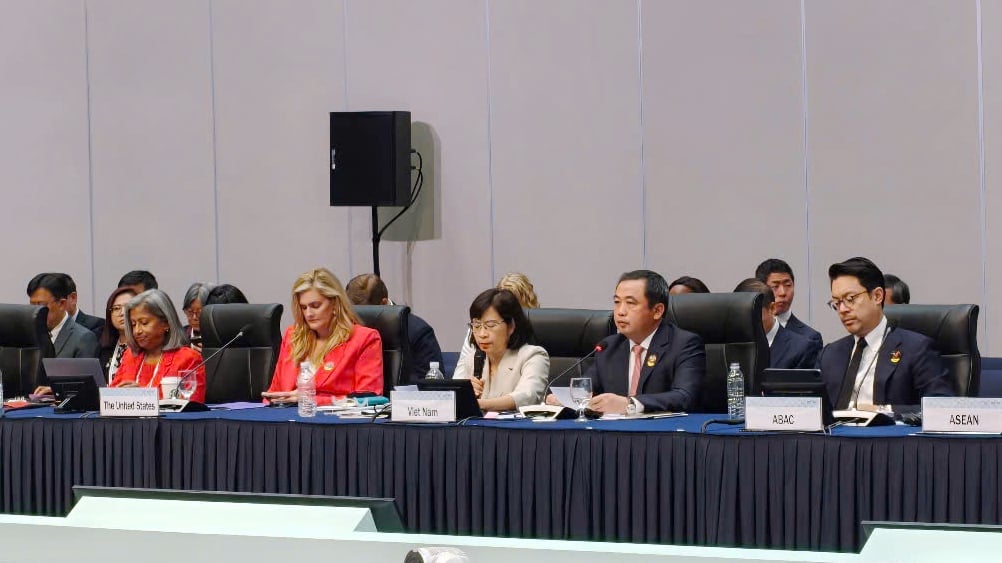
Acting Minister Tran Duc Thang delivers a speech at the APEC Food Security Ministers' Meeting. Photo: Thanh Nguyen.
Thang underscored that food security is central not only to the prosperity of APEC economies but also to global stability. For an agricultural country like Vietnam, where over 60% of the population lives in rural areas, ensuring food security means not just meeting quantity but also enhancing quality and food safety, contributing to social stability, poverty reduction, sustainable development, and maintaining a strong export position. He said Vietnam considers innovation the cornerstone of modernizing agriculture and securing food for its 100 million citizens.
Three flagship policies are underway: a National Action Plan to transform the food system toward “smart production, fair distribution, and healthy consumption”; a one-million-hectare program for high-quality, low-emission rice to boost exports and meet emission-reduction commitments; and the OCOP program to help remote farmers access global markets through e-commerce, increasing incomes while preserving local cultural values.
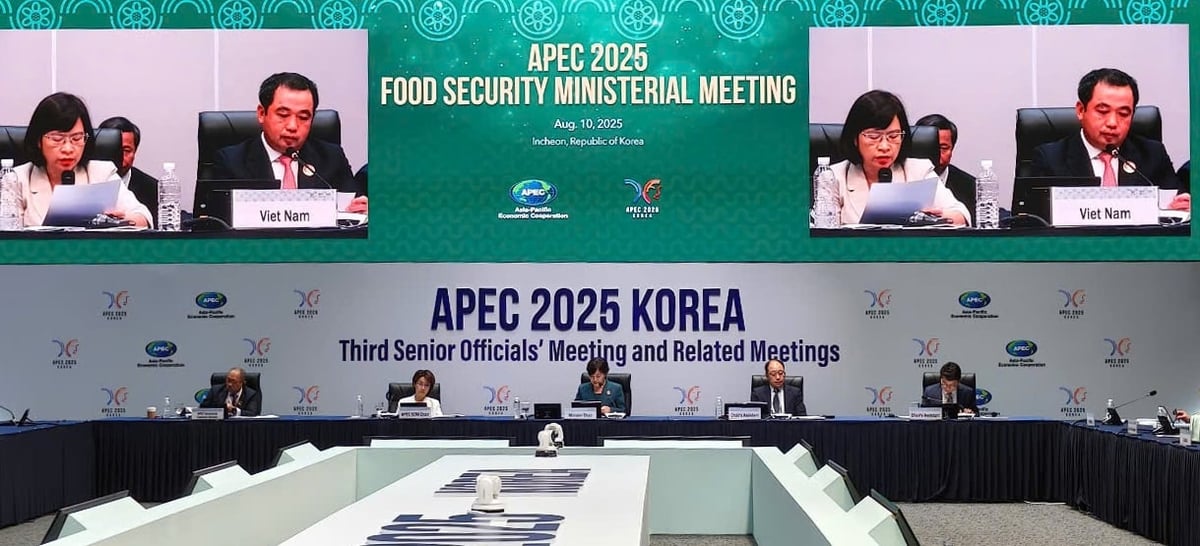
Ms. Song Mi Ryung, Minister of Agriculture, Food and Rural Affairs of the Republic of Korea (sitting in the middle) chaired the Conference. Photo: Thanh Nguyen.
Looking at the broader regional picture, Thang noted that with nearly three billion people and many economies reliant on agriculture, APEC plays a vital role in fostering technical cooperation, agricultural trade, and a green, sustainable, and inclusive food system.
However, he cautioned against persistent cross-border challenges: disparities in technology and innovation capacity, lack of shared data and common standards, trade barriers and new food safety requirements, and differing definitions of “green” and “clean” food that could hinder trade.
To address these, Vietnam proposed establishing an “APEC innovation hub for agricultural and food system transformation” in a developing member economy to share technologies, innovation models, and best practices; developing a common set of criteria for sustainable food and innovation within APEC to promote transparent and seamless agricultural trade; creating a fund to support farmers in adopting innovations, ensuring equitable access to technology; and strengthening academic exchanges, agricultural internships, and institutional reforms among member economies.
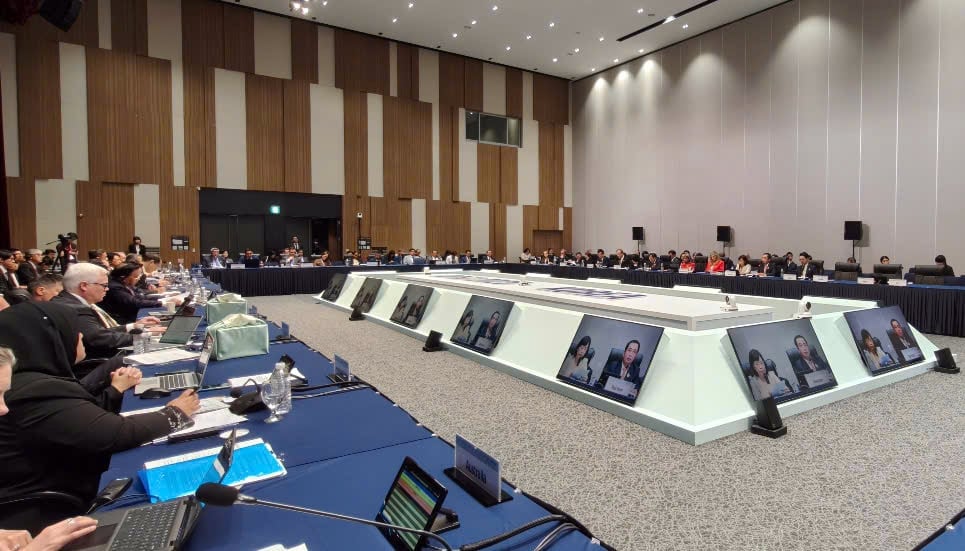
Overview of the Conference on the morning of August 10. Photo: Thanh Nguyen.
Quoting the late South Korean President Kim Dae-jung: “History does not belong to the strong, but to those who innovate at the right time”, Thang called on APEC economies to ignite the flame of innovation so that every farmer, every product, and every meal embodies creativity, harmony with nature, and shared prosperity.
During a session dedicated to advancing agricultural and food innovation through AI, Vietnam emphasized that AI is a key driver in transforming food systems and safeguarding food security amid global uncertainties.
Thang praised South Korea’s initiative, which placed AI at the center of agricultural innovation, noting that the global food system is under unprecedented pressure from climate change, land degradation, population growth, and widening inequality. In this context, AI is not just a technology but a tool to reshape the entire value chain, from farming and processing to distribution and consumption.
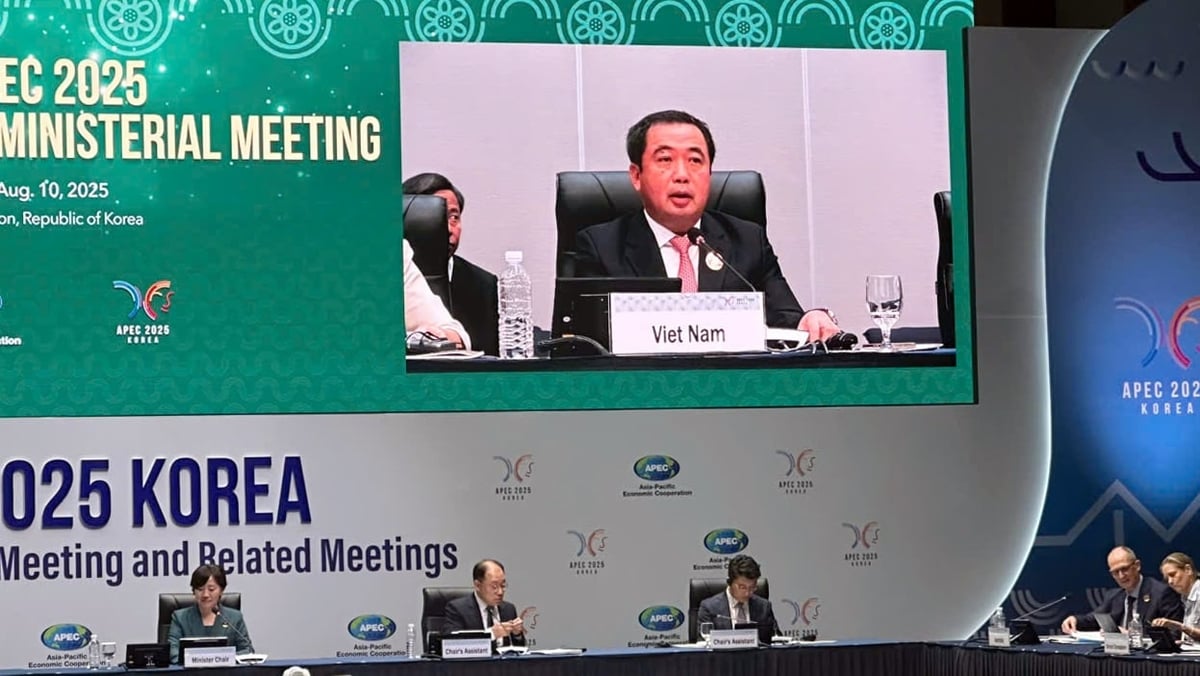
The conference listened to a Vietnamese representative speak on promoting innovation in the agri-food system for shared prosperity. Photo: Thanh Nguyen.
Vietnam recommended building an open, shared database that links climate, production, disease, and market information among member economies via the APEC platform; issuing guidelines for the use of AI in agriculture within APEC, balancing data security and privacy with the need to encourage innovation; and expanding connections between start-ups, enterprises, and innovation centers, with Vietnam ready to work with the Policy Partnership on Food Security to host an “APEC AI Innovation Forum on Food and Agriculture” in Hanoi in 2026.
“Innovation is the guiding light, but for that light to spread, we need data connectivity, technology sharing, and trust among economies”, Thang said, citing a Korean proverb: “It takes many hands for a good harvest”, He concluded that each APEC economy is one of those hands, working together to sow the seeds of AI, nurture innovation, and reap shared prosperity for over three billion people in the region, contributing to global well-being.
Translated by Linh Linh

(VAN) Having technology strength, Finland commits to supporting Viet Nam in implementing projects to modernize monitoring systems.

(VAN) On May 28, a signing ceremony for a coordination mechanism among the VNFOREST, the Department of National Remote Sensing, and the Viet Nam Meteorological and Hydrological Administration was held at the MAE headquarters.

(VAN) Phu Quoc National Park has officially announced two more plant clusters and 14 ancient trees recognized as Vietnam Heritage Trees.

(VAN) This marks the first time the world has established a unified government-level coordination mechanism to strongly promote agricultural cooperation among countries in the Global South.
![Wildlife conservation: [2] Revival in the heart of great forest](https://t.ex-cdn.com/nongnghiepmoitruong.vn/608w/files/content/2026/05/28/z7863744807617_20c0b12d359eb615fcf31095e7ab7d8e-152024_872-101225.jpg)
(VAN) Kon Ka Kinh National Park is also a place that helps revive wildlife that had once been hunted and kept in captivity.

(VAN) On May 28, Deputy Minister Vo Van Hung held a working meeting with Mr. Jonathan Choi, Chairman of Sun Wah.

(VAN) Fish are dying en masse, and shrimp ponds are turning red as extreme heat severely impacts aquaculture households in Phu Tho.
