December 6, 2025 | 01:31 GMT +7
Hotline: 0913.378.918

December 6, 2025 | 01:31 GMT +7
Hotline: 0913.378.918
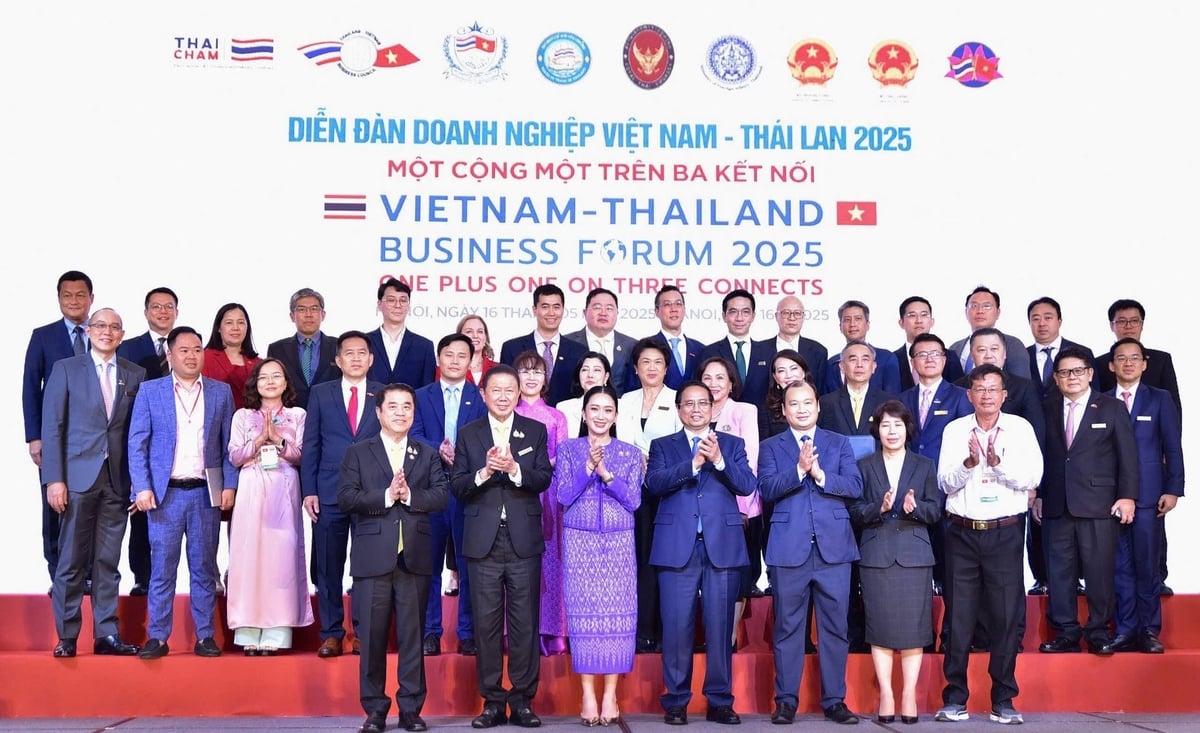
On the afternoon of May 16th, the Vietnam - Thailand Business Forum 2025, themed "One plus one on three connects," took place in Hanoi as part of the state visit of Thai Prime Minister Paetongtarn Shinawatra. Photo: Kieu Chi.
Speaking at the forum, Prime Minister Pham Minh Chinh affirmed that "The essence of cooperation between the two countries is boundless, for the peace, happiness, and prosperity of both nations." The Vietnamese PM emphasized that we are facing global challenges: pandemics, climate change, energy crises, food shortages, and financial instability. Only unity and genuine cooperation can lead to sustainable development.
PM Chinh highlighted three strategic priorities that Vietnam and Thailand need to pursue in the coming period: stability, development, and creating a sustainable future. Vietnam is currently implementing revolutionary strategies focused on institutional reforms, infrastructure development, and improving the quality of human resources.
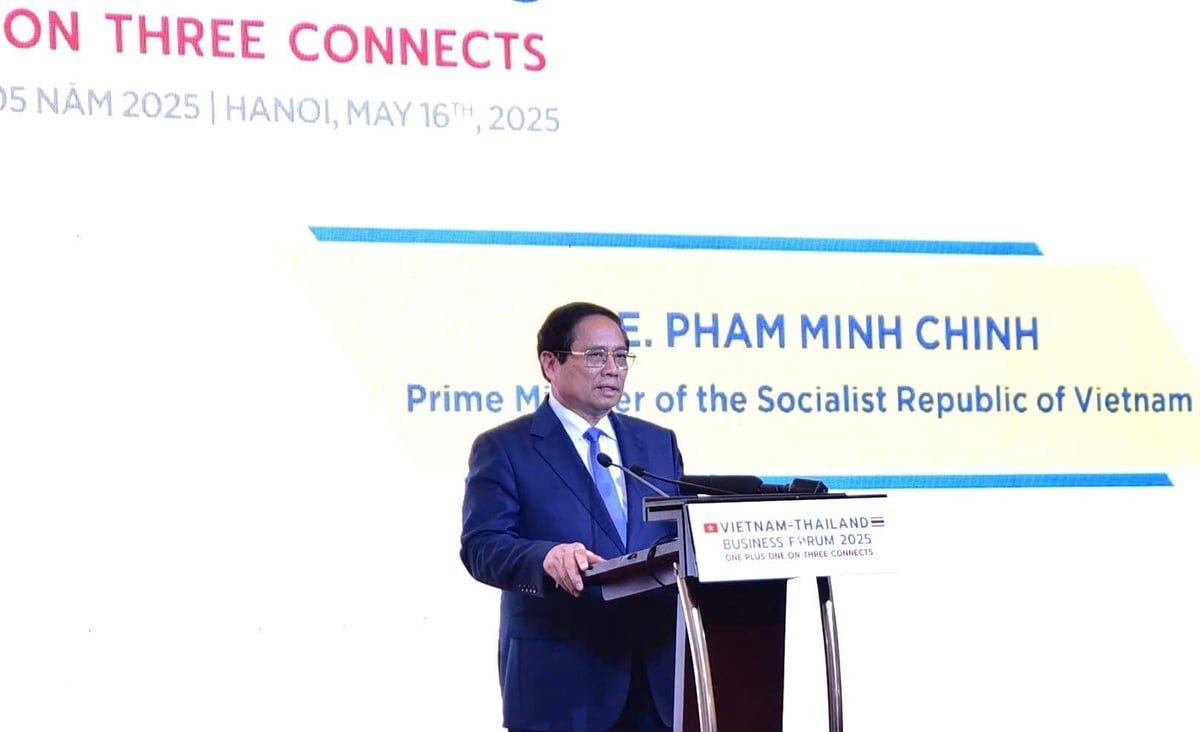
Prime Minister Pham Minh Chinh spoke at the Vietnam - Thailand Business Forum 2025, themed "One plus one on three connects," held on the afternoon of May 16th. Photo: Kieu Chi.
In particular, breakthroughs in infrastructure, including transportation, energy, digital infrastructure, and healthcare, will contribute to enhancing national competitiveness and economic development, while also practically improving the livelihoods of the residents. Developing synchronized infrastructure also helps reduce input costs for products, increase added value, and create concrete, sustainable benefits for both Vietnam and Thailand.
"Vietnam identifies the private economic sector as the most important driver of national economic growth as well as for a deep, substantive, and effective process of international integration," PM Chinh stated.
PM Pham Minh Chinh affirmed that Vietnam will always accompany businesses, listen to and address real difficulties, and create favorable conditions for the Vietnam-Thailand economic relationship to reach new milestones, for the practical benefit of the people in both countries.
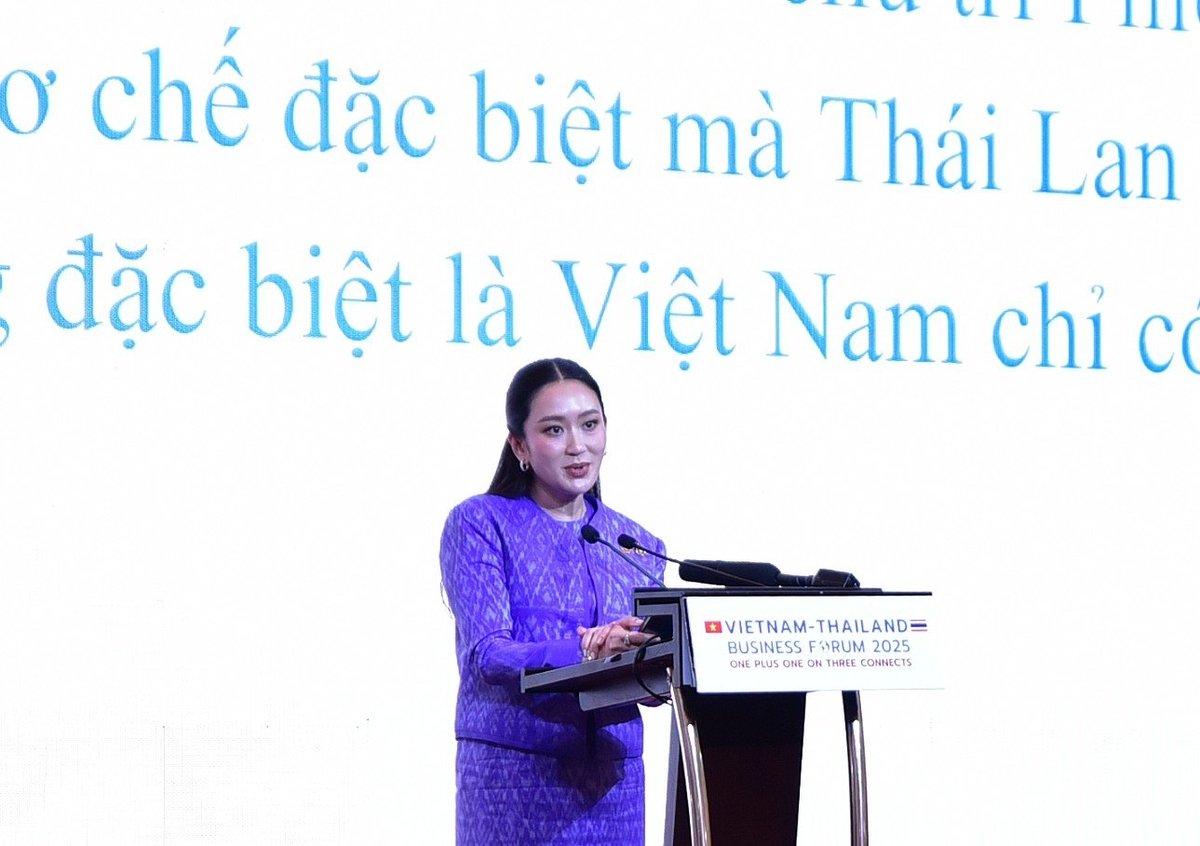
Thai Prime Minister Paetongtarn Shinawatra values the good relationship and sustainable development goals with Vietnam. Photo: Kieu Chi.
Prime Minister Paetongtarn Shinawatra emphasized that Vietnam is a particularly important partner for Thailand within ASEAN. “We agree that our current priority is to promptly promote the connectivity of economic value chains between the two countries, maximizing each nation’s strengths.”
The Thai Prime Minister shared that Thailand is currently the 9th largest foreign investor in Vietnam, with over USD 14 billion in investment capital. Many major corporations, such as SCG, C.P., and B.Grimm Power, have chosen Vietnam as a strategic destination in their plans to expand throughout the Mekong region.
Additionally, the two countries have identified three key areas of connectivity in the supply chain, local economy, and sustainable development. The Thai Prime Minister proposed promoting cooperative projects in electronics, petrochemicals, agricultural processing, artificial intelligence (AI), semiconductors, and high-tech workforce training.
At the local level, 20 partner cities will expand cooperation in tourism and trade. Notably, both sides are considering plans to open more direct flight routes from Northeastern Thailand to Vietnam, boosting tourism, people-to-people exchanges, and cross-border logistics.
Promoting digital agriculture is also extremely important since both Vietnam and Thailand have strong advantages in tropical agriculture. The two countries need to enhance projects on agricultural processing and develop joint ASEAN agricultural brands, aiming not only to meet the market demands of their combined 170 million population but also to serve exports.
The forum also witnessed the signing ceremony of Memorandums of Understanding (MoU) between Vietnamese and Thai businesses, witnessed by Prime Minister Pham Minh Chinh and Prime Minister Paetongtarn Shinawatra. These MoUs open pathways for strategic cooperation in key sectors such as aviation collaboration, financial technology, and high-tech workforce training.
Vietnam and Thailand have formally elevated their relationship to a comprehensive strategic partnership, announced Prime Ministers Pham Minh Chinh and Paetongtarn Shinawatra during a joint press conference in Hanoi on the same day (May 16). After the 4th Vietnam-Thailand Joint Cabinet Retreat, PM Chinh told reporters that the meeting was successful, highlighting that both parties agreed on numerous important strategic directions.
In 2024, the bilateral trade turnover reached USD 21 billion. Thailand expects to increase this figure to USD 25 billion in the near future by expanding cooperation in high value-added sectors such as technology, renewable energy, logistics services, and smart farming. Currently, over 50% of the bilateral trade turnover consists of producing and exporting raw materials and components for production, demonstrating the increasingly deep integration within the regional supply chain.
Translated by Kieu Chi

(VAN) As of 2025, the ASEAN region has a total of 69 ASEAN Heritage Parks recognized across its 10 member states. Among them, Viet Nam contributes 15 ASEAN Heritage Parks.

(VAN) Yok Don National Park has high biodiversity with numerous endemic plant and animal species, and it is also the only dipterocarp forest ecosystem conservation area in Viet Nam.

(VAN) Viet Nam and Brunei signed two important MOUs on fisheries and IUU, expanding cooperation in agriculture, the environment, and Halal exports, aiming to substantively implement joint projects.

(VAN) The Viet Nam Coconut Association worked with the International Finance Corporation (IFC) and businesses to promote the supply chain, enhance competitiveness, and develop the coconut industry sustainably.
![Hue aims for Net Zero: [2] Pioneering low-emission tourism](https://t.ex-cdn.com/nongnghiepmoitruong.vn/608w/files/huytd/2025/12/04/0633-dulichzero-4-095634_236-161125.jpg)
(VAN) The ancient capital of Hue has developed Net Zero tourism products and models, aiming to reduce carbon emissions and pioneer the establishment of Viet Nam's green tourism destination.

(VAN) C.P. Viet Nam has announced the successful completion of its goal to plant 1.5 million trees during the 2021-2025 period, a key milestone within company's long-term ESG strategy and its roadmap for emission reduction.

(VAN) This is an initiative of MAE aimed at creating a unified coordination mechanism to implement agricultural cooperation programs with developing countries.
