June 5, 2026 | 07:29 GMT +7
Hotline: 0913.378.918

June 5, 2026 | 07:29 GMT +7
Hotline: 0913.378.918
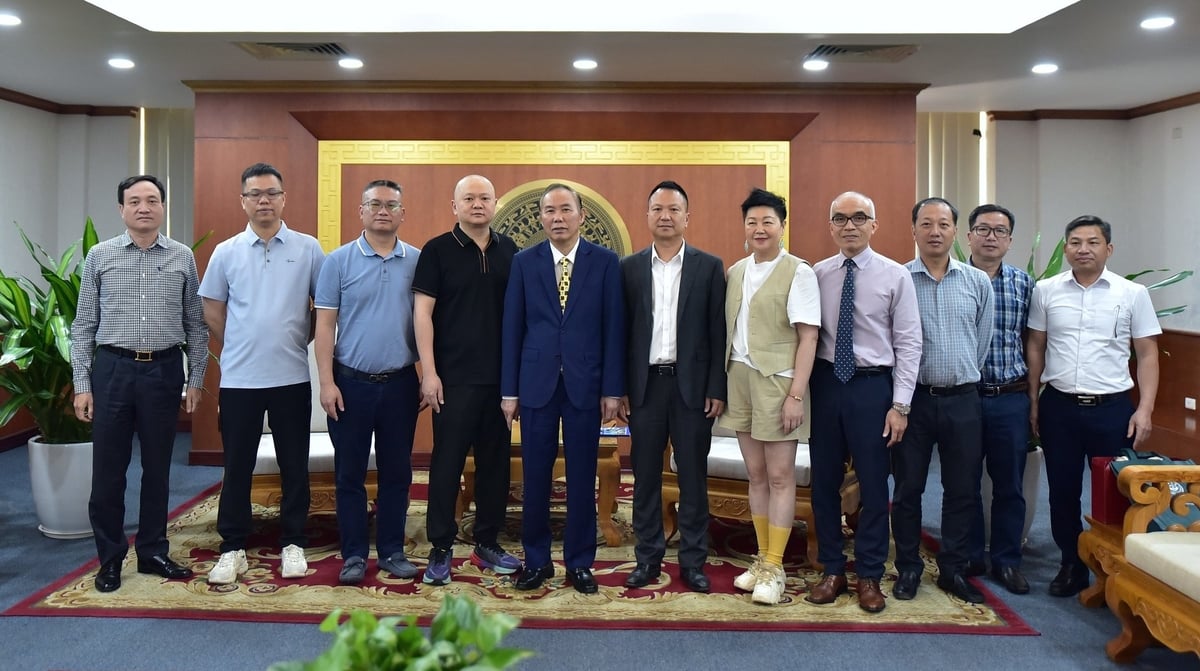
A delegation from the Department of Industry and Information Technology and Sun Yat-sen University (China) visited and worked at the Ministry of Agriculture and Environment. Photo: Kieu Chi.
On May 12, Deputy Minister of Agriculture and Environment Phung Duc Tien received Mr. Mo Shenfan, CEO of BSV Group (China), Ms. Zhang Mengying, General Director of Guangdong Yikang Group, and their delegation.
During the meeting, the two sides exchanged views on issues related to strengthening trade and the development of agricultural products and health care products between Vietnam and China.
In the discussion, Deputy Minister Phung Duc Tien and representatives from the Ministry introduced the delegation to Vietnam's emerging agricultural products such as rice, Bac Giang lychee, and chili. The Deputy Minister noted that Vietnam continues to strengthen its quality control of agricultural products and actively promotes faster customs clearance, expressing hope for increased trade in these new items.
In April, during the official visit of General Secretary and President of China Xi Jinping to Vietnam, the Ministry of Agriculture and Environment signed protocols on the export of chili, passion fruit, bird nest, and rice bran to China, along with agreements on environmental protection and geoscience cooperation.
The Deputy Minister also emphasized that the opening of the Vietnam - China Smart Border Gate will unlock significant potential for durian exports.
In response, Mr. Mo Shenfan highlighted that trade volumes between his company and Vietnam have consistently reached record highs in recent years. He also briefed Deputy Minister Phung Duc Tien on the current status of imports and future development directions for Vietnamese agricultural products such as durian, coconut, pomelo, giant freshwater prawn, spotted babylon snail, bird’s nest, and sliced cassava.

The Chinese side expressed that Vietnamese agricultural products are of high quality and are well-liked by a wide range of consumers. Photo: Kieu Chi.
Chinese enterprises have consistently shown interest in and actively promoted Vietnam’s bird’s nest and durian products. Durian has become especially popular among Chinese consumers due to its high quality and alignment with market preferences.
China wishes to import Vietnamese agricultural products in large quantities, recognizing their good quality and strong market reception.
To date, 16 types of Vietnamese fruits and vegetables have been exported to China via official channels, including 10 items with signed export protocols: watermelon, mangosteen, black jelly, durian, frozen durian, fresh coconut, fresh banana, sweet potato, chili, and passion fruit. Six export items have not yet been formalized through export protocols: dragon fruit, rambutan, mango, lychee, longan, and jackfruit.
The visiting delegation expressed their agreement and sincere appreciation for Vietnam's efforts to optimize the trade environment and facilitate the export of Vietnamese agricultural goods to China.
Regarding shared concerns such as bird’s nest purchase prices, market share of new agricultural products, and product inspections, both sides affirmed that they would report existing issues related to the inspection and customs clearance of Vietnamese agricultural products through their respective channels. The delegation also stated they would represent Chinese businesses in reporting to the relevant authorities in China.
According to statistics from the Vietnam Department of Customs, in the first two months of 2025, the total import-export turnover of agricultural, forestry, and fishery products between Vietnam and China was estimated at USD 2.42 billion, an increase of 5.2% compared to the same period in 2024. China is Vietnam’s largest export market.
Of this amount, Vietnam’s exports of agricultural, forestry, and fishery products to the Chinese market were estimated at USD 1.67 billion, a decrease of 4.3% compared to the same period in 2024. Meanwhile, imports from China were estimated at USD 755.3 million, marking a 36% increase year-on-year.
The two countries have signed 24 memoranda of understanding and protocols on the import-export of agricultural, forestry and fishery products. The signed protocols include:
The Protocol on Phytosanitary Requirements for Chili Peppers Exported from Vietnam to China;
The Protocol on Phytosanitary Requirements for Passion Fruit Exported from Vietnam to China;
The Protocol on Safety and Animal and Plant Quarantine Requirements for Rice Bran and Defatted Rice Bran Used as Animal Feed Ingredients Exported from Vietnam to China;
The Protocol on Quarantine, Inspection, and Veterinary Hygiene Requirements for Raw and Cleaned Bird’s Nests Exported from Vietnam to China.
Translated by Kieu Chi

(VAN) The 93rd General Session of the World Assembly of Delegates of the World Organisation for Animal Health (WOAH) highlighted the importance of investing in animal welfare, biosecurity, and food security.

(VAN) Experts consider AI and IoT-driven digital transformation as the key to building green, climate-resilient, and sustainable agriculture.

(VAN) A series of national-level events in Cua Lo is spreading a message on environmental protection, promoting a sustainable marine economy, and inspiring shared responsibilities across society toward a green, clean, beautiful Viet Nam.

(VAN) MAE Minister meets with WWF-US leadership to promote cooperation in nature conservation, biodiversity conservation, and climate change response.

(VAN) During four-year tenure, Ambassador Nicolai Prytz bridged bilateral cooperation, promoted dialogue and green cooperation implementation between two countries.

(VAN) Can Tho city has officially kicked off the technical assistance component of the Climate-Resilient Green Urban Development Project in Nga Bay.

(VAN) An estimated 25,000 people in Vietnam, Laos, Indonesia and the Philippines will join the 'Act for a Green Planet' campaign to mark World Environment Day.
