May 22, 2026 | 05:50 GMT +7
Hotline: 0913.378.918

May 22, 2026 | 05:50 GMT +7
Hotline: 0913.378.918
On August 11–12, Mr Erik Guttulsröd, Deputy Managing Director of the DLG Competence Center Agriculture and Head of Farm Management and Sustainability, visited Hanoi, Vietnam to discuss concept of a Mekong Delta mechanization center. He met with technical experts from International Cooperation Department (ICD), National Agricultural Extension Center (NAEC), and Department of Cooperatives and Rural Development (DCRD).
Guttulsröd supports the development of the Mekong Delta mechanization center in Can Tho City on behalf of DLG. With a shared vision and mutual understanding that centralizes farmers' benefits, he hopes the collaboration will grow to become a strategic partnership, contributing to Germany–Vietnam agricultural cooperation.
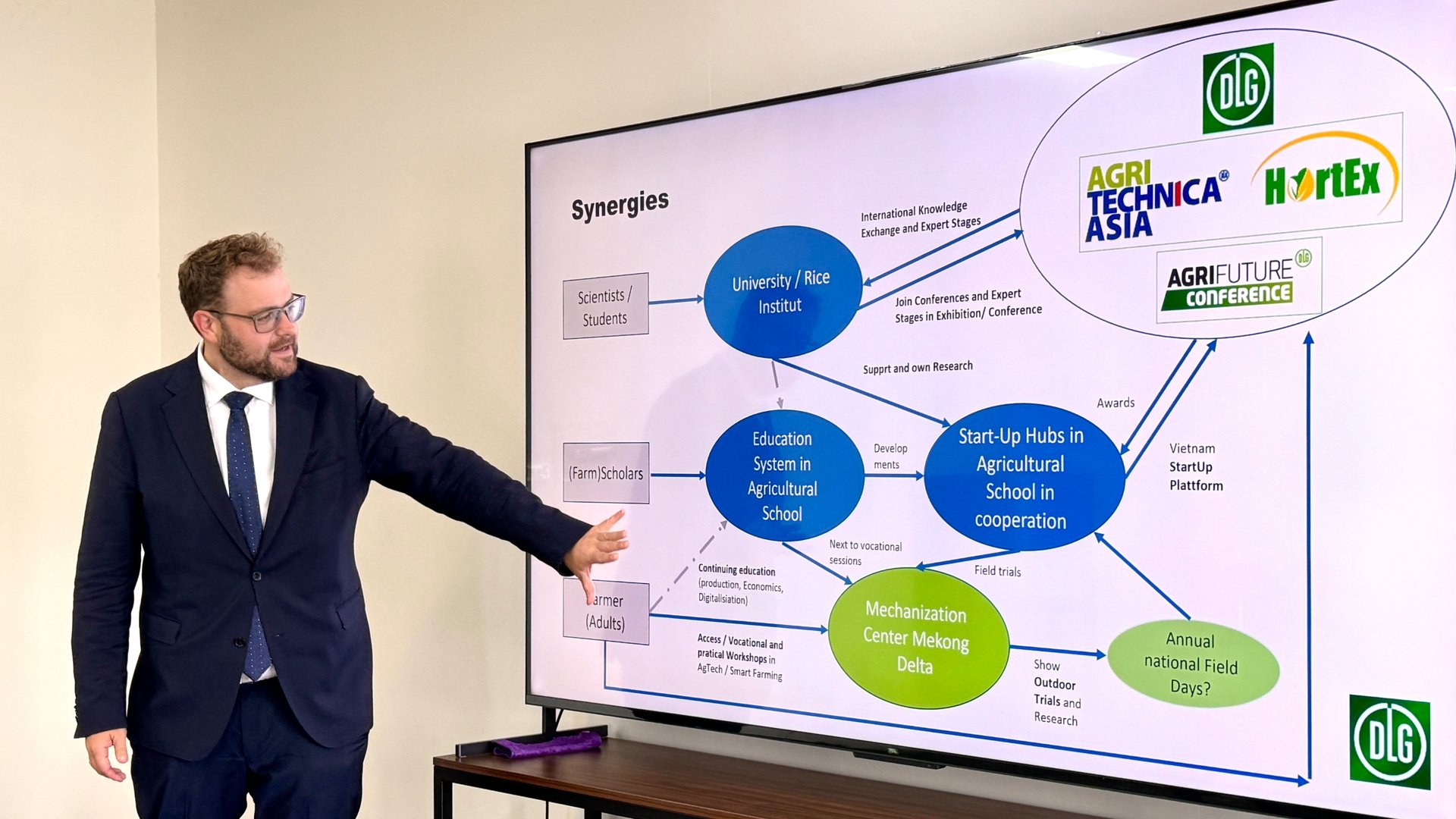
Mr. Erik Guttulsröd presenting the proposed operating model of the Mekong Delta Mechanization Center. Photo: QC.
The proposed center in Can Tho City would drive synchronized mechanization in rice, aquaculture, and fruit production, boosting productivity, cutting costs, and improving quality. It would also introduce advanced technologies, transfer techniques adapted to local conditions, and train farmers, cooperatives, and students to become mechanization specialists.
The long-term vision includes promoting sustainable agriculture through precision farming, smart technologies, and climate change adaptation. Acting as a bridge between machinery manufacturers and local producers, the center aims to expand mechanization services across the Mekong Delta.
As part of ongoing cooperation between DLG and MAE, Guttulsröd provided consultation on the center’s organizational framework and operations.
During an afternoon meeting on August 12 with Mr Le Quoc Thanh, NAEC's Director General, Guttulsröd praised the entrepreneurial and cooperative spirit of Vietnamese farmers. He recalled his earlier survey trip in March 2025 to the Cuu Long Rice Research Institute and the Southern College of Electrical Engineering and Agriculture, which left him with a strong impression of the region’s potential.
With experience operating training schools around the world, Mr. Erik proposed that Vietnam aim for three levels of participation: scientist, farm scholar, and farmers/cooperatives. The center is positioned as a place to meet the needs of farmers, including the middle-aged group from 45 to 65 years old, through an ecosystem associated with agricultural vocational training education system.
This model will link with start-up hubs in the agricultural sector to build a long-term training roadmap for agricultural scholars and open long-term courses for older farmers who need to improve their skills.
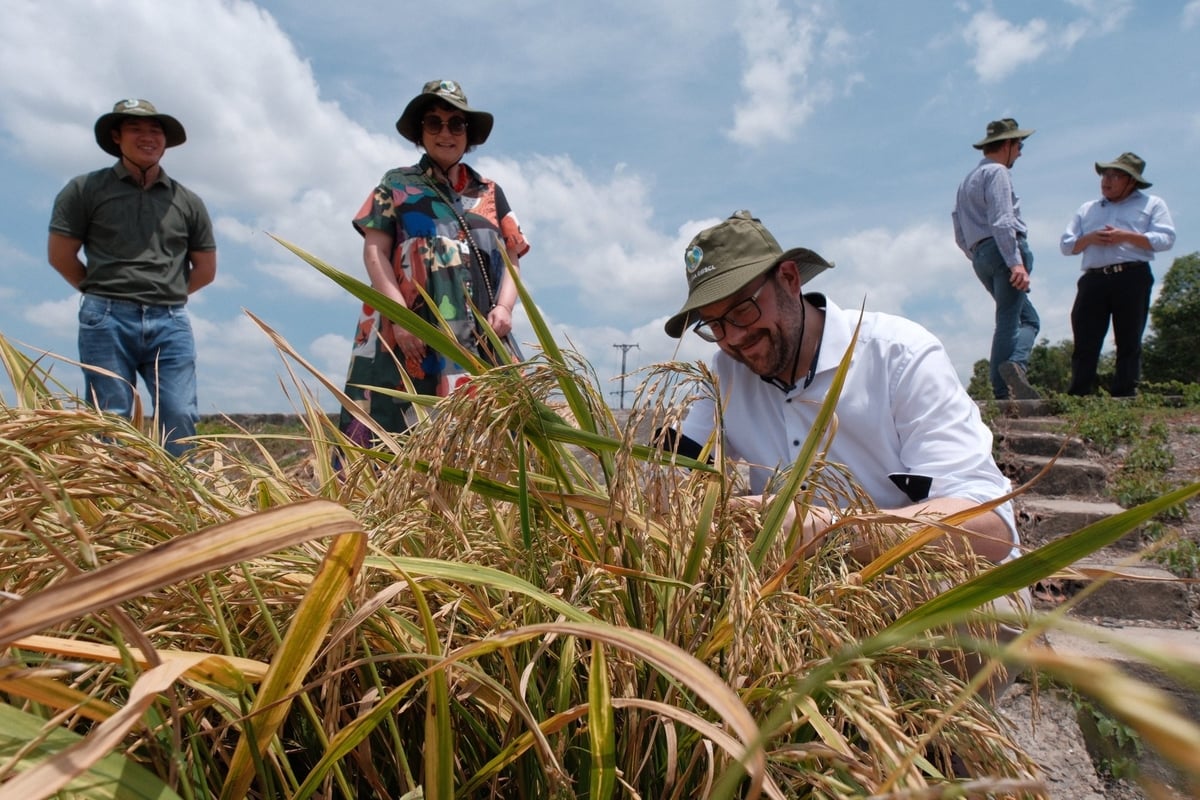
Mr Erik Guttulsröd and senior DLG officials explored opportunities for cooperation in developing agricultural mechanization in the Mekong Delta region in March 2025. Photo: QC.
In terms of infrastructure, he proposes that the center include an indoor vocational training area for students to learn theory and grasp technology. In addition, there should be an outdoor demonstration area where students and farmers can directly operate equipment in the field, creating conditions for learning linked to practical production.
Notably, with a network of more than 31,000 members worldwide and prestigious agricultural technology exhibitions, DLG can create a bridge to help Vietnam access advanced technology and new production trends faster.
Responding to the proposal, Mr. Le Quoc Thanh commended DLG’s proactive and collaborative approach, affirming that the Ministry of Agriculture and Environment’s technical units would review the ideas in detail and report them to the ministry leadership.
Mr Thanh emphasized that the center’s vision not only aligns with Vietnam’s needs but also broadens them, becoming a multi-functional hub that introduces input technologies, provides operational training, and supports their application in real-world production.
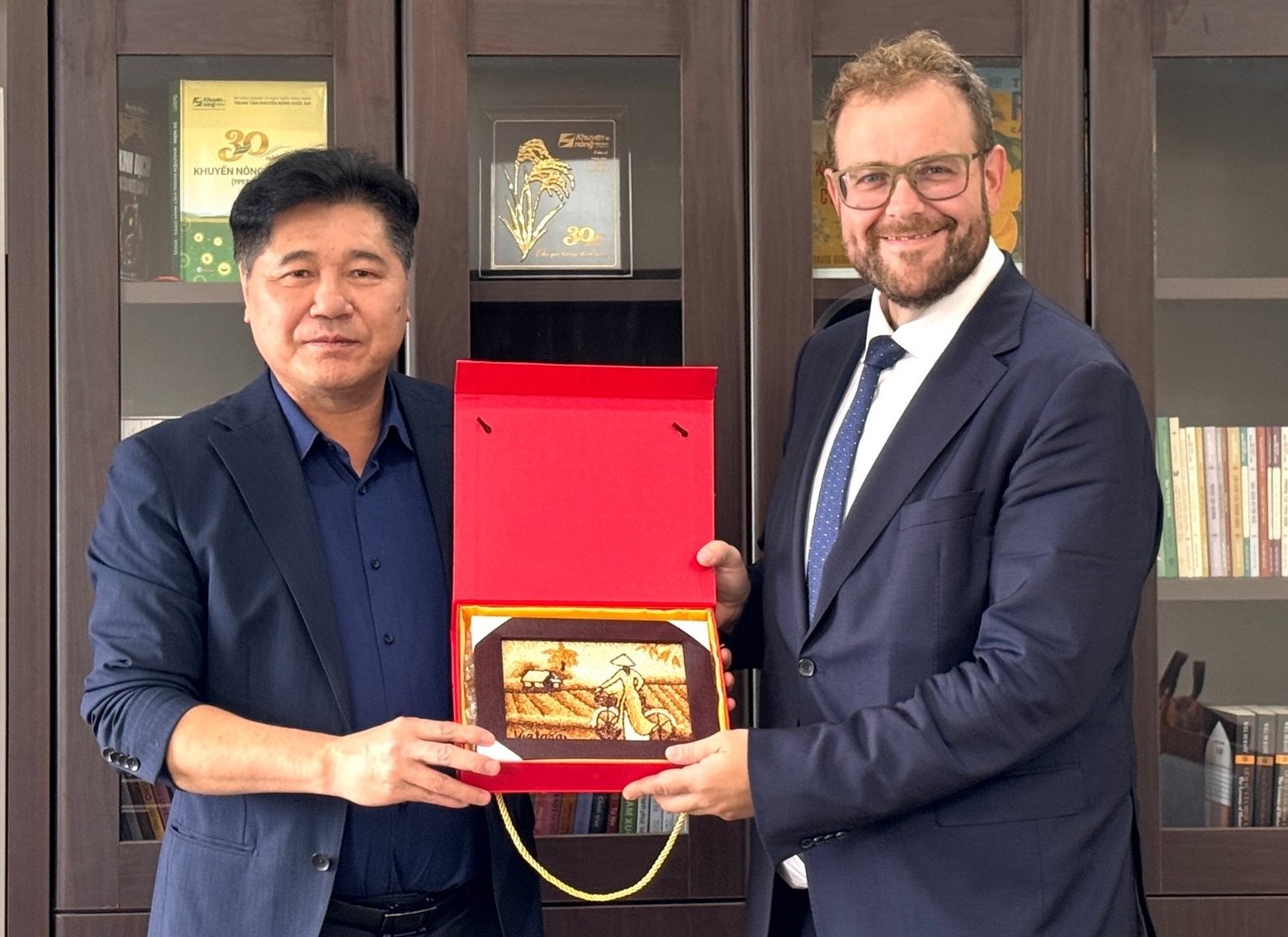
NAEC's Director General Le Quoc Thanh took a photo with DLG's Erik Guttulsröd. Photo: QC.
“In a context where much of the current mechanization workforce remains untrained, the center will be a strategic solution for upgrading human resources,” Mr. Thanh noted. “It will foster a dynamic start-up ecosystem to attract and retain young talent – the next generation of innovation – ensuring sustainable agricultural development in the Mekong Delta for decades to come.”
With the positive progress so far, the Ministry and DLG will continue to work closely together and identify solutions for expanding mechanization adoption and improving production efficiency across the region.
The German Agricultural Society (DLG) was established in 1885 by Max Eyth, an engineer, with the initial goal of testing agricultural machinery and products for farmers. Over time, it evolved into a globally recognized organization, uniting experts in agricultural mechanization, food science, and food technology.
DLG's primary function is to promote technical and scientific progress in the agricultural and food industries through various means, including knowledge transfer and trade exhibition.

(VAN) Viet Nam and Australia are moving to expand agricultural market access, deepen trade cooperation, and strengthen collaboration on climate change and food safety.

(VAN) The photograph 'Plastic Recycling' delivers a powerful environmental message and received an Honorable Mention at the Photography 4 Humanity 2025 competition organized by the United Nations.

(VAN) The MAE has launched a series of activities in response to World Environment Day and Viet Nam's Sea and Islands Week 2026.
/2026/05/20/1329-4-230647_205.jpg)
(VAN) On May 20, Deputy Minister Hoang Trung led a delegation from the Ministry of Agriculture and Environment on a field survey of agricultural production areas in Lao Cai province.

(VAN) A vast, uniform rice field, its stalks bent heavy with grain and blushing the color of young ginger, filled the air with the fragrance of fresh rice, drawing admiring gasps from hundreds of attendees.

(VAN) By strictly maintaining its functional zoning areas, the protected area aims to ensure a safe breeding environment for rare sea turtle populations.

(VAN) Disasters are growing more extreme and harder to predict. Quang Tri province has responded by taking early, proactive steps to prepare.
