June 1, 2026 | 11:08 GMT +7
Hotline: 0913.378.918

June 1, 2026 | 11:08 GMT +7
Hotline: 0913.378.918
According to data from the General Department of Customs, Viet Nam exported approximately 5,700 tonnes of meat and meat products in the first four months of 2026, generating export turnover of 40.8 million USD. Compared to the same period in 2025, export volume declined 20.8 percent, while export value rose 2.9 percent, a noteworthy divergence indicating that average export prices have trended upward, partially offsetting the decline in shipment volumes.
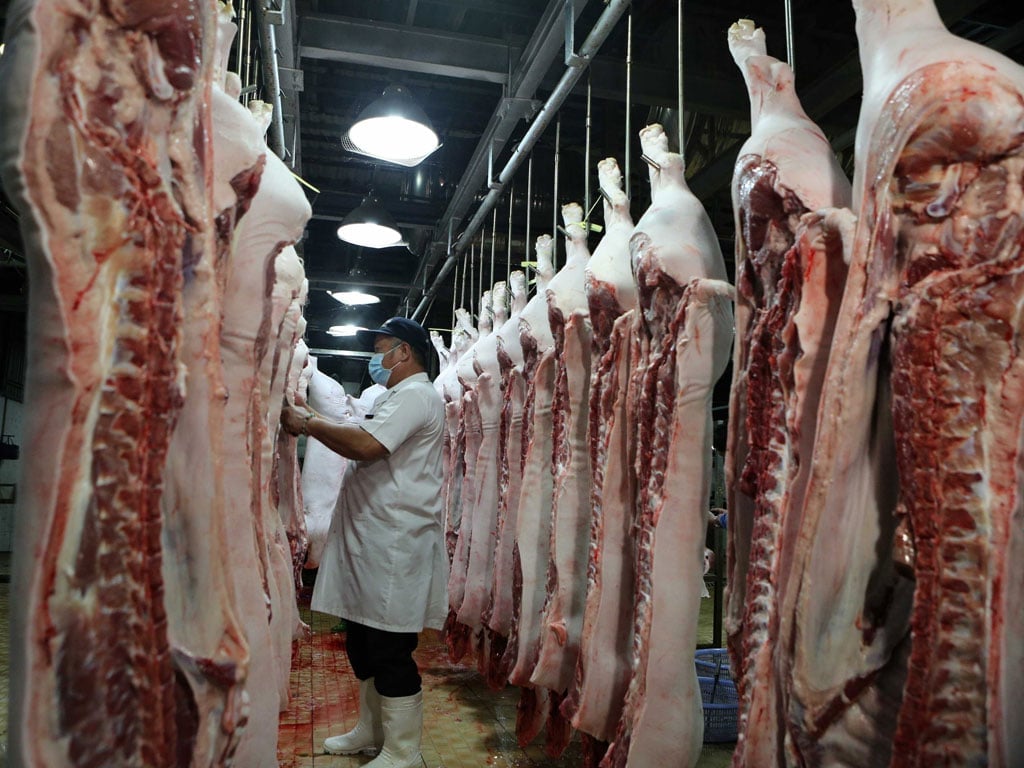
Vietnamese meat products have expanded their reach to 25 international markets. Photo: VAN.
Viet Nam's export footprint was maintained across 25 countries and territories. Hong Kong (China) retained its position as the largest market, accounting for 37.25 percent of total export volume and 46.4 percent of total export value. However, shipments to this market fell sharply, reaching only 2,100 tonnes valued at $18.93 million USD, down 41.6 percent in volume and 24.7 percent in value compared to the same period the previous year.
The decline reflects a range of factors, from shifting market demand to intensifying competition from other supply sources. Nonetheless, Hong Kong remains the anchor destination for Vietnamese meat exports, particularly for traditional products such as whole frozen suckling pigs and whole frozen pork.
Beyond Hong Kong, exports to several other markets including Canada, Malaysia, South Korea, Spain, and Lebanon also recorded declining trends. Conversely, a number of markets posted positive growth, notably China, France, Singapore, the United States, and Cambodia, signaling an ongoing market shift that is opening new diversification opportunities for Viet Nam's livestock and meat processing sectors.
In terms of product structure, pork remains the dominant export category. During the first four months of the year, fresh, chilled, or frozen pork accounted for 40.29 percent of total export volume and 50.24 percent of total export value. However, this category also recorded a substantial decline, reaching only 2,300 tonnes valued at $20.5 million USD, down 24.6 percent in volume and 12.7 percent in value compared to the same period in 2025.
In sharp contrast to exports, imports of meat and meat products rose strongly in the first four months of 2026. Total import volume reached 313,070 tonnes with a value of $928.83 million USD, up 11.2 percent in volume and a particularly striking 37.6 percent in value compared to the same period in 2025.
India remained Viet Nam's largest meat supplier, accounting for nearly 24 percent of total import volume with 74,400 tonnes valued at $310.11 million USD, representing impressive growth of 31.6 percent in volume and 59.4 percent in value from the same period a year earlier.
Imports from numerous other markets also rose sharply, including the United States, Canada, Spain, Germany, Turkey, and Italy. By contrast, imports from Russia, South Korea, Poland, and Argentina declined.
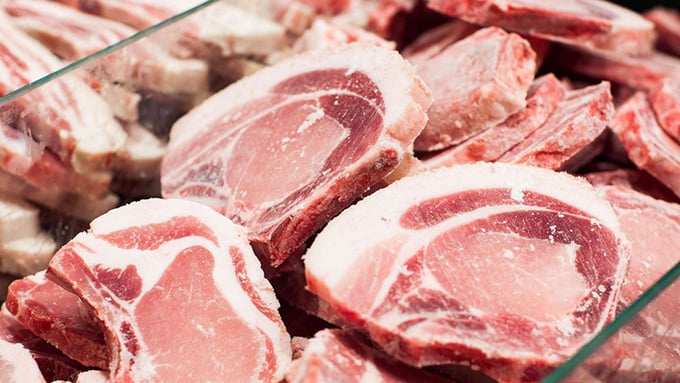
Imports of meat and meat products rose strongly in the first four months of 2026. Photo: VAN.
In terms of import structure, poultry meat and poultry offal accounted for the largest share by volume at 37.27 percent, while frozen buffalo meat dominated by value at 31.9 percent. Imported pork represented 13.77 percent of total import volume and approximately 10 percent of total import value, suggesting that domestic pork supply retains sufficient capacity to meet the majority of local demand.
A notable development is the downward trend in imported pork prices. During the first four months of the year, the average import price for pork stood at just 2,143 USD per tonne, down 19.3 percent from the same period the previous year, a factor contributing to heightened competitiveness of imported meat on the domestic market.
On the domestic front, however, live hog prices have shown signs of recovery. In May 2026, live hog prices rose across all three regions compared to the previous month. In the north, prices ranged from 66,000 to 70,000 dong per kilogram; in the central region and Central Highlands, from 68,000 to 69,000 dong per kilogram; while the south recorded the highest levels, ranging from 69,000 to 71,000 dong per kilogram.
The price recovery suggests that domestic supply may be tightening while consumer demand remains stable. Rising input costs and international market movements are also exerting meaningful influence on domestic price levels.
Viet Nam's meat trade performance in the first four months of 2026 reveals a clear divergence: exports are under volume pressure but have held their value, while imports are rising strongly to meet domestic demand.
Looking ahead, the livestock and meat processing sector must continue to prioritize export market diversification and reduce over-reliance on a handful of traditional destinations. At the same time, improving product quality and developing deep-processed products will be essential to increasing export value per unit.
On the import side, managing import flows carefully, maintaining supply-demand balance, and protecting domestic production are equally pressing challenges that warrant careful consideration. Only by striking the right balance between exports and imports can Viet Nam's meat sector achieve sustainable development amid deepening global integration.
Translated by Linh Linh

(VAN) Vietnamese firms showcased deeply processed farm produce at THAIFEX-Anuga Asia 2026, expanding chances to join the global food supply chain.

(VAN) Following a sharp decline in 2025, Viet Nam’s pepper exports to the United States have rebounded strongly, driving impressive growth in the country’s overall pepper export performance.

(VAN) The Huu Nghi Int'l border gate at Pingxiang stands as China's largest land-based fruit import crossing, widely regarded as the ‘golden channel’ connecting Vietnamese agricultural produce to a market of 1.4 billion consumers.
/2026/05/28/1912-2-175230_122.jpg)
(VAN) The Bac Ninh Provincial People's Committee has pledged to ensure the smoothest administrative procedures, optimize logistics and warehouse infrastructure, and coordinate with Chinese authorities to export Thieu lychees.

(VAN) As China tightens traceability requirements, Viet Nam’s durian industry must shift production practices and strengthen business-farmer linkages.

(VAN) Businesses exporting food products to China are now better supported in navigating registration procedures, as many required documents must be uploaded to the system.
