July 21, 2026 | 16:57 GMT +7
Hotline: 0913.378.918

July 21, 2026 | 16:57 GMT +7
Hotline: 0913.378.918
Dang Tam Dung, head of the Lien Chau Pomelo Production Cooperative Group (Lien Chau commune, Phu Tho province), strolls calmly through the ecological orchard. He can be seen checking the fruit fly traps at one moment, and inspecting newly pruned pomelo branches for future grafting at another.
"To export pomelos to Europe, the fruit must pass tests for 91 active chemical substances. The soil must also be free of chemical residues, and the fruit should have a moderate sweetness of 12-12.5° Brix. In addition, each fruit must have fewer than 10 small blemishes and a bright, flawless appearance, as Europeans dislike insect marks or rust spots. It's almost as demanding as a beauty pageant. Even so, I exported 5,000 fruits in 2024 and another 4,500 in 2025," he said, adding that his cooperative has been granted two growing area codes for domestic sales and export.
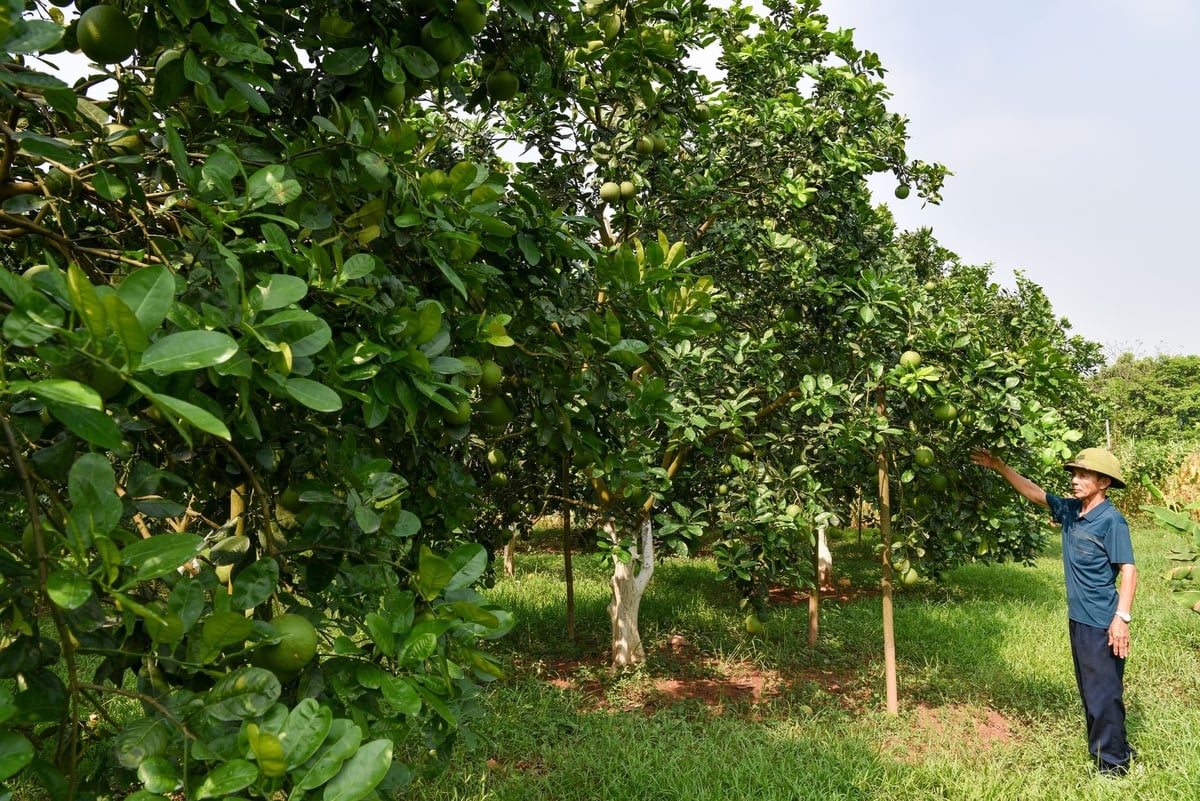
A corner of Dang Tam Dung's orchard. Photo: Duong Dinh Tuong.
After trying various occupations, including trading cattle and raising breeding pigs, Dung decided to switch to fruit cultivation in 2012 because of unstable prices and recurring livestock diseases. He gradually leased and consolidated four hectares of fertile riverside land.
Although the Red River regularly enriches the area with alluvial soil, local farmers traditionally grew vegetables and field crops with relatively low economic returns. After visiting successful orchards both inside and outside the province, he decided to plant pomelos and bananas.
At first, he farmed without much thought, using both manure and chemical fertilizers while applying chemical pesticides whenever he saw fit, regardless of whether pest pressure actually justified spraying. On average, he sprayed pesticides 10-12 times a year, targeting mealybugs, spider mites, fungal diseases, fruit drop, anthracnose, and rust disease at different growth stages.
Each spraying session required not only his own labor but also two hired workers, and took an entire day to empty 12 200-liter drums of spray solution.
At that time, relatively few farmers grew pomelos, and traders cared little about production standards. As long as the fruit was large and tasted good, they readily paid VND 20,000-30,000 per fruit. With annual production reaching 30-40 metric tons, the orchard generated a substantial income.
However, Dung slowly realized that his farming methods were harming not only his own health but also consumers and the surrounding environment. In 2020, he formally applied to convert his orchard to VietGAP standards.
Throughout the transition, he received technical support from the former Vinh Phuc Plant Production and Protection Sub-Department and the provincial Farmers' Union. Under the guidance of agricultural specialists, pesticide applications were reduced by half to just five or six times a year, with spraying carried out only when pest levels required treatment. Technical staff also visited the orchard five or six times annually to monitor compliance with production standards.
After three years of VietGAP production, he decided to take another step by adopting organic farming, believing that although VietGAP products were safe, continued reliance on chemical fertilizers would eventually degrade soil quality.
Under the organic system, he composted livestock manure with microbial inoculants and lime for six to eight months, then combined it with Que Lam organic fertilizers. All of the crop protection products used were 100% biological in origin.
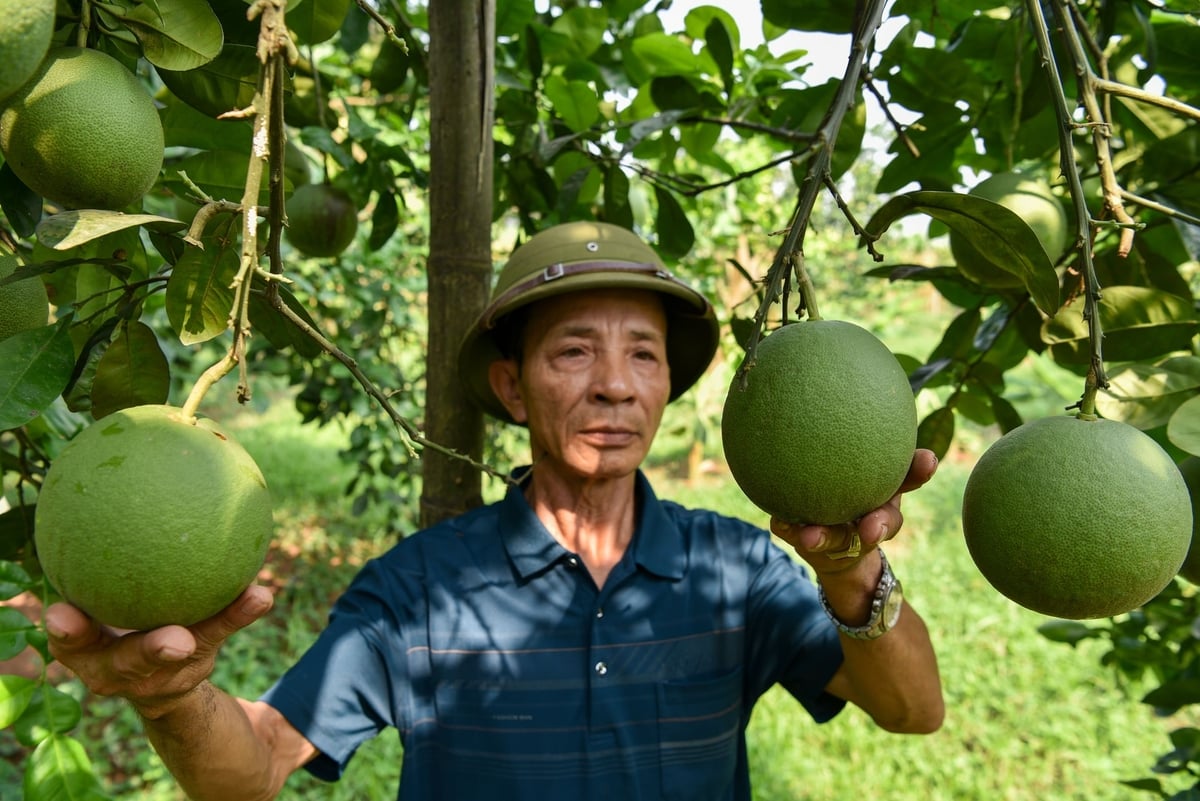
Dang Tam Dung with his organically grown pomelos. Photo: Duong Dinh Tuong.
"Organic farming is more challenging than I ever imagined. Pests have become accustomed to chemical pesticides, so biological products work more slowly and are less effective, often necessitating repeated applications. Even without chemical fertilizers, and despite supplementing nutrients with plant-based nitrogen from soaked maize and soybeans or animal-based nitrogen from fermented fish, the trees still grow more slowly.
“Mechanical weed control is also extremely labor-intensive. We have to mow 10-12 times a year, each requiring six workers. If I used herbicides like many others, the weeds would disappear after one application every three months at only about one-fifth of the cost. That's why I say organic farming could easily collapse without government support. The biggest benefit is healthier soil. It's looser, more fertile, and full of earthworms and crickets," Dung said.
Those long-term improvements in soil health convinced him to continue organic production even after the initial pilot project ended.
After five years of fruit bagging, he abandoned the practice when transitioning to VietGAP and later organic farming. During periods of intense heat, he pumped water into irrigation ditches to cool the orchard through evaporation, reducing sunburn on the fruit. He also sprayed a mixture of lime and copper sulfate to suppress fungal diseases and prevent sun scorch, while hanging fruit fly traps around the orchard to form a protective barrier.
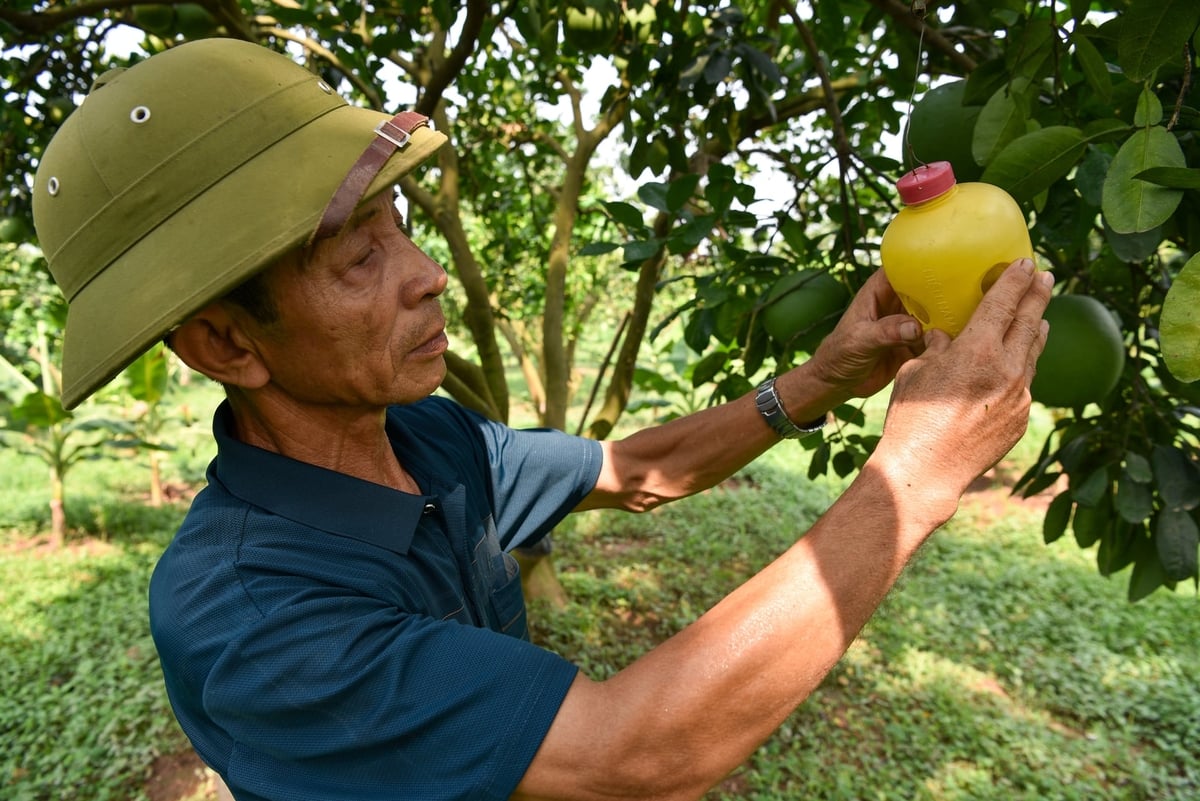
Dung checks fruit fly traps in his orchard. Photo: Duong Dinh Tuong.
In recent years, many localities have expanded pomelo cultivation, leading to oversupply, collapsing prices, and unsold fruit. Yet Dung continues to sell his pomelos for more than VND 10,000 per fruit, thanks to his established reputation and commitment to food safety.
Under VietGAP production, his pomelos are supplied to supermarkets and industrial kitchens. Since adopting organic farming, he has succeeded in exporting pomelos to Europe, although volumes remain modest.
During the three-year organic pomelo project, the former Vinh Phuc Plant Production and Protection Sub-Department provided 12,750 kilograms of microbial organic and biological organic fertilizers. It also organized technical training for Dung and other pomelo growers in Lien Chau commune, coordinated with Que Lam Biotech Co., Ltd. to guide the safe and effective use of organic fertilizers, worked with certification bodies to verify compliance with organic standards, and connected the orchard with ECO Hoa Binh Joint Stock Company to market the fruit domestically and internationally.
*USD 1 = VND 26,470. Source: Vietcombank.
Translated by Samuel Pham

(VAN) Recently, the Lao Ministry of Agriculture and Environment delegation visited, worked, and signed a pact with the Vietnam Academy of Agricultural Sciences.

(VAN) Da Nang steps up free rabies vaccination in mountainous communes, delivering vaccines directly to villages to build an immunity shield.

(VAN) Native honeybee farming in Ha Tinh grew strongly, providing stable incomes and promoting sustainable rural economic development.
/2026/07/20/3847-3-113606_381.jpg)
(VAN) The global spread of the SAT-1 FMD virus strain underscores the need for Viet Nam to proactively enhance surveillance and develop response scenarios well in advance.

(VAN) Agricultural by-products are being recognized as resources that can generate new economic value, reduce emissions, and create new opportunities for green growth in circular agriculture.

(VAN) The project aims to help ethnic minority women strengthen their agricultural processing skills, develop climate-resilient livelihoods, and improve their incomes.

(VAN) The BLOOM project, funded by the Government of Canada, aims to restore ecosystems while improving livelihoods for ethnic minority women in Dak Lak.
