June 3, 2026 | 11:38 GMT +7
Hotline: 0913.378.918

June 3, 2026 | 11:38 GMT +7
Hotline: 0913.378.918
Bang Phuc is a mountainous commune of Cho Don district (Bac Kan province), where the climate is cool all year round. Along the mountain slopes in Bang Phuc commune, there is a famous Shan Tuyet tea variety with a captivating flavour.
The Shan Tuyet Bang Phuc tea variety has the characteristics of dark green leaves, roots that go deep into the ground, and a wide and thick canopy, so it can cover the soil well. Shan Tuyet tea is a precious crop and it is on the list of crops banned from export.
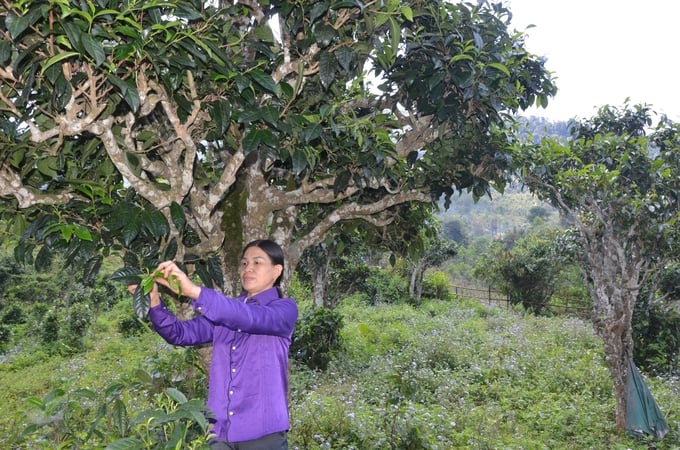
Ancient Shan Tuyet tea trees in people's gardens in Bang Phuc commune. Photo: Ngoc Tu.
Previously, Shan Tuyet tea was available almost everywhere in Bang Phuc, evenly distributed in the villages, but over time, the number of ancient Shan Tuyet tea trees is becoming less and less. Preliminary statistics show that the entire commune now has more than 500 ancient tea trees left.
The reason is that for a long time, the ornament industry has come to hunt and buy ancient tea trees that are hundreds of years old to satisfy their hobby. Therefore, preserving ancient tea roots is essential to preserve precious genetic resources, as well as serving local economic and tourism development.
Faced with the risk of depleting ancient Shan Tuyet tea trees, at the end of 2022, Cho Don district issued a plan "Conserving ancient Shan Tuyet tea trees in Bang Phuc commune for the period 2023 - 2025" to preserve 433 ancient Shan Tuyet tea trees, preserving precious genetic resources, serving experiential eco-tourism, and sustainable agricultural development.
Currently, specialized agencies have numbered each tree, created a tracking book, and supported farmers with the technical process of pruning, creating a balanced canopy, fertilizing, and caring for ancient tea trees.
Mr. Dang Dinh Phong, Vice Chairman of Cho Don District People's Committee said: To preserve the ancient Shan Tuyet tea trees, the district has repeatedly inspected, surveyed, and promptly moved nearly 100 trees located in the site clearance area for the Bac Kan City - Ba Be Lake road construction site to another location for continued care. The district has also assigned Bang Phuc commune to widely propagate to people the benefits of preserving ancient Shan Tuyet tea trees to preserve genetic resources and serve tourism in the future.
Mr. Hoang Van Thai, Chairman of the People's Committee of Bang Phuc commune (Cho Don district) further informed that shortly, when the road from Bac Kan City to Ba Be Lake is completed, the commune will be located in a key tourism area. Therefore, preserving ancient Shan Tuyet tea trees plays an important role in serving tourism development. Currently, the commune has issued regulations prohibiting the trading of ancient Shan Tuyet tea trees out of the locality. If any act of cutting down or exploiting is discovered, it will be strictly handled. The commune also went to each household to mobilize people to participate in protecting these precious tea trees.
“For areas of ancient Shan Tuyet tea that are hundreds of years old, the locality will continue to integrate production support programs and projects to guide people on care and rehabilitation measures, helping people earn more income", Mr Thai shared.
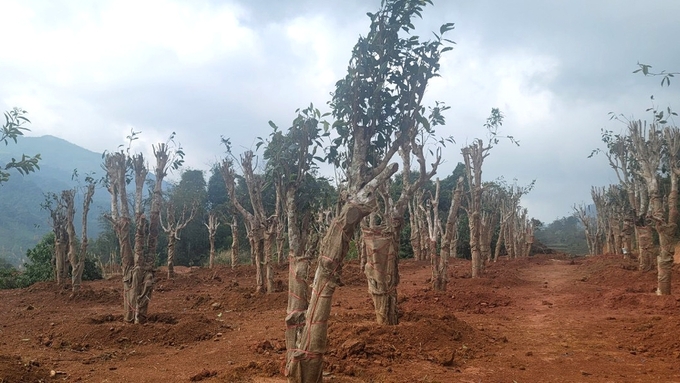
Nearly 100 ancient Shan Tuyet tea trees in the site clearance area for the Bac Kan City - Ba Be Lake road construction were moved to another place to care for and preserve genetic resources. Photo: Ngoc Tu.
Besides protection, currently, the government and professional sectors also build many models of growing Shan Tuyet tea to increase people's income. When people have a stable income, they will join hands with the government to preserve this precious tea variety.
Since 2018, the Department of Science and Technology of Bac Kan province has also implemented a project to care for, process and consume Shan Tuyet tea in Bang Phuc commune. Accordingly, building more than 20 ha of Shan Tuyet tea in the organic direction, and 10 ha of tea in the VietGAP direction, in addition, it also supports cooperation in caring for and improving intensive cultivation of Shan Tuyet tea trees with local people. All tea products of the project are purchased by cooperatives and businesses at prices ranging from VND 15000 to 20,000/kg of fresh tea.
In 2022, the area of Shan Tuyet tea in the Cho Don district is nearly 500 ha, the goal is to expand to about 600 ha by 2025. Cho Don district will focus on developing the Shan Tuyet tea area to meet organic standards, VietGAP, promotes and calls for businesses to invest in the production and processing of Shan Tuyet tea to create high-quality products to serve domestic needs, aiming for export.
Translated by Hoang Duy
/2026/06/01/1824-2-211343_500.jpg)
(VAN) Quang Ngai province is implementing many measures to protect sargassum resources, contributing to restoring aquatic resources, preserving biodiversity, and creating sustainable livelihoods.

(VAN) Farmers in Phu Thuan Commune, Da Nang preserve healthy soil and maintain chemical-free farming seasons, producing clean sesame and bean export products.

(VAN) Alongside his lush golden melon ready for harvest, Nguyen Van Truong from Ha Tinh province is eager to collect another 4,000 Hami melon plants.

(VAN) Summer-autumn crop season is peaking with effectively new weed, pest control to help reduce production costs and improve yields.

(VAN) Save Vietnam’s Wildlife (SVW) has launched the country’s first mobile nature center, using three interactive exhibition buses to promote nature conservation.

(VAN) A project funded by non-refundable official development assistance (ODA) from the German government will focus on restoring natural forests, strengthening forest management, and conserving biodiversity in Quang Ngai Province.
/2026/05/30/4118-3-142117_486.jpg)
(VAN) The pilot deployment of an aquatic weed harvester is expected to help reduce pollution and clear water flow, contributing to the development of a green, clean Hue City.
