July 21, 2026 | 16:33 GMT +7
Hotline: 0913.378.918

July 21, 2026 | 16:33 GMT +7
Hotline: 0913.378.918
Dong Loc town (Can Loc, Ha Tinh) is a locality with many advantages in forests, forest gardens and fruit growing areas. Taking advantage of that strength, in recent years, many households in Khe Tho Street (Dong Loc town) have developed beekeeping for honey in orchards. This model brings high income to people, opens up new prospects for economic development, and contributes to improving the ecological environment.
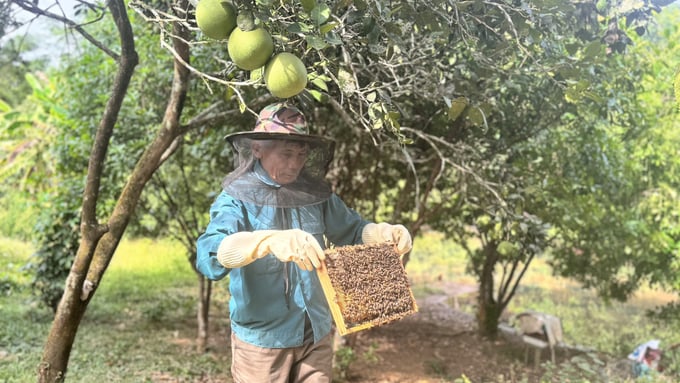
People in Dong Loc town (Can Loc district) have taken advantage of the hills and orchards to combine honey bee farming, significantly increasing their income. Photo: Anh Nguyet.
Mr. Nguyen Huu Thuan's family in Khe Tho residential group has more than 2 hectares of fruit trees, including oranges, grapefruits, persimmons... In 2022, with the support of the Provincial Agricultural Extension Center, Mr. Thuan's family invested in raising 10 bee colonies for honey. With the advantage of hills and orchards with many flowers all year round, Mr. Thuan's family has now grown to 40 bee colonies.
Mr. Thuan said that bees are raised in orchards, so the honey is bright yellow, fragrant, and sweet, giving it a competitive advantage. Wherever the honey product is exploited, it is consumed at a price ranging from VND 250,000 - 300,000 per liter. Mr. Thuan's family earns hundreds of millions of dong from beekeeping every year.
Thanks to the bees, pollinating orchards has also become more convenient and effective. Raising bees in the orchard not only gives his family a source of income from honey but also helps the family's orchard increase both productivity and quality.
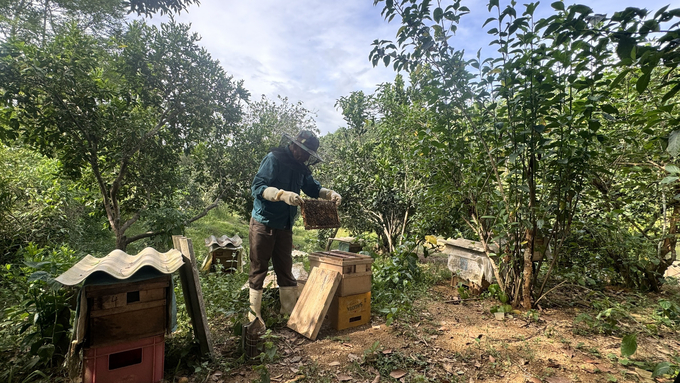
In order for the bees to grow well, the orchard must not use toxic pesticides, so the environment must always be clean. Photo: Anh Nguyet.
Like Mr. Thuan's family, for decades now, Mrs. Tran Thi My's family in Khe Tho sub-division has taken advantage of orchards and forest hills to raise bees for honey. Initially, Mrs. My only raised a few bee colonies to serve her family's needs, but she realized the high economic efficiency, so she expanded the scale. Currently, her family has more than 20 honey bee colonies, collecting more than 100 liters of honey each year, providing a stable source of income. Under the canopy of a more than 3-hectare orchard, Mrs. My proactively placed boxes of honey bees. Thanks to this, plants have a higher ability to be pollinated. Through monitoring, her family's orange and grapefruit gardens have a significantly higher fruit-bearing rate than other gardens.
According to Mrs. My, caring for bees requires farmers to be persistent, meticulous, and clearly understand the characteristics of bees in order to have a care regime suitable for each stage and season. Accordingly, honey quality depends mainly on the weather. If it rains a lot, the honey will be liquid; The sun is too hot and the honey is viscous and difficult to squeeze. Therefore, for the honey product to have a light yellow color, a smooth, sweet taste, and the scent of natural pollen, beekeepers must grasp the flowering process of tree varieties and choose the right flowers with high nutritional value for bees to collect nectar.
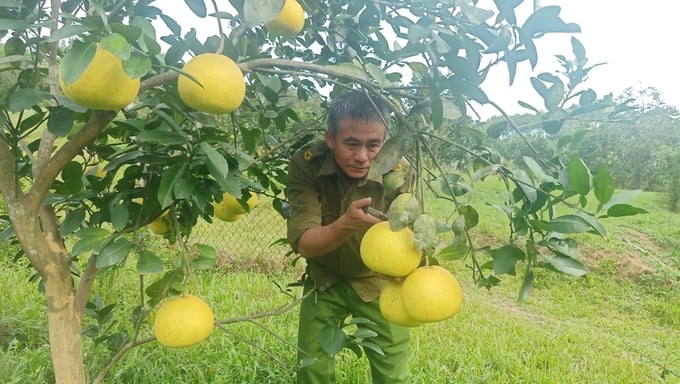
Beekeeping in orchards is a combination to develop organic, ecological and sustainable agriculture. Photo: Anh Nguyet.
According to the experience of households, beekeeping can only require a little capital and effort. Still, one only needs to understand the techniques and behavior of bees for care and management, especially for separating each flock. Besides, bees have very high swarm organization characteristics and are sensitive to external influences such as weather, light, and temperature. Therefore, farmers must grasp the essential characteristics of bees, take appropriate measures to prevent cold and heat, and regularly clean the box to ensure it is dry and clean. Only then will the bee colony be healthy and produce high-yield and quality honey.
In addition, raising under the canopy of orchards and natural forest trees helps bees grow and develop well, has few diseases, increases honey production, and brings high economic efficiency; honey always has beautiful colors, delicious quality, and is popular in the market.
As one of the households that successfully developed the beekeeping model for honey combined with orchards, Mr. Nguyen Hung Thai's family in Khe Tho residential group currently has a fairly large bee colony. From only raising 10 bee colonies on a trial basis with the support of the Provincial Agricultural Extension Center, especially by participating in training and technical training programs, Mr. Thai has boldly developed the bee colony to 50 colonies.
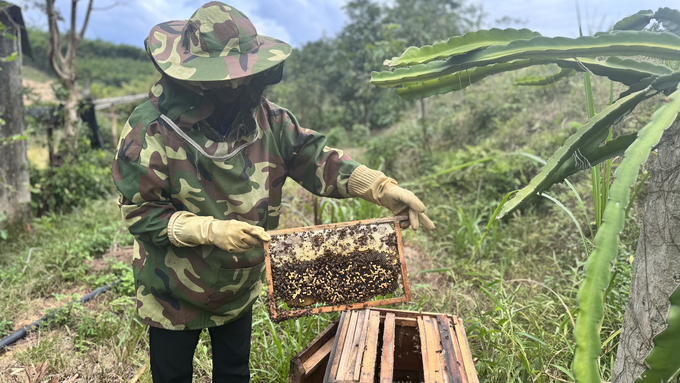
Raising bees in forest hills and orchards helps bee colonies grow and develop well, with few diseases and high honey yield. Photo: Anh Nguyet.
To consolidate his knowledge, Mr. Thai also researched localities with many successful beekeeping models to learn from experience. He paid special attention to managing and monitoring the growth process and techniques for separating bee colonies. Up to now, Mr. Thai's family's bees have grown and developed well.
Bees' primary food source is grapefruit and orange pollen, so when honey is harvested, the honey product is of very high quality. On average, Mr. Thai's family collects from 200 to 300 liters of honey each year. He sells honey from pollen for VND 300,000 per liter.
Mr. Thai said that beekeeping in orchards will have a complementary function, helping the trees produce high fruit and ensuring honey quality. However, for bees to grow well, orchard cultivation should not be sprayed with toxic pesticides. Therefore, it has contributed to improving the ecological environment and protecting the health of producers. This is an environmental and organic form of production. Both honey and fruit products are guaranteed to be safe and of high quality, so the selling price is higher.
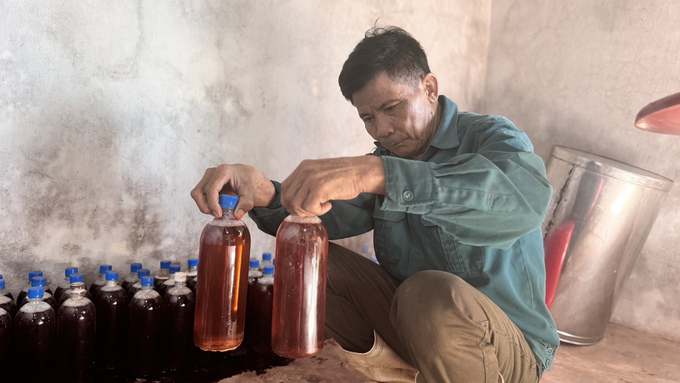
Raising bees under orchards produces honey with beautiful colors and delicious quality, which is popular in the market. Photo: Anh Nguyet.
Mr. Phan Duc Hoa, Vice Chairman of Dong Loc Town People's Committee (Can Loc District), said that Dong Loc Town currently has 200 households with hill gardens, mainly orange and grapefruit, with over 100 hectares. It is a potential strength for combining and developing beekeeping for honey production.
To help people increase their income from beekeeping and ensure sustainability, in recent years, local authorities have coordinated with specialized industries to guide people in applying science and technology to the farming process, also orienting households to establish cooperative groups and cooperatives to link production, share experiences, and support product consumption.
Translated by Huong Giang
/2026/07/20/1547-1-180442_204.jpg)
(VAN) A farmer in Can Tho has found the secret to raising giant water bugs that produce intensely aromatic essence, earning annual profits of hundreds of millions of dong.

(VAN) From crop conversion to deep processing, Ba Che Commune in Quang Ninh Province is building a comprehensive cinnamon value chain that creates sustainable livelihoods while strengthening the local forestry economy.

(VAN) The ACIAR-SunRice public-private partnership, rooted in science and sustainable development, is expected to support rice farmers in the Mekong Delta.

(VAN) Linking the shrimp, rice, and coffee sectors through a circular economy model is opening up a new pathway for Viet Nam's agriculture.

(VAN) HCMC is accelerating the transition to circular industry by transforming industrial parks into eco-industrial zones, fostering industrial symbiosis, and expanding international partnerships for green manufacturing.
(VAN) The digital map of raw material zones is expected to resolve overlapping investments, ensure production transparency, and accelerate deep processing in the coconut industry.
(VAN) Transforming barren hills once dedicated only to acacia and cassava, the Anh Mai Medicinal Plant Cooperative has found a new direction with red turmeric, opening up sustainable livelihoods for local residents.
