December 5, 2025 | 15:09 GMT +7
Hotline: 0913.378.918

December 5, 2025 | 15:09 GMT +7
Hotline: 0913.378.918
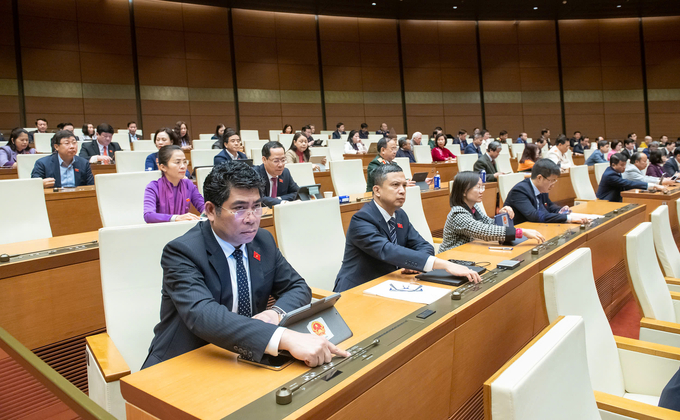
The National Assembly voted to approve the Resolution on the investment policy for the Lao Cai - Hanoi - Hai Phong railway construction project. Photo: Pham Thang.
Under this resolution, the National Assembly has decided to construct a new railway line, with the starting point located at the border crossing in Lao Cai Province and the endpoint at Lach Huyen station in Hai Phong City. The total length of the main railway line will be approximately 390.9 kilometers, while the total length of the branch lines will be about 27.9 kilometers. The railway will pass through the territories of 9 provinces and centrally-administered cities, including: Lao Cai, Yen Bai, Phu Tho, Vinh Phuc, Hanoi, Bac Ninh, Hung Yen, Hai Duong, and Hai Phong.
In terms of scale, the project will involve the construction of a completely new single-track railway with a standard gauge of 1,435 mm. The line will serve both passenger and freight transportation. The design speed for the main line, from the new Lao Cai station to Nam Hai Phong station, will be 160 km/h. For the section passing through the Hanoi metropolitan area, the design speed will be 120 km/h, while the remaining sections will be designed for a speed of 80 km/h.
The investment will be public, and the technology applied will be based on electrified railway tracks. The project will ensure that the infrastructure is modern, integrated, safe and efficient. Land acquisition will take place in accordance with the planning scale, with a double track being constructed for the section from Lao Cai station to Nam Hai Phong station, while the remaining sections will have a single track.
The preliminary total land area required for the project is approximately 2.632 hectares, which is broken down as follows: about 716 hectares of rice paddy land (of which approximately 709 hectares are used for irrigated rice cultivation with two or more harvests per year), about 878 hectares of forest land, and around 1.038 hectares of other land types in accordance with legal land regulations. It is estimated that approximately 19.136 people will need to be relocated due to the project.
The National Assembly has preliminarily approved the total investment for the project, which is estimated at 8.13 billion USD. The funding for this project will be sourced from the state budget over several public investment periods in the medium-term plans, as well as other legal funding sources.
In terms of the project timeline, the preparation of the feasibility study report is set to begin in 2025, with the goal of completing the entire project by 2030 at the latest.
The National Assembly Standing Committee provided clarification, based on the Government’s report, stating that the preliminary total investment has been calculated in accordance with the legal regulations on construction. The investment rates currently published by other countries are only calculated for the construction and equipment portions of the projects and do not include additional costs such as land acquisition, compensation, support, resettlement, and other unique expenses. These unique costs include specific expenditures like the Tan Vu - Lach Huyen bridge, the cost of upgrading the 1,000mm gauge track in the Lao Cai station area, and the cost of the 1,000mm gauge section passing through the Hanoi hub area.
When compared to the investment rate of the Vientiane - Boten railway, which spans 418 kilometers with a total investment cost of 5.96 billion USD, the cost per kilometer amounts to 16.77 million USD. In comparison, the Lao Cai - Hanoi - Hai Phong railway project has an investment rate of about 15.96 million USD per kilometer, which is relatively close to the rates of other reference projects in the region.
Additionally, the comparison of investment rates between different projects is intended for reference purposes only. The rates can vary due to numerous factors, including the timing of the project’s implementation, the type of technology used, terrain and geological conditions, hydrology, technical standards, the applied technology, and the potential for local manufacturing and production.
Regarding the ability to balance the funds for the project, the National Assembly Standing Committee explained that, because this is a particularly prioritized project, the Government will adjust the funding and propose it to the National Assembly for approval within the framework of the medium-term public investment plan for the next five years, as well as the five-year financial plan for each period. This process will follow the principle of ensuring the overall macroeconomic balance and the safety of national public debt.
Referring to the calculations provided by the Government, the National Assembly Standing Committee stated that based on the projected GDP growth targets and the Consumer Price Index (CPI) targets as outlined in Resolution No. 158/2024/QH15 of the National Assembly regarding the socio-economic development plan for 2025, the expected foreign borrowing mobilization (around 1.0-1.1% of GDP for 2025) and the domestic capital mobilization for counterpart funding (about 0.45-0.5% of GDP in 2025) for this project in the period between 2025 and 2032 would result in an increase of Government debt and public debt by approximately 1.4-1.5% of GDP.
However, the calculations for the project do not yet take into account the additional GDP growth that will be generated as a result of the project’s implementation. The current figures are based on the previous growth scenario. If the growth scenario is adjusted to reflect a higher, double-digit growth rate for the period between 2026 and 2030, as directed by the Party, the overall GDP will increase, and the level of public debt attributed to the project will consequently decrease.
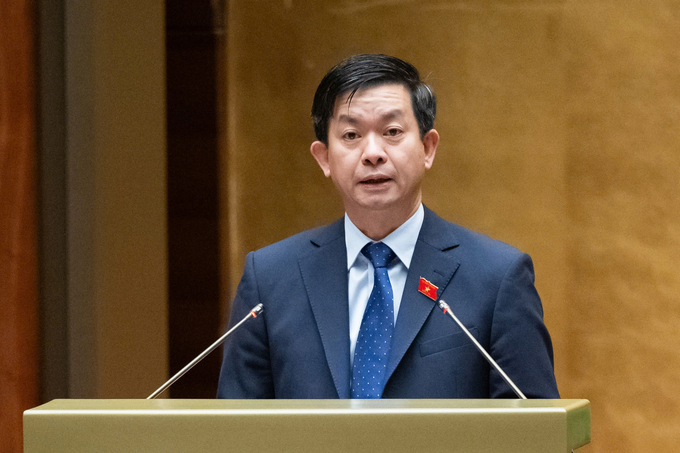
The Secretary General of the National Assembly and Head of the National Assembly Office, Le Quang Tung, presented the Report on the explanation, acceptance, and revision of the draft resolution. Photo: Pham Thang.
Additionally, some opinions suggested proposing a higher proportion of funding from government bonds to reduce the reliance on foreign loans, which often come with high interest rates.
Translated by Phuong Linh

(VAN) As of 2025, the ASEAN region has a total of 69 ASEAN Heritage Parks recognized across its 10 member states. Among them, Viet Nam contributes 15 ASEAN Heritage Parks.

(VAN) Yok Don National Park has high biodiversity with numerous endemic plant and animal species, and it is also the only dipterocarp forest ecosystem conservation area in Viet Nam.

(VAN) Viet Nam and Brunei signed two important MOUs on fisheries and IUU, expanding cooperation in agriculture, the environment, and Halal exports, aiming to substantively implement joint projects.

(VAN) The Viet Nam Coconut Association worked with the International Finance Corporation (IFC) and businesses to promote the supply chain, enhance competitiveness, and develop the coconut industry sustainably.
![Hue aims for Net Zero: [2] Pioneering low-emission tourism](https://t.ex-cdn.com/nongnghiepmoitruong.vn/608w/files/huytd/2025/12/04/0633-dulichzero-4-095634_236-161125.jpg)
(VAN) The ancient capital of Hue has developed Net Zero tourism products and models, aiming to reduce carbon emissions and pioneer the establishment of Viet Nam's green tourism destination.

(VAN) C.P. Viet Nam has announced the successful completion of its goal to plant 1.5 million trees during the 2021-2025 period, a key milestone within company's long-term ESG strategy and its roadmap for emission reduction.

(VAN) This is an initiative of MAE aimed at creating a unified coordination mechanism to implement agricultural cooperation programs with developing countries.
