June 3, 2026 | 00:37 GMT +7
Hotline: 0913.378.918

June 3, 2026 | 00:37 GMT +7
Hotline: 0913.378.918
According to the Vietnam Association of Seafood Exporters and Producers (VASEP), in the first 4 months of 2025, shrimp continued to lead as the key export item of Vietnam's fisheries industry, contributing USD 1.27 billion, up 30% over the same period. In April alone, shrimp export turnover reached USD 330.8 million, an increase of 15%.
This growth momentum was driven by strong demand in major markets such as China, the EU, and Japan. Additionally, shrimp prices have gradually recovered thanks to a rebalancing of global supply and demand.

Shrimp continued to be the key export item of Vietnam's fisheries industry in the first months of 2025.
Pangasius maintained its significant position with export turnover of USD 632.7 million, up 9%. However, growth shows signs of slowing, especially in April, when exports reached only USD 167.7 million, virtually unchanged from the same period.
Tuna exports declined in April to USD 76.1 million, down 12%, despite a modest cumulative increase of 1% in the first four months of the year, reaching USD 304.2 million. The main reason is the shortage of raw materials, particularly stemming from regulations on the minimum size for skipjack tuna.
Some other products had outstanding growth despite their small share. Tilapia and red tilapia exports surged 138%, reaching USD 19 million. Mollusks (both cephalopods and bivalves), crabs, and sentinel crabs also saw impressive growth, driven by strong demand from China and ASEAN. Specifically, export turnover reached USD 216.4 million for mollusks (up 18%), USD 83.1 million for crabs (up 82%), and USD 112.1 million for sentinel crabs (up 50%).
According to VASEP, China and Hong Kong emerged as the largest consumers, with a total value of USD 709.8 million in the first 4 months, up 56%. In April alone, exports to this area reached USD 182.3 million, an increase of 29%, thanks to shrimp, crab, sentinel crab, and mollusk products for the high-end segment.
The Japanese market ranked second with USD 536.6 million (up 22%), maintaining growth thanks to stable consumption of value-added products. The EU and South Korea also achieved positive results with turnover of USD 351.5 million (up 17%) and USD 264.1 million (up 15%), respectively.
In contrast, the U.S. market showed clear signs of slowing down. Total export turnover in the first 4 months reached USD 498.4 million, increasing by only 7%, while April alone saw a 15% decline over the same period to USD 120.5 million. The downturn was primarily driven by the reciprocal tariff policy that the U.S. forced domestic importers to consider shifting to alternative suppliers such as India and Ecuador.
Additionally, technical barriers such as stringent traceability requirements and food safety regulations also put significant pressure on Vietnamese businesses.
Before the new U.S. tariff policy takes effect on July 9, 2025, many Vietnamese seafood businesses are taking advantage of the remaining time to boost exports, especially for key products like shrimp and pangasius.
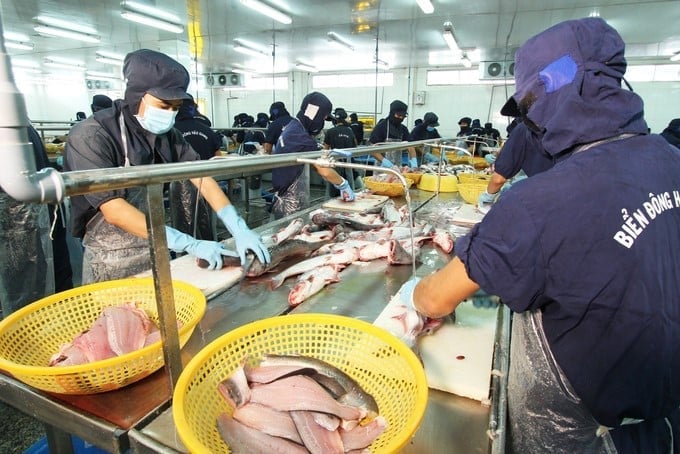
Pangasius export turnover reached USD 632.7 million, up 9%, maintaining its significant position in the fisheries industry.
It is forecast that in May and June, the export turnover to the U.S. market could rise by 10-15% compared to April, thanks to a series of urgently signed contracts and price adjustment strategies to retain market share.
Conversely, exports to markets such as China and ASEAN may slow down in the next two months, with an expected growth of only about 3–5%. This slowdown is due to Chinese seafood products being redistributed to domestic and nearby regional markets after facing high tariffs in the U.S. This created significant competitive pressure for Vietnamese products, especially in the low-price segment.
Meanwhile, the EU and Japan are expected to maintain stable growth rates of around 8–10%, mainly benefiting from tariff advantages under free trade agreements such as EVFTA and CPTPP. However, this growth is unlikely to fully offset the downturn in the U.S. market and the increasingly fierce competition in Asia.
Faced with tariff challenges and technical barriers, many Vietnamese seafood businesses are restructuring their strategies, shifting toward lower-risk markets and focusing on the development of deeply processed products with high added value. Thanks to this flexibility, Vietnam’s fisheries industry expects to maintain the growth momentum, despite unpredictable fluctuations in the global market.
Translated by Thu Huyen

(VAN) Khanh Hoa Province has approved a project to develop Halal-compliant goat and sheep products through 2030, creating opportunities to bring the province’s distinctive livestock products to export markets.

(VAN) Viet Nam was Malaysia’s largest coffee supplier in the first three months of 2026, with exports totaling 8,000 tons worth $37.1 million.

(VAN) The recognition of Buon Ma Thuot City in Dak Lak Province has opened up new opportunities to showcase the rich cultural and culinary heritage of Viet Nam’s Central Highlands to the world.

(VAN) This year’s egg lychee season at Doan Dao Egg Lychee Cooperative is considered the most successful, achieving high yields and record selling prices.

(VAN) For the first time, organic nipa palm nectar products from Can Gio have been exported to the US, bringing Vietnam’s native ingredients globally.

(VAN) The 2026 edition places a strong emphasis on capacity‑building, and practical adoption of innovations tailored to Asia’s diverse production systems.
/2026/06/01/0300-3-105942_623.jpg)
(VAN) Agro-forestry-fishery exports surpassed USD 30 billion in the first five months of 2026, up 9.2%, remaining a bright spot of the economy amid ongoing global uncertainties.
