December 31, 2025 | 06:08 GMT +7
Hotline: 0913.378.918

December 31, 2025 | 06:08 GMT +7
Hotline: 0913.378.918
Rambutan is one of the key fruit crops of the Mekong Delta, concentrated in provinces such as Ben Tre, Tien Giang, Vinh Long and Tra Vinh.

The Mekong Delta owns over 7,400 ha of rambutan trees. Photo: Minh Dam.
Rambutan is exported and consumed in many places, and production facilities in Ben Tre also use it to make dried rambutan.
In the past rambutan peels were usually removed and dumped directly into the environment.
Ms. Tran Thi Thu Hong, owner of Co Chin dried rambutan production facility ( Phu Ninh hamlet, Phu Duc commune, Chau Thanh district), said, “The facility discharged 500 - 600kg of peels daily. This amount is equivalent to 2 tons of rambutan consumed. The facility focuses its production on the months of June - August, and November - January every year. After each Tet season the amount of removed fruit peels even went up to several tens of tons.”

Thoroughly grind rambutan peel to make organic fertilizer. Photo: TL.
Such a predicament as it may be, rambutan peels can still be put into good use. Bringing it back to help farmers in agricultural production in fact has deep economic and environmental significance.
Research shows that rambutan peel is a rich source of phosphorus and potassium as well as other beneficial mineral components.
At the end of 2018, the program “Adaptation to climate change in the Mekong Delta - Ben Tre province” (AMD Ben Tre) collaborated with Co Chin dried rambutan production facility and a group of lecturers from the University of Science - Ho Chi Minh City National University (UOS - VNUHCM) to study and develop a rambutan peels processing procedure in combination with coco peat, sawdust, and other organic components. This method has been successfully deployed at dried rambutan production facilities in Chau Thanh district.
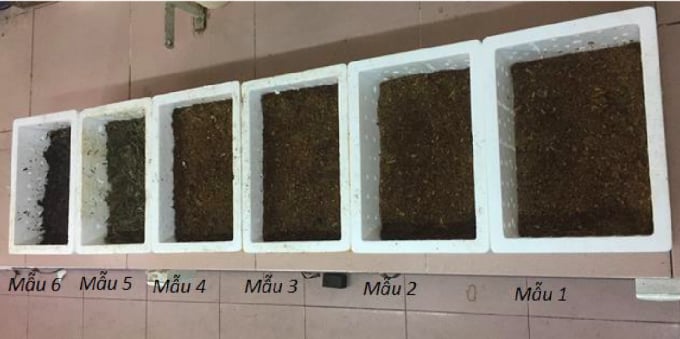
Organic fertilizers composted in the laboratory. Photo: TL.
According to Mr. Nguyen Thanh Nho, program manager of AMD Ben Tre, phosphorus and potassium are well fixed in the compound with relatively high content, contributing to the increase in value of produced organic fertilizers.
AMD Ben Tre also suggests adding a definite amount of inorganic fertilizer such as urea to the compost pile. This will increase the amount of nitrogen for plants and provide nutrients for microorganisms during the organic fertilizers production process, thus we can obtain semi-organic fertilizers with high nutritional value.
Implementation of this method has been proven to resolve environmental issues around rambutan facilities. There is no longer the odor caused by decomposed rambutan peels. Produced fertilizers are brought back to orchards, enrich the soil. The trees’ growth rate is comparable to when chemical fertilizers were applied.
Co Chin facility has been able to save a significant amount of fertilizer from composting rambutan peels into bio-organic fertilizers.
Organic composting procedure for rambutan peels
Step 1: Ingredient preparation
- Chopped rambutan peel to the size of less than 1cm edge.
- Ground coco peat collected from households.
- Trichoderma after being increased in biomass.
- Prepare Trichoderma solution (1 kg of bran-based yeast + 0.5 kg of molasses + 20 l of water, incubate for 3 days, usable when the solution is frothy and has yellow-copper color)
Step 2: The process
The entire 500 kg of thoroughly ground rambutan peels will be mixed with 150kg of coco peat.
Take 0.5 l of Trichoderma solution + 20 l of water and spray on the rambutan peel + coco peat pile.
Adjust the amount of water to ensure that the mixture’s moisture content is at 50 - 55% (can squeeze out water, 1 to 2 drops).
Step 3: Check the ripeness and quality of the compost pile
Use shovels to stir the compost pile every 5-7 days to increase oxygen for microbial to grow and promote bioconversion.
In cases of dry season and high temperature, the mixing process should be done more often every 3 to 4 days.
Check the humidity to see if it is necessary to add more water to maintain humidity at 50 - 55%, ensure the compost is of good quality, and limit nutrient loss due to thermal decomposition.
The compost sample will be checked for ripeness through the pile’s texture.
The compost can be used after 28 days.
(Temperature stable from 30 to 40oC, no sign of the burning sensation upon touching, the color turning black)
Translated by Samuel Pham

(VAN) From extensive shrimp ponds, baskets of don gathered on the mudflats, to boats carrying visitors to watch birds, all livelihoods here depend on clean water, green forests, and the calls of migratory birds.
/2025/12/26/0703-3-204813_117.jpg)
(VAN) Transparency in information and listening to local people have helped address ground clearance bottlenecks and build social consensus, thereby accelerating the progress of the JICA3 irrigation project.
/2025/12/27/0609-3-233846_327.jpg)
(VAN) The JICA3 project is expected to become a 'water shield,' helping control saltwater intrusion, proactively secure water resources, protect livelihoods, and promote sustainable development in coastal areas.
/2025/12/26/5654-3-164509_655.jpg)
(VAN) As Viet Nam makes strong commitments toward achieving net-zero emissions, controlling and reducing methane emissions in livestock production is increasingly becoming a mandatory requirement.

(VAN) 'People, Primates, Plants: Co-managing Biodiversity and Improving Livelihoods in Vietnam' (the PPP Project) is an international initiative implemented in Vietnam by BGCI, CEGORN, and ICRAF/World Agroforestry.

(VAN) Dak Nong established a risk-level zoning map for coffee, built a digital data platform for the sector, and promoted certified production in line with EUDR.
/2025/12/25/2709-1-211551_295.jpg)
(VAN) In response to the U.S. Marine Mammal Protection Act (MMPA), Gia Lai province is implementing many solutions to protect marine mammals and develop sustainable, responsible fisheries.
