December 1, 2025 | 11:15 GMT +7
Hotline: 0913.378.918

December 1, 2025 | 11:15 GMT +7
Hotline: 0913.378.918
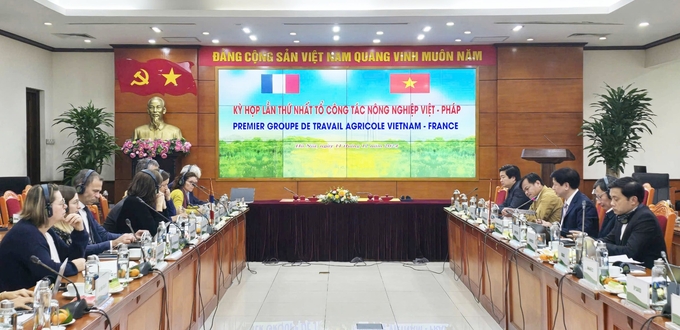
Overview of the meeting of the Vietnam - France Agricultural Working Group. Photo: Linh Linh.
Vietnam's Ministry of Agriculture and Rural Development (MARD) and France's Ministry of Agriculture and Food Sovereignty convened the inaugural meeting of the Vietnam-France Agricultural Working Group on December 11.
Trade and agricultural processing; sustainable agriculture development; capacity-building training; sustainable aquaculture development; South-South cooperation; geographical indications; and the export of agricultural and forestry products to the EU were the primary focuses of the meeting.
In accordance with Mr. Nguyen Do Anh Tuan, Director of the International Cooperation Department (MARD), the two parties have been collaborating closely to create and execute cooperation programs that are tailored to the respective strengths and priorities of each party.
The collaboration has made significant progress in the following areas: ecological agriculture, geographical indications, industrial crops (smallholder rubber, coffee, and tea), fishing port infrastructure, water management systems, market information systems, agricultural supply chains, digital transformation, and green agriculture development.
Furthermore, France has provided funding and technology transfers for initiatives such as the "Agroecological and Safe Food System Transitions in Southeast Asia" (ASSET) and the "Monitoring System for Fishing Vessels, Fishing Areas, and Aquatic Resources via Satellite Technology" (MOVIMAR).
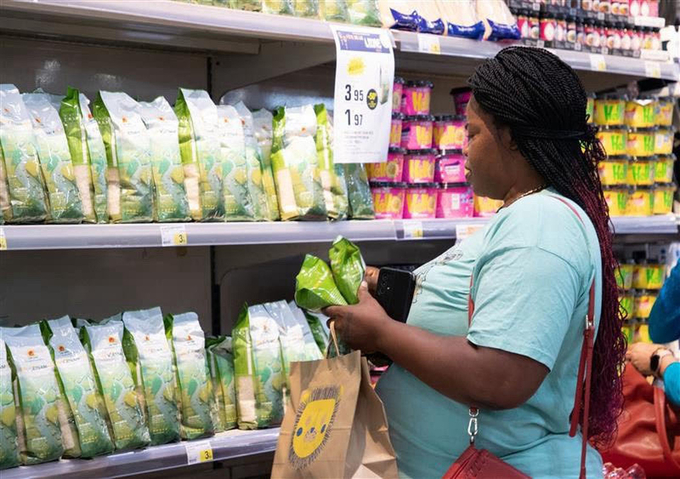
Vietnamese rice is displayed on the shelves of the Leclerc supermarket chain in France. Photo: Tuoi Tre Newspaper.
Mr. Olivier Brochet, Ambassador Extraordinary and Plenipotentiary of the French Republic to Vietnam, emphasized the advancement of bilateral relations to a Comprehensive Strategic Partnership in October 2024 during his opening remarks. This represents a significant advancement in trade and investment relations. He underscored the necessity for the agricultural ministries of both nations to enhance their collaboration, particularly in the areas of agriculture and food.
The ambassador also observed that recent collaboration has been focused on critical pillars, including climate change adaptation and mitigation. France has provided €500,000 through CARE to improve disaster prevention capabilities, food systems transition, promote transparent and responsible food systems, and value chain quality management and cooperation in the salt industry.
Mr. Pham Ngoc Mau, the Deputy Director of the International Cooperation Department, emphasized that France provides Vietnam with a variety of cooperation mechanisms, including financial and scientific research support. The most recent decentralized cooperation initiatives between France and local Vietnamese regions have included grant aid programs that address the conservation of natural resources and climate change. These endeavors have been both efficient and successful.
Mr. Mau recommended that in the future, decentralized cooperation be integrated with central-level policy-making to create technical standards and solutions that could be implemented on a national scale. Project design should incorporate activities at the local level.
The MARD has suggested the following areas of collaboration with the French Ambassador to Vietnam and representatives of France's Ministry of Agriculture, Food Sovereignty, and Forestry, AFD (French Development Agency), and CIRAD (French Agricultural Research Centre for International Development).
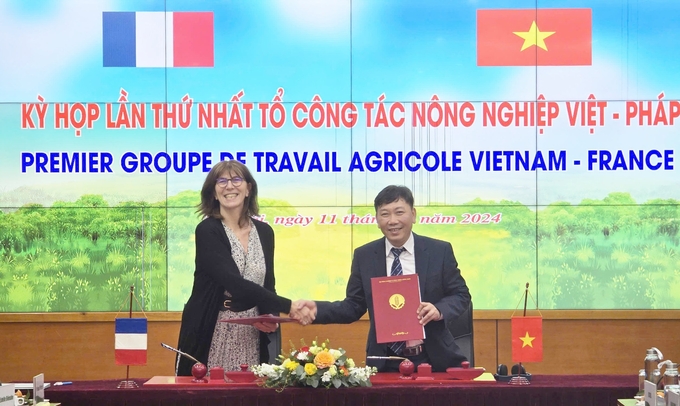
Mr. Nguyen Do Anh Tuan, Director of the Department of International Cooperation and Ms. Francoise Simon, Deputy Director in charge of International Relations, Ministry of Agriculture and Food Sovereignty of France signed the Memorandum of Cooperation of the Vietnam - France Agricultural Working Group. Photo: Linh Linh.
He suggested that the initial focus of ecological agriculture cooperation should be on the conservation of biodiversity, the preservation of genetic resources, the development of value chains, and the promotion of South-South cooperation.
Secondly, in order to facilitate policy development, cooperation should prioritize the establishment of programs for policy consultation, technical management, and climate change response, all while simultaneously reducing emissions.
MARD anticipated that France would assist Vietnamese enterprises in obtaining international certifications and adhering to the standards for pesticides, food additives, and colorants in the third area of trade and investment.
Fourth, France is encouraged to strengthen technical and financial cooperation to assist Vietnam in complying with EU recommendations for the removal of the "yellow card" under IUU (illegal, unreported, and unregulated fishing) regulations in order to promote sustainable fisheries development.
MARD recommended that France establish programs to enhance the capabilities of Vietnam's agricultural sector as the final step in capacity-building training.
Ms. Francoise Simon, the Deputy Director of International Relations at the Ministry of Agriculture and Food Sovereignty of France, concurred with the directions and regarded this meeting as a positive beginning. She stated France's intention to persist in fostering bilateral trade and agricultural cooperation in the aforementioned regions, thereby establishing a comprehensive plan for future collaboration.
Translated by Dieu Linh

(VAN) The inevitable path forward is to reorganize production along the value chain, utilizing cooperatives as the core, enterprises as the driving force, and farmers as the central subjects.

(VAN) On November 28, Minister Tran Duc Thang, together with China's Minister of Agriculture and Rural Affairs Han Jun, chaired the 2nd meeting of the Viet Nam - China Agricultural Cooperation Committee.

(VAN) Forest carbon credits are only accepted when they ensure absolute environmental integrity, additionality, permanence, and transparency.

(VAN) Viet Nam partners with Beijing on controlling air pollution, cross-regional management, high-tech monitoring and relocating polluting facilities.

(VAN) With a USD 50 million investment, Australia is partnering with Viet Nam to operate its first public electric bus fleet and develop a nationwide EV charging network.

(VAN) On November 28, in Beijing, Minister Tran Duc Thang met Minister of Ecology and Environment of China Huang Runqiu, to share experience on environmental protection.
/2025/11/28/0950-2-120557_751.jpg)
(VAN) The recent flood spell in the South Central region clearly reflects the characteristics of natural disasters in 2025, which are compound, prolonged, and amplified.
