November 27, 2025 | 20:30 GMT +7
Hotline: 0913.378.918

November 27, 2025 | 20:30 GMT +7
Hotline: 0913.378.918
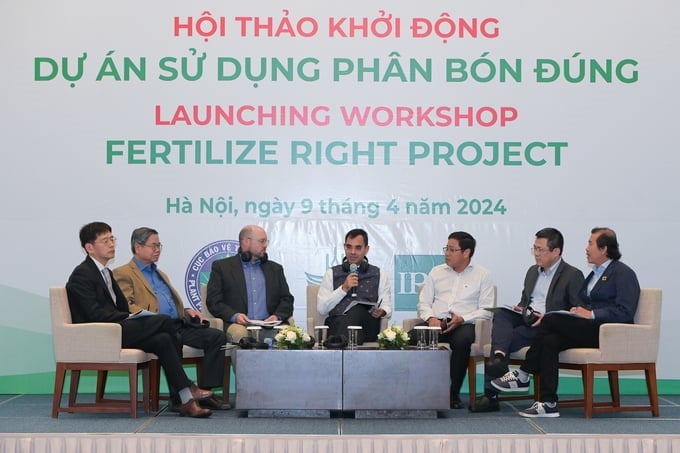
Mr. Phan Van Tam (far right), Marketing Director of Binh Dien Fertilizer Joint Stock Company, participated in the workshop at the launching ceremony of the "Fertilize Right Project". Photo: Tung Dinh.
Participating in the workshop, Mr. Phan Van Tam, Deputy General Director of Binh Dien Fertilizer Joint Stock Company, had discussions on how to use fertilizer properly while still ensuring productivity and income for farmers.
The business representative said that in recent times, the unit has had many programs related to effective fertilizer use, but in general, no matter what they do, the most important thing must be the benefits to farmers.
"This means that when raising the issue of proper fertilizer use, farmers must enjoy benefits. In addition, it is important that the income from their fields be guaranteed and increased," Mr. Phan Van Tam offers an approach.
Thus, according to Mr. Tam, if the project offers an increase of 5% in profit, it will be difficult to encourage farmers to participate. Binh Dien's representative said that the application of scientific research must be accompanied by practice to be effective.
In addition to reducing seeds and fertilizer, farming solutions and techniques are very important. A right solution will help farmers both reduce input material costs and increase productivity, similar to the way Binh Dien is coordinating with the National Agricultural Extension Center to deploy in some localities.
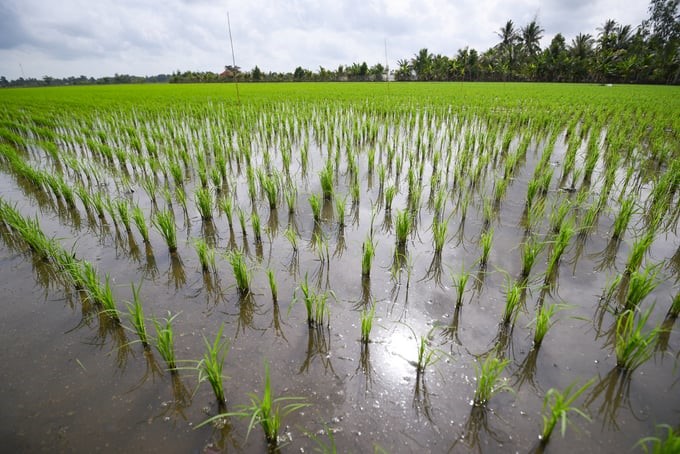
Farming techniques will be the key to convincing farmers. Photo: Tung Dinh.
Another problem in convincing farmers to participate in the project is communication. The leader of Binh Dien Company said that currently, videos and clips of agricultural instructions are widespread on social networks, especially TikTok, but most of them are wrong.
“Despite the wrong instructions, the quantity of these products is very large, causing farmers to get confused about information and follow the wrong methods. Thus, we must have a way to convey the right messages and methods to social networks more strongly," said Mr. Tam.
According to the Plant Protection Department, compared to 35 years ago (1985–1986), the amount of inorganic fertilizers used today is estimated to be more than 6 times higher, while the farming area is 1.68 times higher.
This shows that the habit of using inorganic fertilizers has been formed over the past decades, and the amount of fertilizer used per unit of farming area has increased rapidly during the period when the agricultural sector needs to prioritize the targets of productivity and output over quality to ensure food security.
The convenience and quick effects of inorganic fertilizers on crop productivity have made the practice of using traditional organic fertilizer gradually disappear because this type of fertilizer acts slowly while being bulky and inconvenient in transportation and use.
Besides, in recent times, organic fertilizer production and use have increased, but farmers use it mainly based on experience and habits.
In addition, farmers also use fertilizer according to the instructions of the seller, lack methodical training on how to use it according to the right principles or use a balance between inorganic and organic fertilizers, and have few opportunities to access and learn about economical, balanced, and effective fertilizer use models.
According to data from the Plant Protection Department, the organic/inorganic fertilizer nutrient ratio is now estimated at approximately 18/82, while experts say that the ideal ratio should be 30/70.
Therefore, the promulgation of the project "Promotion of production and use of organic fertilizers until 2030, with a vision to 2050" will exploit the potential and advantages of available organic raw materials for organic fertilizer production.
Thereby contributing to reducing environmental pollution, reducing greenhouse gas emissions, and balancing inorganic and organic nutrients to maintain and improve soil health for sustainable agricultural development. This aims to create safe products, protect consumers' health, and increase economic efficiency in agricultural production.
Previously, on April 9, the Ministry of Agriculture and Rural Development, in coordination with the US Department of Agriculture, inaugurated the "Fertilize Right Project," with implementation led by the International Rice Research Institute.
The project, which spans four years, has an estimated budget of USD 4.4 million funded by the US Government. The Plant Protection Department (Ministry of Agriculture and Rural Development) is the project owner.
Translated by Thu Huyen

(VAN) According to Mr. Vo Minh Thanh, Director of the Tay Ninh Department of Agriculture and Environment, Resolution 57 has created a new development pathway for the locality, shifting from traditional toward modern agriculture.
/2025/11/26/4909-2-154329_878.jpg)
(VAN) Pearl grouper farming in HDPE cages not only delivers economic efficiency but also contributes to protecting the environment, creating jobs, and promoting marine-based experiential tourism.

(VAN) The model of making a living under the forest canopy through the agroforestry system in Van Son commune, Bac Ninh province, is expected to generate an annual income of approximately VND 30 million/ha.

(VAN) Many enterprises in Can Tho are harnessing natural energy and reducing greenhouse gas emissions in their production processes, thereby contributing to the promotion of a sustainable green transition.
/2025/11/24/3536-2-112800_176.jpg)
(VAN) Dong Nai now has tens of thousands of hectares of forests certified for sustainable management, and this area will continue to be expanded in the coming period.

(VAN) Vinh Ha hamlet (Dai Xuyen commune, Hanoi) is shifting away from small-scale farming as households adopt bioscurity into their breeder chicken models.

(VAN) Heavy rains make aquatic species more vulnerable to disease. Proactive water management and high-tech systems help farmers prevent outbreaks and protect yields.
