November 23, 2025 | 01:14 GMT +7
Hotline: 0913.378.918

November 23, 2025 | 01:14 GMT +7
Hotline: 0913.378.918
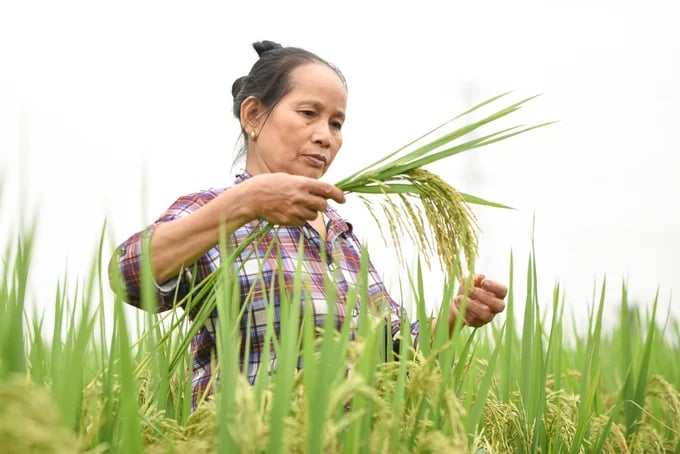
The "4 Rights" in using fertilizer are Right Product, Right Rate, Right Time, and Right Place. Photo: Tung Dinh.
The project, which spans four years, has an estimated budget of $4.4 million. The Plant Protection Department (MARD) is the project owner.
Present at the project launch workshop were Mr. Hoang Trung, Deputy Minister of Agriculture and Rural Development; Mr. Marc E. Knapper, US Ambassador to Vietnam; Mr. Ralph Bean, Agricultural Counselor of the United States Embassy; along with over 80 delegates from ministries, departments, local specialized agencies, international organizations, non-governmental organizations, businesses, and relevant research institutes.
In his address at the conference opening, Deputy Minister of Agriculture and Rural Development Hoang Trung highlighted two of the United Nations' Sustainable Development Goals being strongly promoted in Vietnam: "Responsible Consumption and Production" and "Climate Action."
Acknowledging their significance, the Government of Vietnam, particularly the Ministry of Agriculture and Rural Development, has diligently undertaken numerous efforts and practical measures to align economic development with environmental preservation.
The Deputy Minister mentioned that the Ministry of Agriculture and Rural Development has issued the Project "Development of Production and Use of Organic Fertilizers until 2030, with a Vision towards 2050". The project aims to harness the potential and advantages of available organic materials to produce organic fertilizers, thereby contributing to environmental pollution reduction, greenhouse gas emission mitigation, and balancing inorganic and organic nutrients to maintain and enhance soil health for sustainable agricultural development.
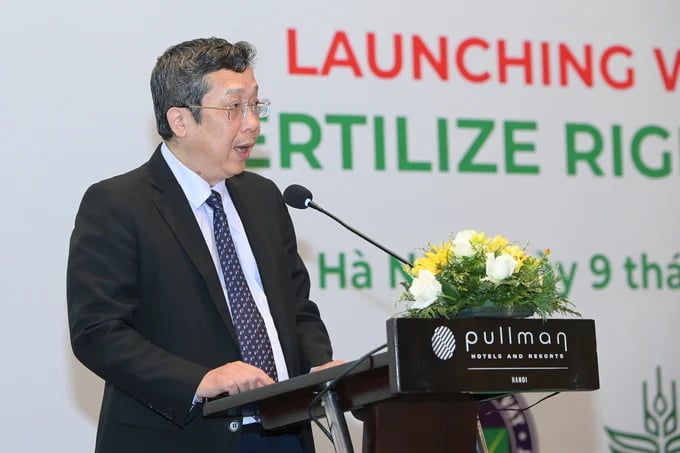
Deputy Minister Hoang Trung discussed Vietnam's objectives of emission reduction and increased efficiency in agricultural production. Photo: Tung Dinh.
Additionally, there is the "Development of Integrated Plant Health Management (IPHM) until 2030" project aimed at enhancing plant health and improving production efficiency. Most recently, the Project "Sustainable Development of 1 Million Hectares of High-Quality, Low-Emission Rice Cultivation Associated with Green Growth in the Mekong Delta" was initiated.
"The MARD aims to build a rice value chain towards emission reduction, high quality, and improved production efficiency. Consequently, this will enhance farmers' income and ensure national food security," affirmed Deputy Minister Hoang Trung.
In light of this, the MARD deeply values the support the US Department of Agriculture extended in implementing the Fertilizer Right Project. While this isn't the first collaboration project between Vietnam and the United States in the agricultural sector, it's certainly one aimed at fostering sustainable and environmentally responsible farming practices.
Deputy Minister Hoang Trung further shared, "Through this project, I hope to enhance Fertilize use efficiency, boost farmers' income, and reduce greenhouse gas emissions in rice cultivation by promoting the correct fertilizer application."
With technical guidance from experts from the US Department of Agriculture, IRRI, and Vietnamese scientists, the primary beneficiaries of the project, farmers in the project provinces, will gain access to technical knowledge, advanced technology application, and precision agricultural practices for optimal utilization of inputs, including fertilizers in rice cultivation. This will pave the way for scaling up successful practices nationwide.
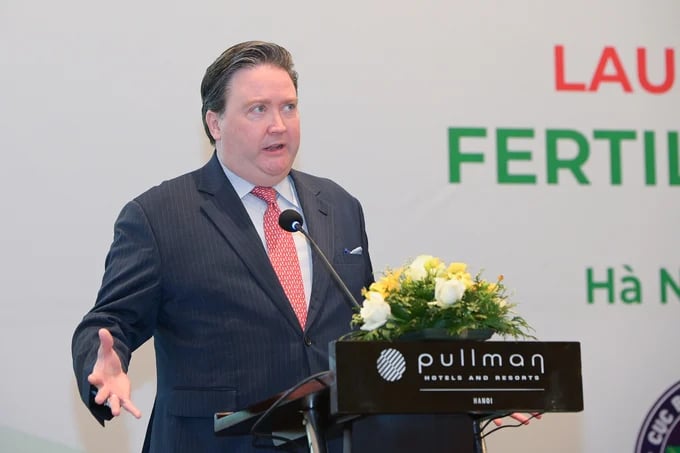
US Ambassador to Vietnam Marc Knapper also expressed his expectations regarding the project's efficacy for the agricultural sector and Vietnamese farmers. Photo: Tung Dinh.
On the US side, speaking at the launch ceremony, Mr. Marc Knapper, US Ambassador to Vietnam, stated, "In 2023, Vietnam and the United States upgraded their relationship to a comprehensive strategic partnership, opening up new opportunities for agricultural cooperation towards sustainable development.
The United States is Vietnam's second-largest importer of agricultural products, and Vietnam holds a significant position in global food security. Personally, I've witnessed the beauty of the landscape and ecosystem and observed the dedication of Vietnamese farmers, understanding their challenges."
Hence, Ambassador Marc Knapper highlighted that the Fertilize Right Project will offer technical support and training for rice farmers to enhance their livelihoods, ensure food security, and improve soil health.
Presently, rice is the primary and pivotal crop in Vietnam, contributing 6% to the country's GDP and producing an annual output of approximately 40 million tons. Fertilizer consumption in Vietnam reaches around 10 million tons per year, with inorganic fertilizer comprising 75 - 80% of the total. However, inappropriate and inefficient fertilizer usage poses a significant challenge in rice production, resulting in limited incomes and low nutrient utilization efficiency.
The Fertilize Right Project, hosted and sponsored by the US Department of Agriculture, falls under the purview of the Global Fertilize Challenge Program of the United States Department of State. Project activities are designed and executed based on the "4 Right" principles (4Rs) in nutrient management, emphasizing the necessity of utilizing the right type, ratio, timing, and placement of fertilizers. These principles align with the "5 Proper Fertilization" guidelines outlined in Vietnam's Law on Crop Production, encompassing the proper soil type, plant, dosage, timing, and method.
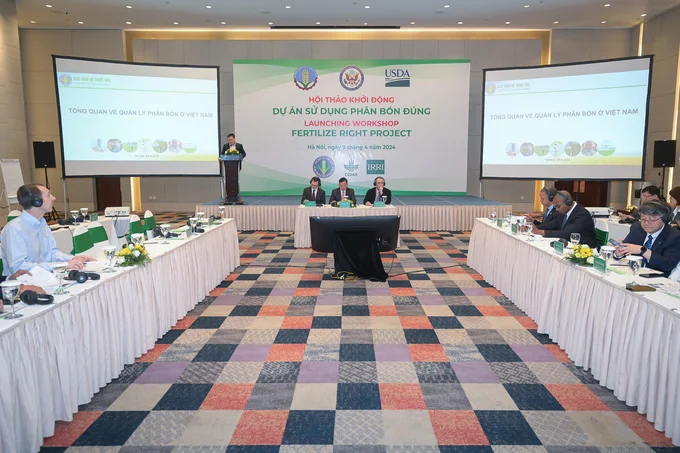
Speakers presented the current status and expectations regarding correct fertilizer usage in Vietnam. Photo: Tung Dinh.
The project aims to bolster Vietnam's achievement of economic development goals in the agricultural sector, facilitate market access, and address climate change concerns. Specifically, the project seeks to enhance fertilizer use efficiency, increase farmer incomes, and mitigate greenhouse gas emissions in rice cultivation by adopting appropriate fertilizers.
Implemented across three provinces in the Red River Delta (including Hai Duong, Thai Binh, Nam Dinh) and three provinces in the Mekong Delta (including Can Tho, Dong Thap, and Soc Trang), the project is slated for a four-year duration (from 2024 to 2027). With technical support from experts at the US Department of Agriculture, the International Rice Research Institute (IRRI), and Vietnamese scientists, the primary beneficiaries of the project, farmers in these provinces, will gain access to advanced techniques, technology applications, and precision agricultural practices for optimal fertilizer utilization in rice cultivation, thereby paving the way for nationwide replication of successful practices.
Expected outcomes of the Fertilizer Right Project
It is anticipated that over 2,600 individuals will directly benefit from short-term training facilitated by the project, with 24 participating organizations enhancing their capacities during project execution. Furthermore, greenhouse gas emissions such as CH4 and N2O are projected to decrease, equivalent to 56,000 tons of CO2 per year compared to previous levels.
To enact the project, a network of partners is being established domestically and regionally to promote Good Agricultural Practices (GAP) utilizing sustainable fertilizers, building upon the existing frameworks of plant conservation departments. Moreover, the project will support the involvement of this network in the USDA's international fertilizer forum.
Four technologies or practices will be developed, shared, or supported to bolster fertilizer use efficiency, enhance fertilizer effectiveness, and cultivate alternatives to chemical fertilizers, improving soil health and fertility.
Technical procedures and manuals on correct fertilizer utilization for research subjects in specific areas where the project will be implemented are slated for development.
Translated by Quynh Chi

(VAN) Results from the Sustainable Durian Model Project in Dak Lak have confirmed the critical role of Yara Viet Nam in transferring advanced nutritional solutions to farmers.

(VAN) In Tuyen Quang province, livestock farmers have introduced effective models and innovative practices that significantly strengthen African Swine Fever prevention and control efforts.

(VAN) This is the study conducted by IRRI and Can Tho University on the rice straw value chain in Mekong Delta showing an economic potential of more than 6.6 trillion VND/year.

(VAN) By participating in cooperative economics, many farmers in Tay Ninh have overcome hardship, mastered clean dragon fruit cultivation techniques.

(VAN) The crossbreeding program in the former Binh Dinh province (now part of Gia Lai) has shown signs of decline, and urgent measures are needed to revive it and sustain past achievements.

(VAN) The agricultural sector agreed on a roadmap to pilot the MRV protocol and expand low-emission rice production from the 2025-2026 winter-spring crop.

(VAN) Agricultural extension officers in Quang Ninh do more than transmit knowledge; they have become a steadfast support system for farmers on the path to sustainable agricultural development.
