June 2, 2026 | 20:09 GMT +7
Hotline: 0913.378.918

June 2, 2026 | 20:09 GMT +7
Hotline: 0913.378.918
On June 21-22, the Ministry of Industry and Trade in collaboration with the APEC Secretariat Board held “APEC Workshop on Promoting Small Farmers’ Integration Into Global Value Chains (GVCs)”.
The event had the participation, comments, and sharing of economic experts, researchers, and lecturers from training institutions in Vietnam and member economies of the Asia-Pacific Economic Cooperation (APEC), which aims to implement APEC's commitments and priorities to promote capacity building, innovation, sustainability and inclusion through "paying particular attention to the economic empowerment of other groups with untapped economic potential" including those in rural and remote areas to "improve access to global markets".
The workshop cited some reports stating that the livelihoods of approximately 2.2 billion people are linked to small-scale agriculture, being that it is the predominant form of agriculture in many developing and developed economies. In economies with high population density, like China, India, and Indonesia, there are almost 310 million small-scale farms, accounting for more than 80% of all the farms in each one of these economies. Although small farmers might account for a large proportion, their participation is believed not to be equal to their potential.
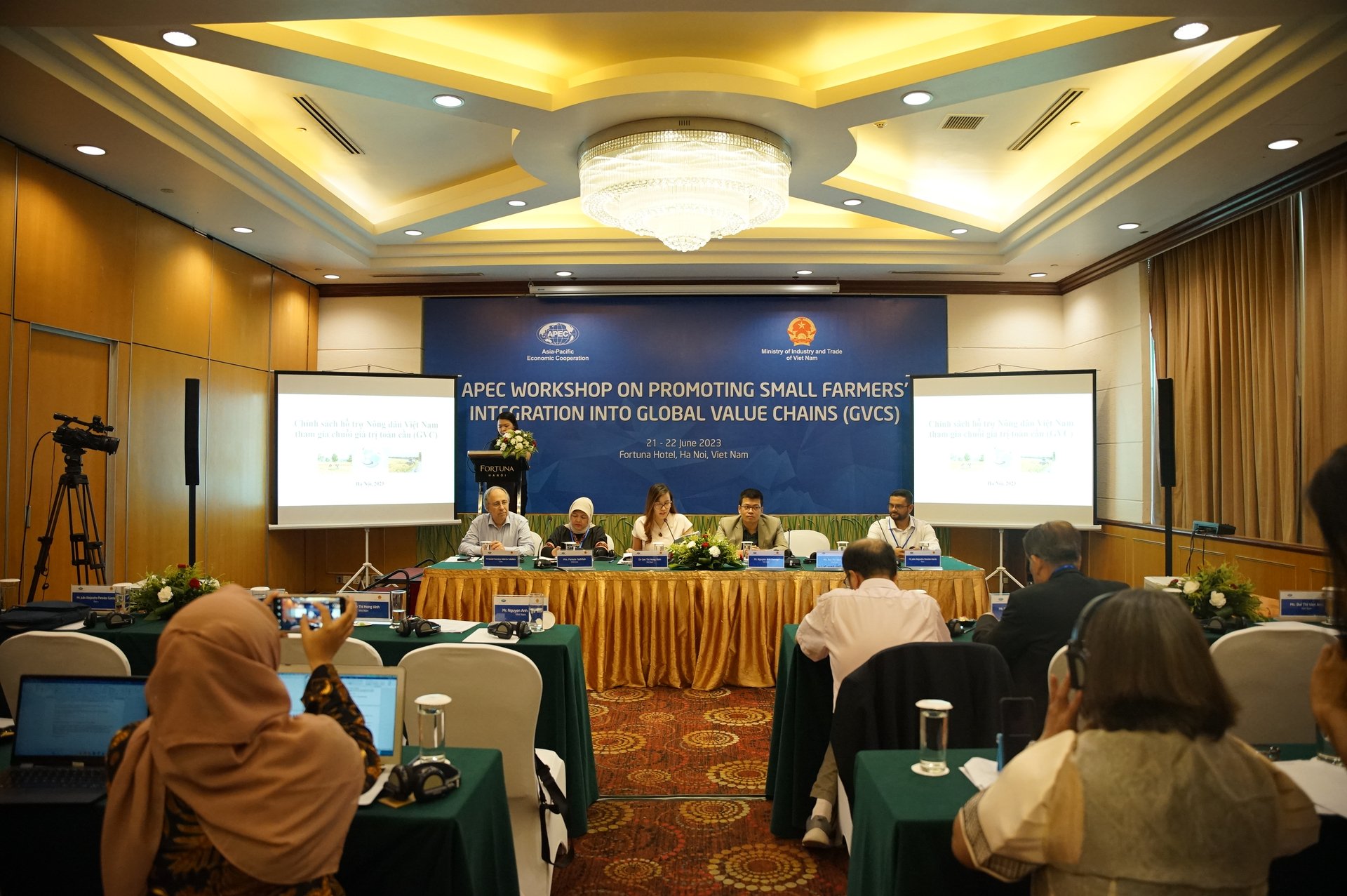
The content of the workshop focused on promoting the effective integration of manufacturers and smallholder farmers into global value chains.
In fact, farmers and small-scale producers encounter a great number of challenges integrating into the GVCs given their limited resources in land, access to technology, innovation, and bank loans, low skills, poor networking, etc. Besides, policies, incentives, and support programs are not specifically targeted to farmers and small-scale producers to enable their efficient participation in the value chains.
Mr. Nguyen Van Tien, Vice Chairman of the Association of Agricultural Economics and Rural Development, cited some challenges in practice from Vietnam, demonstrating that the small-scale production of smallholder farmers, fragmentation, poor networking, and inefficiency are significant barriers to participation in the global agricultural supply chain.
In addition, the level of labor in agriculture and rural areas is still generally low, and the population is aging (the proportion of people aged 50 and older increased from 10.4% in 2006 to 15.2% in 2011 and 26.9% in 2020).
While science-technology, innovation, and human resource training are still limited, they have not yet become the primary driving force behind development breakthroughs; farmers' incomes remain low, and the role of associations, professional social organizations, and rural communities has not been fully promoted.
In order to overcome limitations and capitalize on new opportunities, Mr. Tien proposed a number of solutions, such as promoting training, improving the level and subject capacity of farmers, raising awareness and qualifications in the direction of "intellectualizing farmers" so that they can master technology in production, processing, and trade, and become prospering from agriculture; perfecting institutions and policies on the organization of the value chain of agricultural and food products; and establishing institutions and policies on the organization of the value chain of agricultural and food products.
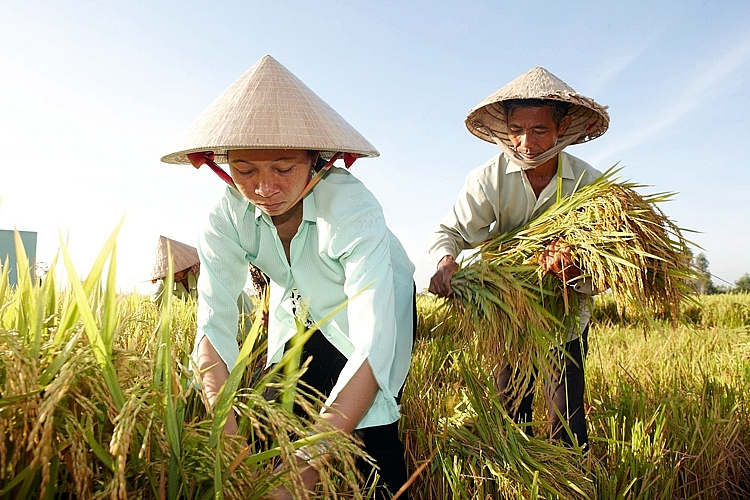
The livelihoods of approximately 2.2 billion people are linked to small-scale agriculture, being that it is the predominant form of agriculture in many developing and developed economies. Photo: TL.
Ms. Pham Quynh Mai, Deputy Director of the Multilateral Trade Policy Department at the Ministry of Industry and Trade and Vietnam's senior official to APEC, stated that the content of the workshop focused on promoting the effective integration of manufacturers and smallholder farmers into global value chains.
The workshop presented opportunities, challenges, and lessons for promoting farmers' participation in global value chains by sharing in-depth knowledge on the current state of their participation in value chains.
Ms. Mai stated that the participation of small-scale farmers in the global value chain benefits both farmers and value chain participants. Smallholders have the opportunity to participate in the value chains in order to tap into niche markets with a growing global demand for new and unique products. To guarantee more active participation in this value chain, however, smallholders must still surmount a great number of obstacles.
“The application of global standards facilitates smallholders' access to regional and global markets through their innovative capabilities. There are numerous ways to encourage the participation of smallholder farmers in this extensive value chain, including programs, the formation of clusters, groups, and cooperatives, and marketing strategies geared toward small farmers. Mai opined that there should be close cooperation between the government, local authorities, and non-governmental organizations to strengthen the capacity of farmers to help them participate in global value chains.
Translated by Dieu Linh

(VAN) Dak Lak Province is implementing a range of measures to reduce environmental risks, safeguard production, and enhance the value of freshwater cage aquaculture on rivers and reservoirs.

(VAN) Deputy Minister Hoang Trung hopes that first agricultural counselors in key markets would contribute to the sector’s growth objectives.

(VAN) Deputy Minister Dang Ngoc Diep expressed confidence that the messages and initiatives emerging from the event series will resonate widely among the public, driving meaningful shifts in environmental awareness and action.

(VAN) Minister Trinh Viet Hung held bilateral working sessions with Singapore and Thailand to deepen cooperation in high-tech agriculture, environmental management, digital transformation and sustainable development.

(VAN) Following the countryside development strategy, the eco-museum model offers a new approach by returning heritage to communities and the village spaces.

(VAN) To make South-South cooperation truly effective, it is time to move beyond a narrow focus on technical transfer and adopt a long-term, systemic, and field-oriented approach.

(VAN) What Tuyen Quang’s agricultural sector seeks is not merely investment, but also large-scale production zones, modern value chains and greater opportunities for farmers to prosper.
