December 5, 2025 | 17:03 GMT +7
Hotline: 0913.378.918

December 5, 2025 | 17:03 GMT +7
Hotline: 0913.378.918
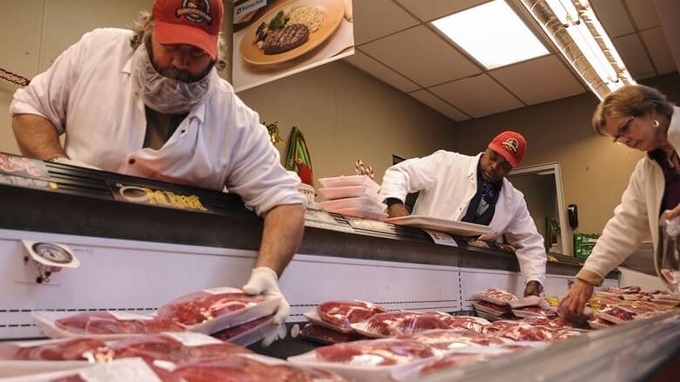
Brazilian meat processing giant JBS supplies meat to companies all over the world. Photo: The Guardian.
Shares of JBS SA, the world’s biggest meat company, and other Brazilian beef producers slumped on the news that China is starting a probe into its imports of the meat, which have surged in recent years.
The Asian country, the world’s largest beef buyer, will decide if a surge in shipments from overseas has hurt the domestic industry, the Ministry of Commerce said Friday. The investigation, launched at the request of China’s domestic industry associations, is likely to end within eight months, but may be extended under special circumstances, according to a statement on the ministry’s website.
Any protectionist measures from China are likely to hurt major exporters, including Brazil, Argentina and Australia, as well as companies in the US.
Concerns over a potential drop for sales sent JBS and others tumbling. The top meat packer was among the worst performers in Brazil’s benchmark Ibovespa index on Friday, falling as much as 3.3%. Minerva SA dropped 3.1%, and Marfrig Global Foods SA lost as much as 7.8%.
China imports surged between 2019 and mid-2024, dealing a blow to the domestic industry, groups representing the animal husbandry sector from several top producing regions said in their petitions. China’s beef producers are struggling with huge losses after local prices plunged to multi-year year lows due to oversupply and sluggish consumption.
Brazil accounts for almost half of China’s total beef imports, and the Asian country holds similar significance for Brazil, typically purchasing nearly half the nation’s exports of the meat.
“It’s a nuisance, of course,” said Roberto Perosa, the president of the Brazilian Association of Beef Exporters. Still, he says Brazilian producers can be competitive even in a scenario of higher tariffs. The group also will also work to open new markets for Brazilian beef in hopes of diversifying exports in the long term. Ongoing efforts include negotiations with Japan, Vietnam, South Korea and Turkey, Perosa said.
Brazil’s Agriculture Ministry, Trade Ministry and Foreign Relations Ministry said in a joint statement that the country will seek to demonstrate that its beef exports don’t cause any kind of damage to the Chinese industry, and simply complement local production.
China’s move could also be a blow to North American companies.
US beef exports to China and Hong Kong climbed 16% in October to the largest in more than a year, according to the US Meat Export Federation. Still, overall exports to China in the January-to-October period are down 8%. The USMEF said it’s aware of the investigation and will be monitoring its progress.
In Argentina, the head of Argentine beef industry group Ciccra Miguel Schiariti said the nation is a much smaller exporter and therefore less likely to be targeted by any potential tariffs from China.
Still, Argentina’s government said it’s paying “maximum attention” to developments amid concern about the impact that any measures by China would have on Argentina beef exports there. China accounts for about two-thirds of Argentine beef exports.
Some earlier probes by China against other countries resulted in hefty taxes. It slapped anti-dumping duties in 2020 on Australian barley as diplomatic tensions escalated between the two trading partners.
Even though Brazil has embraced closer ties with Beijing, it has also pushed back against a perceived deluge of cheap exports from China.
Brazil imposed new tariffs on various products from China and other Asian nations in October, including a duty increase on fiber optics and cables, and iron and steel products.
Bloomberg

(VAN) As of 2025, the ASEAN region has a total of 69 ASEAN Heritage Parks recognized across its 10 member states. Among them, Viet Nam contributes 15 ASEAN Heritage Parks.

(VAN) Yok Don National Park has high biodiversity with numerous endemic plant and animal species, and it is also the only dipterocarp forest ecosystem conservation area in Viet Nam.

(VAN) Viet Nam and Brunei signed two important MOUs on fisheries and IUU, expanding cooperation in agriculture, the environment, and Halal exports, aiming to substantively implement joint projects.

(VAN) The Viet Nam Coconut Association worked with the International Finance Corporation (IFC) and businesses to promote the supply chain, enhance competitiveness, and develop the coconut industry sustainably.
![Hue aims for Net Zero: [2] Pioneering low-emission tourism](https://t.ex-cdn.com/nongnghiepmoitruong.vn/608w/files/huytd/2025/12/04/0633-dulichzero-4-095634_236-161125.jpg)
(VAN) The ancient capital of Hue has developed Net Zero tourism products and models, aiming to reduce carbon emissions and pioneer the establishment of Viet Nam's green tourism destination.

(VAN) C.P. Viet Nam has announced the successful completion of its goal to plant 1.5 million trees during the 2021-2025 period, a key milestone within company's long-term ESG strategy and its roadmap for emission reduction.

(VAN) This is an initiative of MAE aimed at creating a unified coordination mechanism to implement agricultural cooperation programs with developing countries.
