December 4, 2025 | 04:17 GMT +7
Hotline: 0913.378.918

December 4, 2025 | 04:17 GMT +7
Hotline: 0913.378.918
The move came from a project Sustainable Agricultural Transformation in Vietnam (VNSAT), which has been widely conducted in the Cuu Long (Mekong Delta). The farmers previously produced 2 or 3 rice crops per year, but they now grow vegetables instead of one rice crop, which are inefficient such as Summer-Autumn and Spring-Summer crops.

The Kien Giang VnSAT Project Management Board organizes a workshop, transferring the intercropping technology to farmers in the Cuu Long (Mekong Delta). Photo: Trung Chanh.
To gain this success, farmers have received support and intercropping technology from the VnSAT Project Management Board.
Speaking at a workshop held recently in the southern province of Kien Giang, Vo Thi Hong Thuy, a technical officer of Kien Giang VnSAT project said the workshop focused on transferring techniques of growing short-term vegetables on paddy field, in which technicians and farmers discussed and chose the most suitable model.
Thuy said the project helps farmers build the model in the coming Spring-Summer crop. In addition, farmers can also apply the model of growing vegetables on the edge surrounding the paddy field to increase income.
According to Nguyen Thanh Hung, the Chairman of the Doan Ket I Agricultural Cooperative in Kien Giang Province, the new model of intercropping subsidiary crops with paddy field, with new technology and solutions, has helped local farmers cut cost, save working time and minimize diseases for rice crop and vegetables as well.
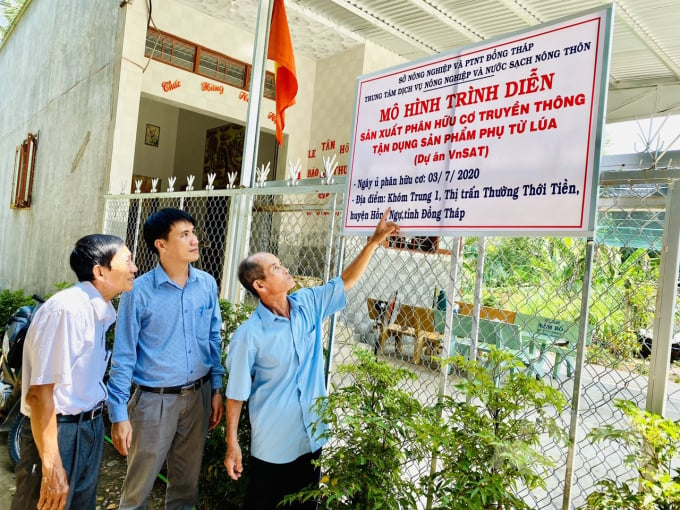
Dong Thap VNSAT Project Management Board (the central) announces a workshop introducing the production of mushroom by rice by-products in Dong Thap Province. Photo: Le Hoang Vu.
“We have cooperated with companies to consume rice for the farmers. The consumption of subsidiary crop is quite easy, bringing higher economical value for farmers,” Hung said.
In An Giang Province, the VnSAT project has been implemented in 45 communes of 5 districts including Chau Phu, Thoai Son, Tinh Bien, An Phu and Tri Ton since the Autumn-Winter crop of 2016, of which 26,000 farming households have benefited technical support for their 38,600 ha in the total.
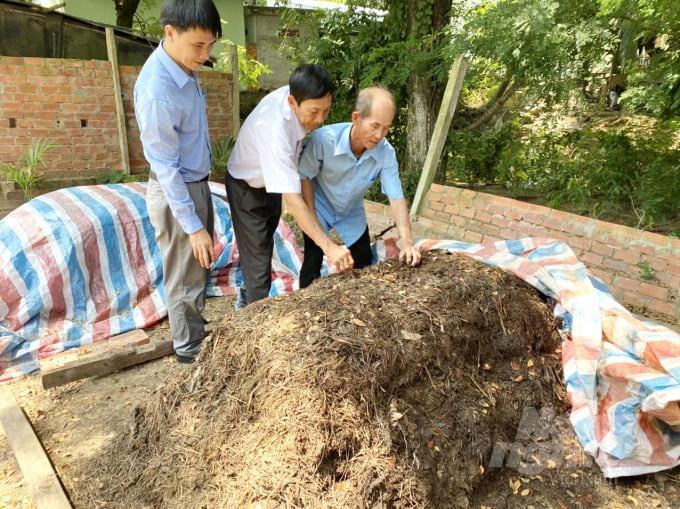
Participating in the VnSAT project, farmers are trained in the use of rice by-products to compost organic fertilizers for clean agricultural production, helping reduce environmental pollution. Photo: Hoang Vu.
Nguyen Van Minh, a farmer of Vong Dong Agriculture Cooperative in Thoai Son District, said his family has 2 ha of rice with 3 crops per year.
“My Summer-Autumn rice crop often suffers from pests and disease, making low income. Over the past 2 years, I have applied VnSAT intercrop model in this crop that has helped me earn high profits,” Minh said.
By-products – a new source of income
Rice production does not only affect the environment due to the use of land, water, fertilizers, and chemical drugs, but also cause pollution by its by-products such as straw and rice husks.
Using by-products is also a key part of the VnSAT project.
The project has trained farmers to use straw to produce mushrooms and compost organic fertilizer for crops. Meanwhile, the rice husk is used to produce husk pellets for export.
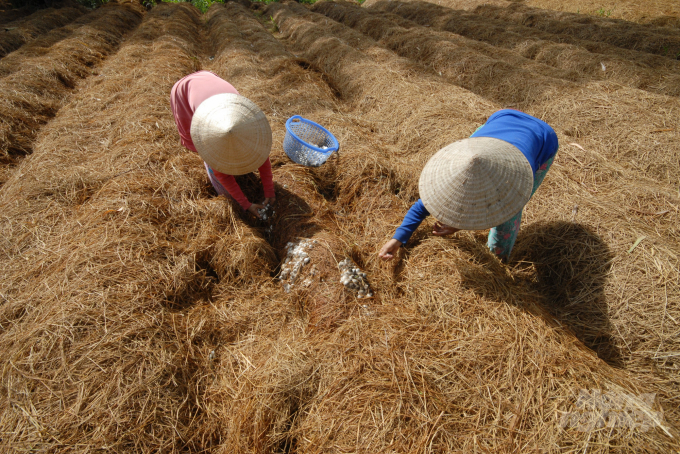
Nhờ được dự án VnSAT hỗ trợ tập huấn kỹ thuật, rất nhiều hộ nông dân ĐBSCL đã biết tận dụng sản phẩm phụ từ lúa gạo để trồng nấm rơm, tạo việc làm, tăng thu nhập. Ảnh: Hoàng Vũ.
The VnSAT project aims to contribute to implementing restructuring programme in the agriculture sector, focusing on strengthening the sector's institutional capacity, reforming the farming management and enhancing value chains for rice and coffee, in the two hubs of the Mekong Delta and the Central Highlands, respectively.
Under the project, about 200,000 ha of rice will be applied advanced technology, that will increase the farmer's profit by 30 per cent per ha, bringing the total added value for the Mekong Delta of US$ 40-60 million per year.
About 140,000 rice farmers in the Mekong Delta will apply sustainable farming techniques and join in the value chain from production to consumption, with the support from businesses and cooperatives. It is expected to decrease environmental pollution by reducing the amount of irrigation water, the volume of fertilizers and pesticides in the rice cultivation process, and taking use of by-products in rice cultivation to move towards a closed ecological model.
Authors: D.T.Chanh - Le Hoang Vu. Translated by Tramy Nguyen. Edited by Duc Huy.
/2025/12/01/0509-2-175427_206.jpg)
(VAN) Emission-reducing coffee areas in Lam Dong have entered the new crop with stable yields, improved quality, and a remarkably enhanced cultivation environment.

(VAN) The Institute of Agricultural Sciences for Southern Vietnam (IAS) marked its 100th anniversary in Ho Chi Minh City, celebrating a century of growth as a leading institute contributing significantly to Viet Nam’s agricultural development.

(VAN) An increasing number of livestock farms are using biogas generators to create a source of renewable electricity, helping to save costs and mitigate environmental pollution.

(VAN) Small changes in rice cultivation, from irrigation methods and straw collection to input management, are paving a new way for Vietnam's agriculture in the journey toward emission reduction.

(VAN) With the project of converting biogas into renewable electricity, Australia is both helping pig farms reduce their energy costs by up to 25% and contributing to environmental protection.
![Hue aims for Net Zero: [1] Initial steps from green transportation](https://t.ex-cdn.com/nongnghiepmoitruong.vn/608w/files/huytd/2025/11/28/0853-anh-6-giao-thong-xanh-hue-094717_940-153724.jpg)
(VAN) For sustainable development, Hue City is implementing many solutions to promote green transportation, which is an important initial step on the journey to building a Net Zero Hue.

(VAN) Nghe An Province, one of the localities with the largest forest area in Vietnam, is set to gain significant benefits from the implementation of forest carbon credit payments.
