December 2, 2025 | 02:03 GMT +7
Hotline: 0913.378.918

December 2, 2025 | 02:03 GMT +7
Hotline: 0913.378.918
A clean environment, abundant food sources, and strong protection measures have, in recent years, made Nui Chua - Phuoc Binh National Park (Khanh Hoa province) a ‘red address’ for sea turtles to nest and lay eggs.
Records show that sea turtles come ashore to nest every year at the marine protected area of Nui Chua - Phuoc Binh National Park, with Bai Ngang - Bai Thit serving as their main nesting site.
According to Mr. Tran Van Tiep, Director of Nui Chua—Phuoc Binh National Park, the park has conducted surveys of nesting beaches and turtle species that come ashore in its marine area since 2000 with the support of the World Wide Fund for Nature (WWF) and the provincial Department of Science and Technology.
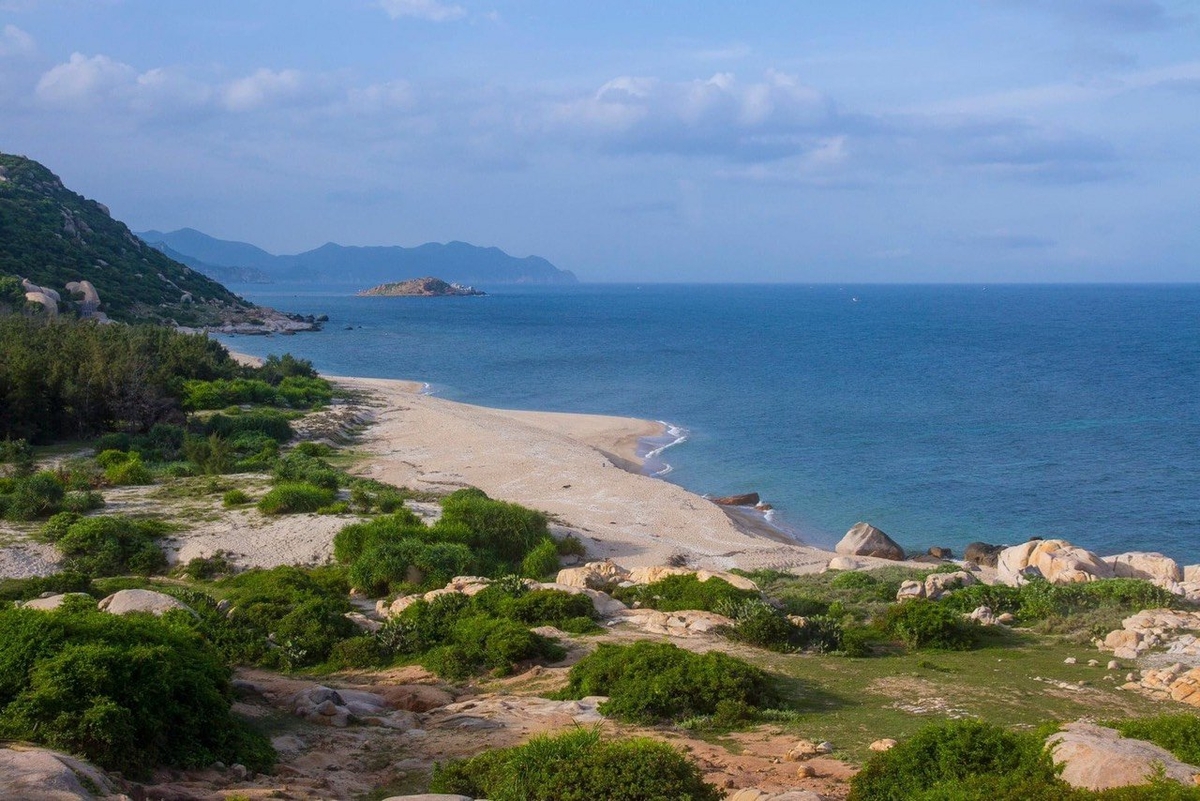
There are a lot of nesting beaches for sea turtles at Nui Chua - Phuoc Binh National Park. Photo: MP.
These surveys identified several nesting beaches, with the primary ones being Bai Hom - Suoi Sau - Go Bu, Bai Ngang - Bai Thit - Bai Mong Tay. In addition, other beaches are inside and around the marine protected area where turtles occasionally nest. The park has identified three species that nest regularly: the green turtle (Chelonia mydas), the hawksbill turtle (Eretmochelys imbricata), and the olive ridley turtle (Lepidochelys olivacea).
"Green turtles are the most frequent nesters, coming ashore every year. The main nesting beaches are designated no-fishing zones during the nesting season, with park rangers and community members patrolling nightly. Beaches where turtles nest only occasionally are inspected regularly by staff and community members to record and protect the nests. Currently, Nui Chua - Phuoc Binh National Park has eight identified turtle nesting beaches," Mr. Tiep said.
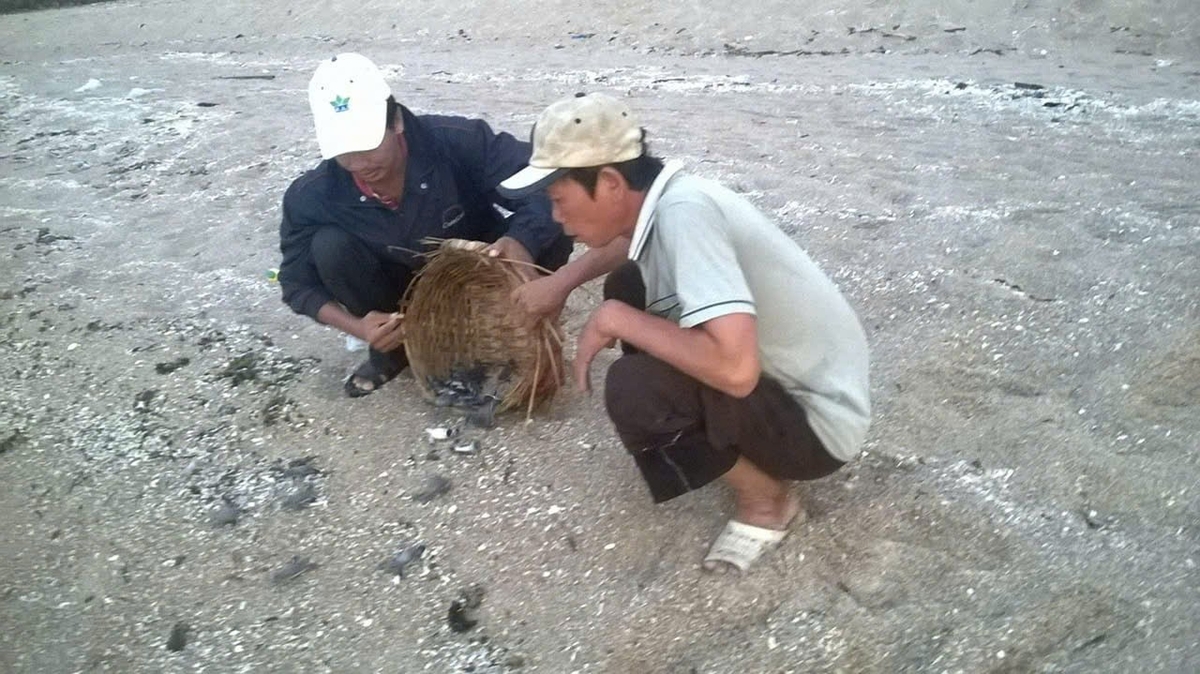
Local community has engaged in turtle conservation programs and released hatchlings. Photo: MP.
He also noted that since 2000, the park has established two sea turtle protection stations at Bai Thit - Bai Ngang and Bai Hom, initially staffed by 12 local community volunteers. Thanks to effective awareness campaigns, the number of community volunteers protecting sea turtles has steadily increased, now reaching 22 members who not only participate in turtle rescue and protection but also in safeguarding coral reefs, seagrass beds, and mangrove forests.
Since 2016, the park has worked with both domestic and international organizations to run sea turtle conservation programs involving volunteers nationwide. These initiatives combine sea turtle rescue and protection with English and computer training, integrated into environmental and wildlife education activities.
"Every year, the park prepares plans for patrolling and protecting nesting turtles, rescuing and releasing hatchlings into the sea, and for receiving, rehabilitating, and returning injured or stranded turtles to the wild," Mr. Tiep added.
To protect sea turtles, every year Nui Chua - Phuoc Binh National Park develops patrol plans for both marine and nesting beaches. The key forces involved include the Provincial Fisheries Sub-Department, Border Guards, forest rangers, the Special-Use Forest Management Board, commune authorities, and community volunteers.
In addition, the park regularly conducts annual training courses on sea turtle conservation techniques for volunteers nationwide. In 2023, 240 people took part; in 2024, the number rose to 247. The park also organizes programs for students and young people from across the country to study and learn about sea turtles, with 1,000 participants in 2023 and 700 in 2024.
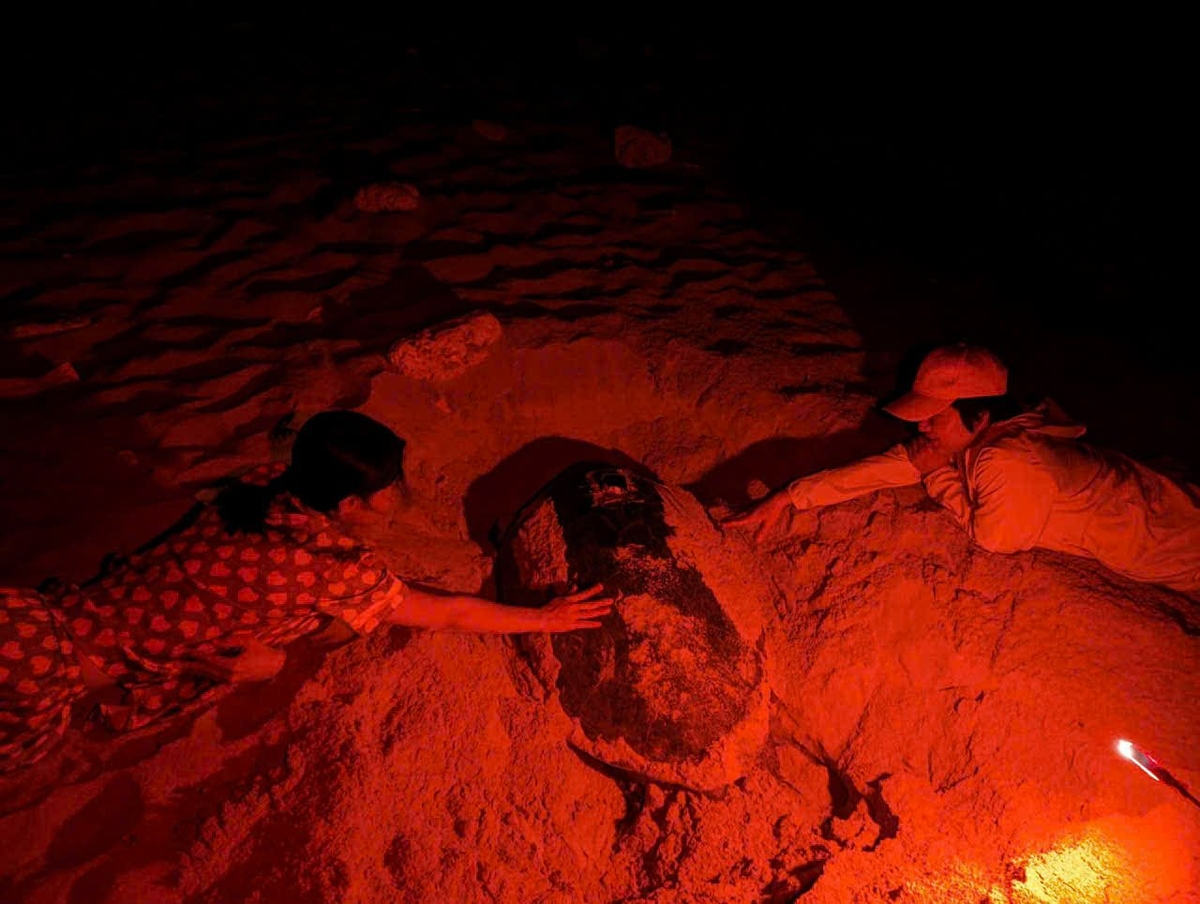
The young took care of turtles nesting (midwifery assistance). Photo: MP.
"On a regular basis, Nui Chua National Park, in coordination with IUCN Vietnam, conducts training for staff, local communities, and volunteers on species identification, rescue techniques for nesting turtles, releasing hatchlings into the sea, and rescuing turtles entangled in fishing nets, hooks, or stranded ashore," said Tran Van Tiep.
From 2023 to 2025, the park, together with Fauna & Flora International (FFI), installed 12 temperature-monitoring devices at nesting beaches, 6 tracking devices for nesting females, of which 3 have recorded migration routes between nesting intervals, and purchased 2 satellite tracking devices. All nesting females are tagged for identification.
Before each nesting season, the park implements beach-cleaning plans, mobilizing volunteers to collect and transport waste to treatment plants. In partnership with IUCN and FFI Vietnam, the park also levels and improves nesting beaches to facilitate turtle nesting.

In partnership with IUCN and FFI Vietnam, the park also levels and improves nesting beaches to facilitate turtle nesting. Photo: MP.
According to Director Tran Van Tiep, 2021 recorded the highest number of nesting visits of 78 in total, resulting in 23 clutches with 1,377 eggs, of which 829 hatched and 810 hatchlings were released to the sea. In 2022, there were 68 nesting visits with 17 clutches totaling 1,542 eggs, yielding 1,282 hatchlings, of which 1,262 were released. In 2023, 64 nesting visits produced 24 clutches with 2,306 eggs, resulting in 1,936 hatchlings and 1,858 released.
"As of August 6, 2025, we have recorded 28 nesting visits producing 16 clutches with 407 eggs, including 42 that failed to develop, and 362 hatchlings. 361 of which were released to the sea. Notably, thanks to effective protection efforts and extensive public awareness campaigns, no illegal sea turtle harvesting or catching has been recorded in the marine protected area of Nui Chua - Phuoc Binh National Park in recent years," Tiep added.
Translated by Kieu Chi

(VAN) The Institute of Agricultural Sciences for Southern Vietnam (IAS) marked its 100th anniversary in Ho Chi Minh City, celebrating a century of growth as a leading institute contributing significantly to Viet Nam’s agricultural development.

(VAN) An increasing number of livestock farms are using biogas generators to create a source of renewable electricity, helping to save costs and mitigate environmental pollution.

(VAN) Small changes in rice cultivation, from irrigation methods and straw collection to input management, are paving a new way for Vietnam's agriculture in the journey toward emission reduction.

(VAN) With the project of converting biogas into renewable electricity, Australia is both helping pig farms reduce their energy costs by up to 25% and contributing to environmental protection.
![Hue aims for Net Zero: [1] Initial steps from green transportation](https://t.ex-cdn.com/nongnghiepmoitruong.vn/608w/files/huytd/2025/11/28/0853-anh-6-giao-thong-xanh-hue-094717_940-153724.jpg)
(VAN) For sustainable development, Hue City is implementing many solutions to promote green transportation, which is an important initial step on the journey to building a Net Zero Hue.

(VAN) Nghe An Province, one of the localities with the largest forest area in Vietnam, is set to gain significant benefits from the implementation of forest carbon credit payments.

(VAN) Circular agriculture helps Mekong Delta farmers cut greenhouse gas emissions while boosting incomes through efficient reuse of agricultural by-products.
