July 21, 2026 | 17:58 GMT +7
Hotline: 0913.378.918

July 21, 2026 | 17:58 GMT +7
Hotline: 0913.378.918
Shrimp farming has long been a vital source of livelihood for the residents of Hoang Chau commune, Thanh Hoa Province. However, in recent years, climate change, extreme weather, and disease outbreaks have exposed many limitations and rising risks within traditional farming methods.
Mr. Le Van Phuong's family repeatedly suffered severe losses due to mass shrimp mortalities. Driven by this reality, in 2018 he began experimenting with high-tech whiteleg shrimp farming on approximately 1 hectare of land.
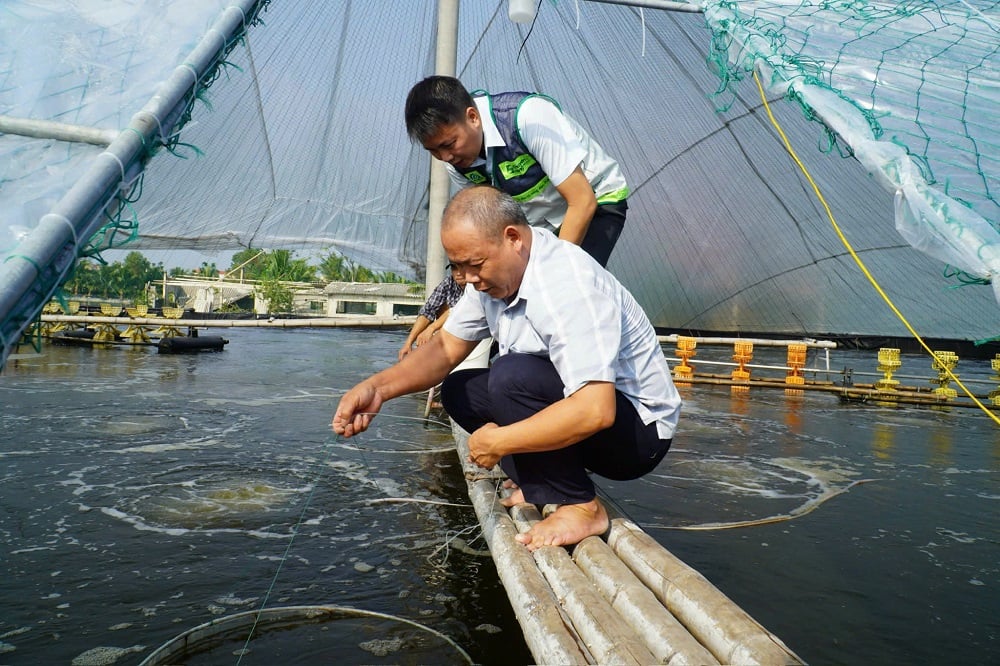
Mr. Le Van Phuong of Hoang Chau commune practices high-tech shrimp farming, boosting economic efficiency. In 2018 he began experimenting with high-tech whiteleg shrimp farming on approximately 1 hectare of land. Photo: Thu Thuy.
The core difference of this model lies in applying a three-stage farming workflow inside netting houses, which helps increase the survival rate of seed stocks and limit diseases from the start of the crop season. Following a trial period, the significantly higher economic returns compared to traditional extensive farming motivated him to expand his investment.
By 2021, he had renovated his entire 5-hectare farm into a high-tech system, with a total investment of around 10 billion VND. The synchronized infrastructure comprised separate plastic-lined elevated ponds, settling ponds, and water treatment ponds, along with a closed water supply and drainage network.
In addition, the farm installed automatic paddlewheel aerators, air-injection systems, and monitoring devices to continuously track critical indicators, including temperature, pH, dissolved oxygen, and water quality. Utilizing technology enables the grower to proactively control the environment, lower the risk of disease outbreaks, and elevate the success rate of each farming cycle.
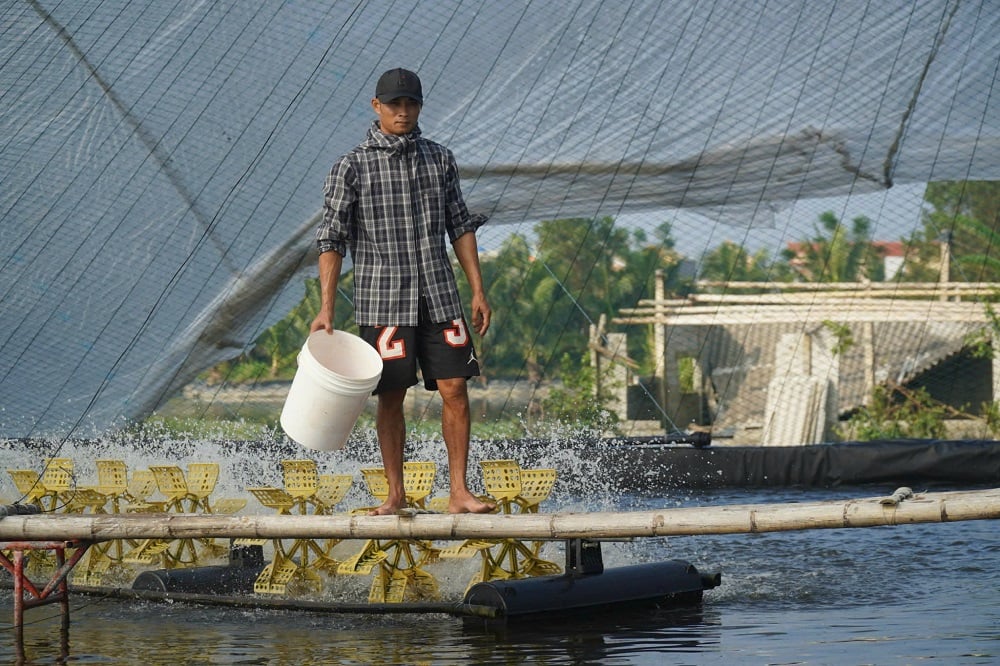
The high-tech shrimp farming model applies a three-stage cultivation workflow inside netting houses, helping raise the survival rate of breeding stocks and limit diseases right from the start of the crop season. Photo: Thu Thuy.
Currently, alongside associated households, Mr. Phuong operates 38 farming ponds across an acreage of about 5 hectares and is continuing to expand production scale, which includes building a dedicated nursery zone to secure a proactive source of high-quality breeding stocks.
Beyond investing in infrastructure, Mr. Phuong focuses on applying technical progress throughout the cultivation process. Instead of abusing chemicals and antibiotics, the farm prioritizes the use of microbial products to treat the environment, decompose organic matter, and maintain stable water quality.
Environmental parameters are tested and recorded daily for timely adjustments whenever fluctuations occur. Consequently, the shrimp grow healthily, maintain high survival rates, and require shorter farming periods, while production costs drop significantly.
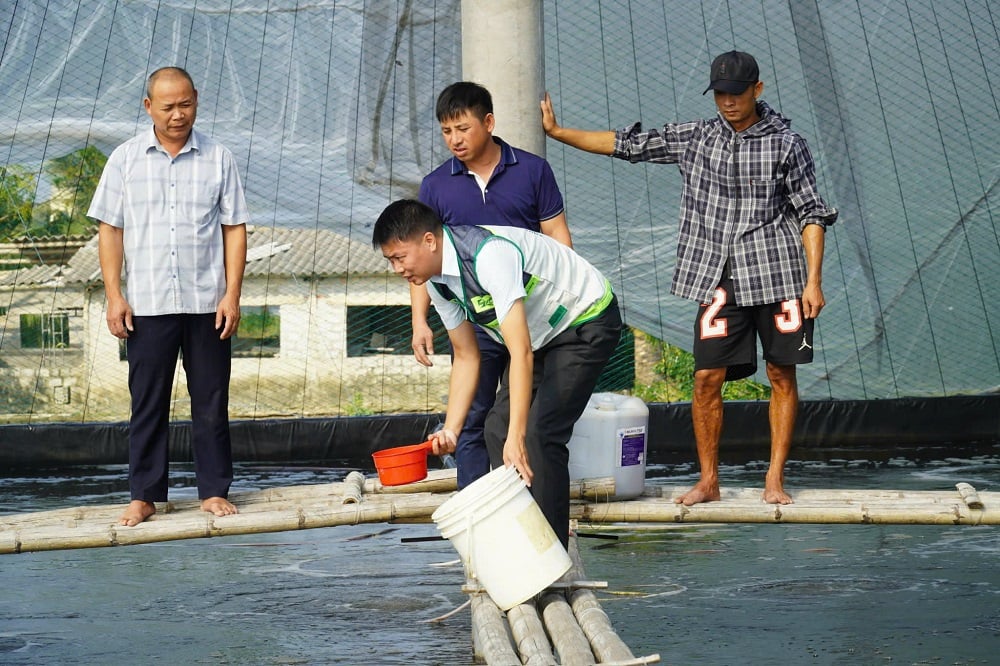
Caption: Mr. Le Van Phuong's shrimp farming model stands as one of the highly effective high-tech application examples locally, not only boosting productivity but also minimizing environmental impacts and driving sustainable development. Photo: Thu Thuy.
Each year, the farm carries out three cultivation cycles, yielding an output of approximately 50-70 tons of commercial shrimp. The average revenue reaches around 12 billion VND (USD 459.929), while the net profit after deducting expenses stands at nearly 5 billion VND (USD 191.637) per year. The model also generates regular employment for about 20 local workers.
According to Mr. Phuong, to practice high-tech shrimp farming efficiently, growers must place severe focus on selecting breeding stocks with clear origins, renovating ponds according to proper workflows, tightly managing water quality, and building alliances with enterprises to secure a stable output market.
In parallel with expanding production, he actively shares technical experience with numerous farming households in the region, contributing to driving the transition from traditional farming methods to science- and technology-applied models, raising the survival rate of breeding stocks.
Experts evaluate that this is one of the highly effective examples of high-tech application in the locality. Investing synchronously from infrastructure to environmental management workflows not only boosts productivity and product quality but also minimizes environmental impacts, aligning with sustainable fisheries development orientations.
In the context where the aquaculture sector must adapt to climate change and increasingly higher food quality demands, Mr. Le Van Phuong's model demonstrates that scientific and technological applications are becoming a vital solution to help growers control risks, enhance product value, and develop the shrimp farming trade along modern, sustainable lines.
$ 1 = VND 26,091 - Source: Vietcombank.
Translated by Ha Chi
/2026/07/20/1547-1-180442_204.jpg)
(VAN) A farmer in Can Tho has found the secret to raising giant water bugs that produce intensely aromatic essence, earning annual profits of hundreds of millions of dong.

(VAN) From crop conversion to deep processing, Ba Che Commune in Quang Ninh Province is building a comprehensive cinnamon value chain that creates sustainable livelihoods while strengthening the local forestry economy.

(VAN) The ACIAR-SunRice public-private partnership, rooted in science and sustainable development, is expected to support rice farmers in the Mekong Delta.

(VAN) Linking the shrimp, rice, and coffee sectors through a circular economy model is opening up a new pathway for Viet Nam's agriculture.

(VAN) HCMC is accelerating the transition to circular industry by transforming industrial parks into eco-industrial zones, fostering industrial symbiosis, and expanding international partnerships for green manufacturing.
(VAN) The digital map of raw material zones is expected to resolve overlapping investments, ensure production transparency, and accelerate deep processing in the coconut industry.
(VAN) Transforming barren hills once dedicated only to acacia and cassava, the Anh Mai Medicinal Plant Cooperative has found a new direction with red turmeric, opening up sustainable livelihoods for local residents.
