December 3, 2025 | 18:55 GMT +7
Hotline: 0913.378.918

December 3, 2025 | 18:55 GMT +7
Hotline: 0913.378.918
Recently, the United Nations Development Programme (UNDP) convened a technical consultation meeting to finalize the "Methodological Framework on Food and Nutrition Security in the Context of Climate and Environmental Change in Vietnam." More than 30 participants from both domestic and international organizations, including researchers and experts in health, public health, agriculture, and environment, took part in the workshop.
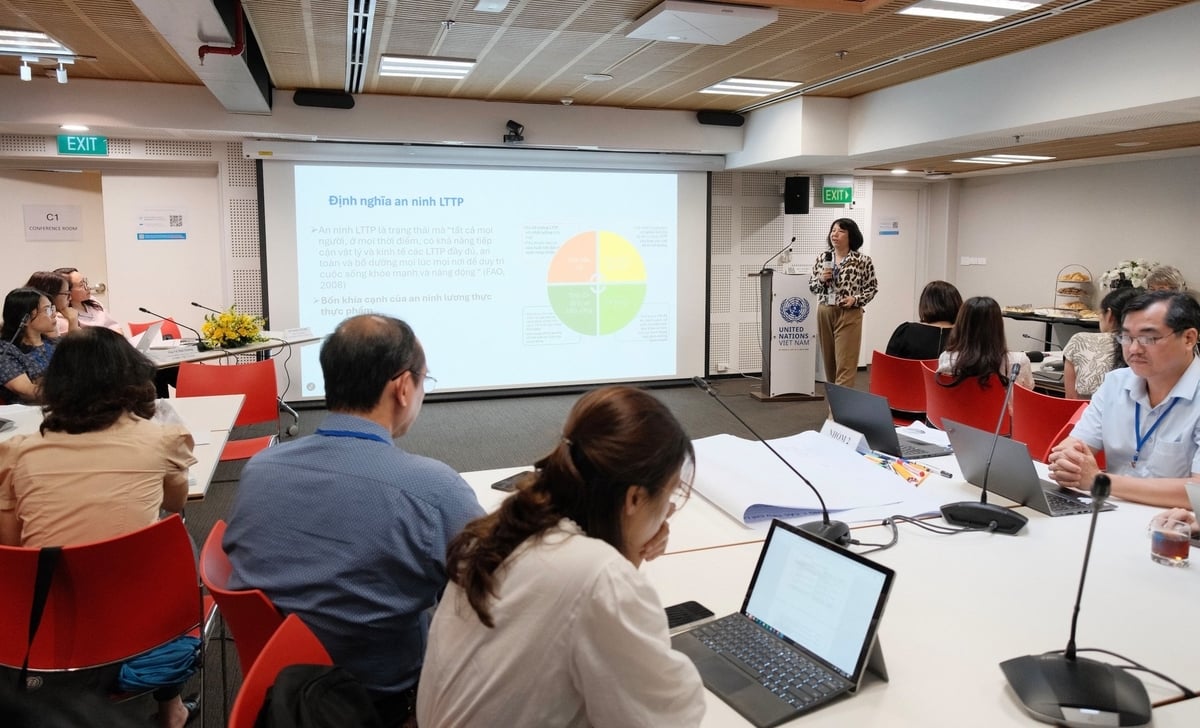
Mrs. Huynh Thi Thanh Tuyen, an expert in environmental issues, food and nutrition security, and consumer behavior, delivered a presentation during the consultation workshop. Photo: Quynh Chi.
The consultation workshop was supported by the Joint-SDG Fund for the Incubation of innovations in partnerships and financing for agrifood systems transformation in Viet Nam (MPTF Joint Programme), implemented by UNDP in collaboration with the Food and Agriculture Organization of the United Nations (FAO) and the International Fund for Agricultural Development (IFAD). This partnership directly supports the Government of Vietnam in enhancing its capacity to respond to shocks in nutrition, food systems, and environmental-climate challenges, contributing to the implementation of the National Action Plan on Food Systems Transformation - towards Transparency, Responsibility and Sustainability by 2030 (NAP-FST), which was approved by the Prime Minister in Decision 300 dated March 28, 2023.
“In the context of increasingly severe climate change, understanding the interconnections between nutrition and food systems under climate impacts is absolutely essential,” affirmed Associate Professor Dr. Truong Tuyet Mai, Deputy President of the National Institute of Nutrition (Ministry of Health).
According to Dr. Mai, Vietnam is facing a double burden of malnutrition. On one hand, the rate of undernutrition remains high, with approximately one in five children under the age of five suffering from malnutrition. On the other hand, the rates of overweight, obesity, and non-communicable diseases such as cardiovascular disease and diabetes are rising rapidly, especially in urban areas.
Malnutrition and micronutrient deficiencies are more severe in mountainous regions and among ethnic minority communities, where access to food and healthcare services remains limited. A 2020 survey in Yen Bai showed that between 34% and 47.62% of households lacked sufficient food following flash floods and landslides.
Under the worst-case scenario, global supply may decrease due to extreme weather: 23% for fruits, 16% for vegetables, and 22% for nuts and crop varieties. Scientists forecast that if this trend continues, 173 million people worldwide could suffer from folate deficiency and up to 71 million from vitamin A deficiency.
At the same time, food quality and safety are significantly affected. The decline in the production of nutrient-rich fruits and vegetables leads to changes in meal composition, increasing the risk of micronutrient deficiencies in communities. In livestock farming, heat stress reduces the average milk yield by approximately 5.5 kg per cow.
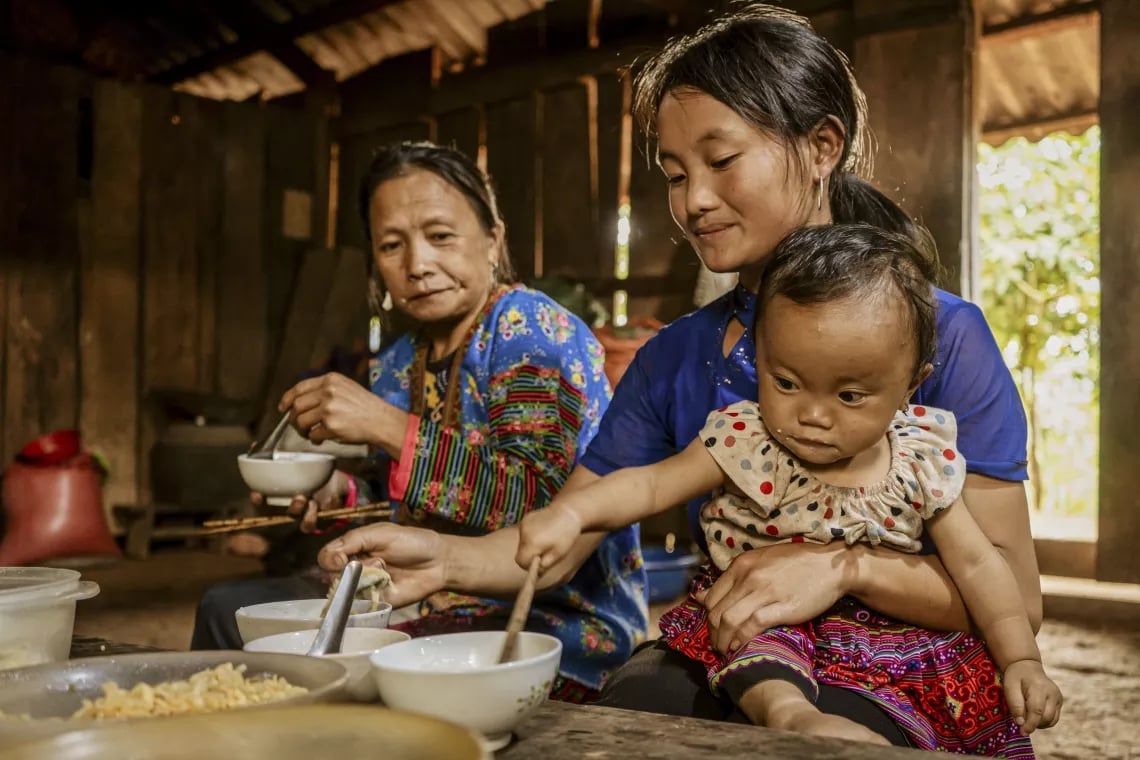
The United Nations has provided slow-cooked, nutrient-rich food to many mothers and children across the country. Photo: UNICEF.
At the meeting, the expert group shared the initial results of a study aimed at developing a climate–food systems–nutrition methodological framework and the criteria for selecting early warning indicator sets based on this framework. The experts emphasized that Vietnam needs to develop such a framework as a scientific foundation for decision-making. At the same time, it is essential to align resilient food systems transformation with programs that promote healthy diets.
The concept of food security was clarified in the experts' presentation, citing the FAO (2008) definition. According to this, food security exists when all people, at all times, have physical and economic access to sufficient, safe, and nutritious food to meet their dietary needs for an active and healthy life.
After reviewing and comparing 17 theoretical frameworks assessing the impacts of climate change on food system security, Mrs. Huynh Thi Thanh Tuyen, Food Environment and Consumer Behavior in the Asia & Pacific region, from the Alliance of Bioversity International and CIAT, stated that the framework by Baars et al. (2023) has several strengths and is well-suited for integration into the methodological framework on food and nutrition security in the context of climate and environmental change in Vietnam under this study.
“This theoretical framework has the advantage of analyzing both short- and long-term climate phenomena in detail, while also delving into the intrinsic elements of food system security and related health issues,” Mrs. Tuyen noted.
Thanks to its clear articulation of the linkages between climate change, food system security, and health, this theoretical framework has been adopted by the United Nations Economic and Social Commission for Asia and the Pacific (ESCAP) since 2022 to develop the Integrated Food System Risk Assessment (INFER) tool in various regions.
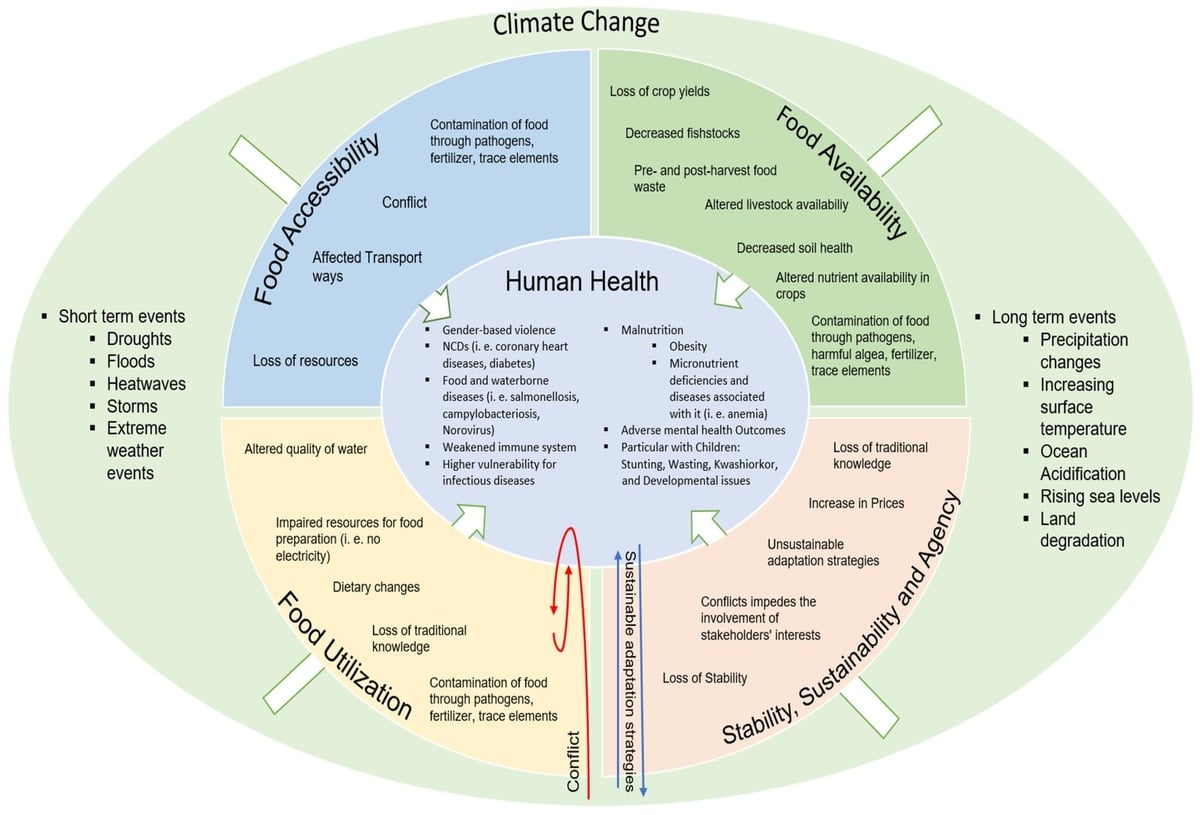
Theoretical framework on the impact of climate change on health through food and nutrition security. Photo: Baars et al. (2023).
The idea proposed by the expert group received positive feedback from delegates due to its long-term vision and early action orientation, which effectively promoted connections among stakeholders within the food and nutrition security system.
One of the top priorities emphasized by scientists is establishing a synchronized and integrated data-sharing mechanism that encompasses both domestic and international data.
Moreover, data also reflects the relationships between food consumption behavior, healthcare practices, medical and sanitation conditions, and the broader socio-economic context. This serves as the foundation for evidence-based policymaking aimed at sustainable and equitable development.
Associate Professor, Dr. Dao The Anh, Deputy Director of the Vietnam Academy of Agricultural Sciences (VAAS), noted that in recent government meetings, the Prime Minister has repeatedly stressed the importance of data connectivity and sharing among state agencies. This is regarded as an essential step in national management and administrative reforms.
Data plays a crucial role in the process of building a digital government and analyzing the correlations between climate change, public health, and the stability of food supply chains. When data is comprehensively collected and analyzed, the government can make faster and more accurate policy decisions, thereby enhancing its ability to respond to risks such as nutrition crises, supply disruptions, and the impacts of climate change.
***
References:
Nga Thanh Thi Pham, Duy Nong, Archana Raghavan Sathyan, Matthias Garschagen. 2020. "Vulnerability assessment of households to flash floods and landslides in the poor upland regions of Vietnam." Climate Risk Management, Issue 28.
Baars, Caterina, Jelena Barbir, João Henrique Paulino Pires Eustachio. 2023. "How Can Climate Change Impact Human Health via Food Security? A Bibliometric Analysis." Environments, Vol. 10, No. 11.
Translated by Kieu Chi

(VAN) This is an initiative of MAE aimed at creating a unified coordination mechanism to implement agricultural cooperation programs with developing countries.

(VAN) Con Dao National Park officially received its Green List status after it was announced at the IUCN World Conservation Congress in Abu Dhabi in October.

(VAN) The National Assembly’s inspection delegation called for a renewed approach to marine economic development, the removal of legal 'bottlenecks,' and strengthened marine environmental protection.

(VAN) The inevitable path forward is to reorganize production along the value chain, utilizing cooperatives as the core, enterprises as the driving force, and farmers as the central subjects.

(VAN) On November 28, Minister Tran Duc Thang, together with China's Minister of Agriculture and Rural Affairs Han Jun, chaired the 2nd meeting of the Viet Nam - China Agricultural Cooperation Committee.

(VAN) Forest carbon credits are only accepted when they ensure absolute environmental integrity, additionality, permanence, and transparency.

(VAN) Viet Nam partners with Beijing on controlling air pollution, cross-regional management, high-tech monitoring and relocating polluting facilities.
