December 1, 2025 | 11:48 GMT +7
Hotline: 0913.378.918

December 1, 2025 | 11:48 GMT +7
Hotline: 0913.378.918
From October 9 to 11, the Kick-off Workshop of the Capacity Building for Sustainable and Low-Carbon Rice Innovations in Southeast Asia (CABIN) project took place in Can Tho city. The project is supported by the Taiwan International Cooperation and Development Fund (Taiwan ICDF) and implemented by the International Rice Research Institute (IRRI) for the period 2024 - 2028, with the participation of 5 Southeast Asian countries: Cambodia, Indonesia, Laos, Philippines and Vietnam.
To give an overview of the rice production situation of the five countries participating in the CABIN project, each year these countries produce millions of tons of rice and gain a total straw output of nearly 150 million tons, accounting for approximately 20% of global straw output. Due to limited knowledge of straw management and a lack of suitable technology, straw burning has become a common problem.
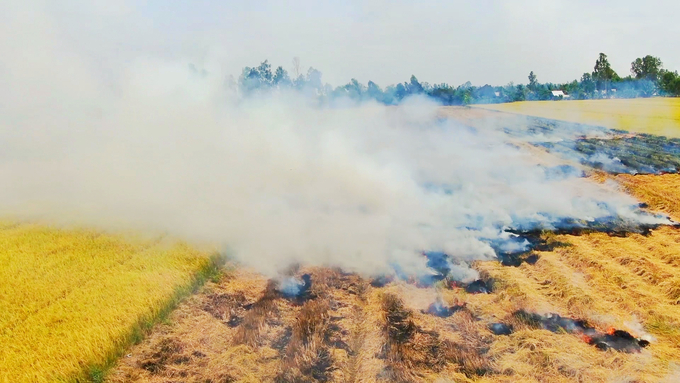
Due to limited knowledge of straw management and a lack of appropriate technology, farmers in countries participating in the CABIN project mainly choose the straw burning method. Photo: Kim Anh.
Indonesia is the country with the largest rice cultivation area among the countries participating in the project. Its rice output in 2022 reached 54.75 million tons (unmilled). The total amount of straw ranged from 75 to 90 million tons.
Before 2009, more than 85% of Indonesian farmers burned straw to clear their fields and prepare the land after harvest. In 2009, the Indonesian government issued Law No. 41 on sustainable agricultural land protection. It stipulated that farmers were not allowed to burn straw, but instead, they would decompose it and return it to their fields, or use it as animal feed, industrial materials and energy.
In a similar manner, the Philippines has an annual rice harvest area of approximately 4.82 million ha, with an output of 20.06 million tons. The government has taken initiatives on straw management, through the promulgation of the Philippine Clean Air Act of 1999 and the Solid Waste Management Act of 2000, which prohibit the burning of straw in rice fields.
The Philippines has also implemented a number of projects such as: using straw to produce biodegradable geotextiles; producing mushrooms, animal feed and composting, etc.
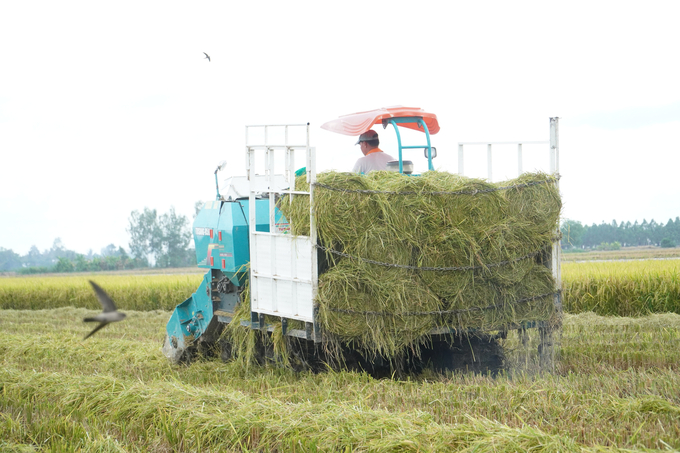
One of the goals of the CABIN project is to increase knowledge of sustainable low-emissions rice cultivation through training, field demonstrations and technology transfer. Photo: Kim Anh.
In Cambodia, with a rice cultivation area of over 3.5 million ha, the amount of straw produced is approximately 10 million tons, and 55% of which is collected to make silage for livestock, produce mushrooms and vegetables, make organic fertilizer, and transport to Vietnam for consumption. The remaining 45% is processed by farmers by burning or allowing it to decompose naturally.
Straw management in Cambodia is facing many challenges due to farmers' lack of knowledge about increasing the value of straw, high labor costs for straw collection, lack of storage, and high humidity during the rainy season.
As a country with a low rice growing area, Laos has nearly 994,000 ha of rice with a total output of over 3.9 million tons. More than the impacts of natural disasters, pests and the environment, only 3% of the country is fertile land area (equivalent to approximately 26,000 ha), the rest is medium fertile land and poor land. To improve rice production, the Lao Government has focused on improving the quality of rice varieties for each ecological type, ensuring good adaptability, resistance and commercial production capacity.
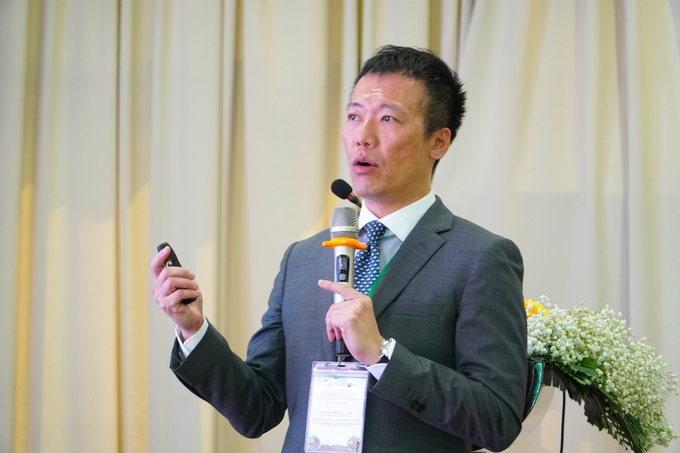
Representatives of Taiwan ICDF pledged to accompany countries in the CABIN project to improve low-emissions rice cultivation capability for farmers in Southeast Asia. Photo: Kim Anh.
As for Vietnam, Deputy Director of the Department of Crop Production (Ministry of Agriculture and Rural Development) Le Thanh Tung, said that each year the country produces over 43 million tons of rice and approximately 43 million tons of straw.
The Mekong Delta is the largest rice producing region in Vietnam, contributing nearly 90% of rice exports, but localities in the region are still focusing on economic and food security goals. The public has not paid much attention to the issue of emission reduction.
Localities lack mechanisms to promote and encourage farmers to grow low-emissions rice. The common problem is that infrastructure conditions (mainly irrigation) do not ensure the application of emission reduction measures. Emission source management (straw) is not optimal, and there is a lack of innovative emission reduction policies.
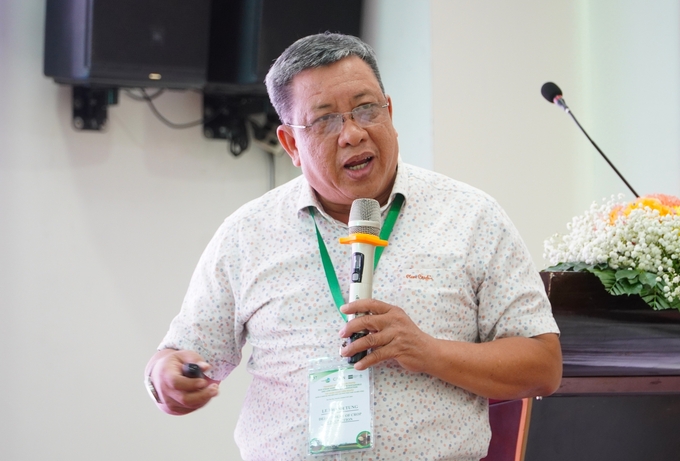
Le Thanh Tung, Deputy Director of the Department of Crop Production (Ministry of Agriculture and Rural Development) shared the current situation of rice production in Vietnam. Photo: Kim Anh.
Together with the research efforts of IRRI and financial resources from Taiwan ICDF through the CABIN project, it will contribute to helping Vietnam solve the challenges in rice production. The project not only brings opportunities for participating countries to develop a modern and environment-friendly agricultural sector but also reveals a sustainable direction, closely linking rice production and natural resource protection to open up a green future for the Southeast Asian region.
The five participating countries have agreed on strategic plans for sustainable straw management, which will guide the CABIN project in promoting these practices in each country.
In the first phase (2024 - 2028), the CABIN project will focus on several key objectives:
Developing annual plans and strategies for sustainable and low-emissions rice transformation;
Developing training materials on sustainable and low-emissions rice appropriate to scale;
Enhancing knowledge and adoption of sustainable and low-emission rice production through training, field demonstrations and technology transfer.
Translated by Samuel Pham

(VAN) The Institute of Agricultural Sciences for Southern Vietnam (IAS) marked its 100th anniversary in Ho Chi Minh City, celebrating a century of growth as a leading institute contributing significantly to Viet Nam’s agricultural development.

(VAN) An increasing number of livestock farms are using biogas generators to create a source of renewable electricity, helping to save costs and mitigate environmental pollution.

(VAN) Small changes in rice cultivation, from irrigation methods and straw collection to input management, are paving a new way for Vietnam's agriculture in the journey toward emission reduction.

(VAN) With the project of converting biogas into renewable electricity, Australia is both helping pig farms reduce their energy costs by up to 25% and contributing to environmental protection.
![Hue aims for Net Zero: [1] Initial steps from green transportation](https://t.ex-cdn.com/nongnghiepmoitruong.vn/608w/files/huytd/2025/11/28/0853-anh-6-giao-thong-xanh-hue-094717_940-153724.jpg)
(VAN) For sustainable development, Hue City is implementing many solutions to promote green transportation, which is an important initial step on the journey to building a Net Zero Hue.

(VAN) Nghe An Province, one of the localities with the largest forest area in Vietnam, is set to gain significant benefits from the implementation of forest carbon credit payments.

(VAN) Circular agriculture helps Mekong Delta farmers cut greenhouse gas emissions while boosting incomes through efficient reuse of agricultural by-products.
