December 1, 2025 | 20:20 GMT +7
Hotline: 0913.378.918

December 1, 2025 | 20:20 GMT +7
Hotline: 0913.378.918
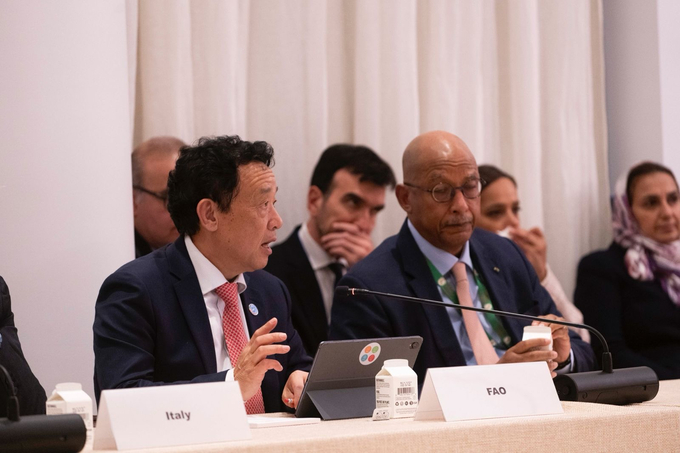
FAO Director-General QU Dongyu addresses a side event on climate policies during the UN General Assembly.
Taking climate action through agrifood systems presents a unique opportunity to address all at once multiple global and local challenges, making it imperative that actors around the world exchange their experiences and information to foster a world with better solutions for hunger and human resilience.
“Advancing climate actions through sustainable agriculture and resilient food systems,” a side event hosted by FAO, Azerbaijan, Italy the United Arab Emirates and the World Bank on the sidelines of the United Nations General Assembly on Sunday, provided a platform for all Member States to present actions they have implemented to enhance their agrifood systems and to share their perspectives on what can be achieved at COP 29, the next international climate summit, and related fora.
“The science is clear,” said QU Dongyu, Director-General of the Food and Agriculture Organization of the UN (FAO) in his featured intervention at the round table. “The consequences are evident.
”Qu emphasized how the climate crisis is already impacting agricultural production and productivity and undermining food security and rural livelihoods, noting that climate variability and extremes are one of the main drivers behind the current trends in global hunger, a scourge affecting more than 730 million people today. More than 40 percent of the world’s population is highly vulnerable to the impacts of the climate crisis, which demonstrably correlates to higher levels of undernourishment, he added.
The challenges are inseparable and so are the solutions, the Director-General insisted, noting they lie at the core of FAO’s action plans and set out in the FAO Strategic Framework 2022-2031. He emphasized that transforming agrifood systems to be more efficient, inclusive, resilient and sustainable will require action in a host of areas ranging from livestock and the re-carbonization of soils to aquatic food value changes and ending deforestation.
Senior officials from various countries and institutions participated in the round table, which wrapped up with a presentation of the priorities for the upcoming COP29 to be hosted by Azerbaijan in November.
Qu hailed the Baku Harmoniya Climate Initiative for Farmers, which will be hosted at FAO headquarters and is designed to foster collaboration and to serve as an effective reporting mechanism from one COP to the next that focuses on FAO priorities such as empowering women farmers and youth.
New frontiers in Artificial Intelligence
Making sure the exciting prospects of Artificial Intelligence applications benefit smallholders is essential to achieving the best and most equitable agrifood systems transformation.The UAE, which has committed sizable resources to the development of open-access platforms in this space, held another side event on Sunday devoted to “Agriculture in large language models (LLMs) and AI for smallholders.
”FAO Chief Economist Maximo Torero noted that FAO has already embedded AI in a number of digital capabilities and that it could bring even more positive results if used widely and for the right purpose, benefiting all rather than exacerbating current divides.
FAO is a signatory to the Rome Call for Ethics in AI since early 2020.In that regard, Foundation Models, which are large deep-learning neural networks trained on massive data sets that help data scientists develop machine learning models for specific tasks more quickly and cost-effectively, and can accelerate the accessibility of high-performance AI solutions in a wide array of sectors.
FAO is enthusiastic about Foundation Models for agrifood systems to leverage FAO’s technical expertise through AI models to generate public goods and services, especially for small family farmers, Torero said. This would be beneficial for research, digital advisory and extension services and policy making, he said.
Defining the roles and responsibilities of key actors in such a collaborative effort will be key, he added.
(FAO)

(VAN) The Mediterranean and the Black Sea: Fisheries sustainability concerns remain, but overfishing drops to its lowest level in a decade, while aquaculture feeds more people.

(VAN) Cargill Inc has no plans to close its U.S. beef processing plants, days after meatpacker Tyson Foods l opens new tab announced it would shutter a Nebraska facility as industry grapples with cattle supplies.

(VAN) New outbreaks of avian influenza and Newcastle disease have hampered egg production in several European countries, triggering a supply deficit.

(VAN) Pakistan's state agency, TCP, received its lowest rice tender offer at $394.95 CIF liner out for 100,000 metric tons.

(VAN) On 21 November, the Washington State Department of Health confirmed that a person who was undergoing treatment for H5N5 avian influenza had died.

(VAN) A new study reveals how the simultaneous effects of ocean acidification, salinity and loss of oxygen are making the world more fragile.

(VAN) Hopes are growing that the creation of the first 3D turkey gut model could be a turning point in the battle against the virulent blackhead disease.
