December 9, 2025 | 13:46 GMT +7
Hotline: 0913.378.918

December 9, 2025 | 13:46 GMT +7
Hotline: 0913.378.918
On the occasion of the 80th anniversary of the Agriculture and Environment sector, Mr. Julien Guerrier - Ambassador of the European Union delegation to Viet Nam spoke with VAN News to reflect on the sector’s remarkable development journey.

Julien Guerrier, Ambassador of the Delegation of the European Union (EU), gives an exclusive interview to VAN News. Photo: Khuong Trung.
Ambassador Guerrier congratulated all officials and staff of the Ministry of Agriculture and Environment for their remarkable progress, especially when reflecting on Viet Nam’s position 80 years ago compared to today, particularly in the field of agricultural production. "It is truly impressive to see the achievements Viet Nam has made," he remarked.
According to him, Viet Nam has not only ensured domestic food security in a sustainable manner but has also become an essential supplier to the global market with many products such as fruit, coffee, cocoa, rice, and seafood. EU greatly values its longstanding partnership with Viet Nam, especially in promoting sustainable agriculture.
Not only in Europe but worldwide, consumers increasingly seek delicious, nutritious, and safe products. Therefore, Ambassador Julien Guerrier emphasized that investing in organic production and transparent supply chains will help meet market trends. Stable market access and entry into premium segments will improve Vietnamese farmers' incomes and quality of life.
In May 2025, the European Commission announced its ranking of Viet Nam as a “low-risk” country for deforestation, creating a competitive advantage for agricultural exports.
Vietnamese agricultural products are now facing a significant opportunity to elevate their position in the global market thanks to the EU’s green policies. EU has demonstrated great respect for Viet Nam’s role in ensuring global food security and hopes the country will access the European market in line with sustainable standards that avoid overexploitation of natural resources.
Speaking about the EU’s Deforestation Regulation (EUDR), Ambassador Guerrier noted that it is a highly important legal instrument aimed at preventing excessive deforestation caused by agricultural production.
Since the EUDR was introduced in late June 2023, the EU and Viet Nam have worked closely to support smallholder farmers, enterprises, and cooperatives in implementing traceability systems. The goal is to ensure data transparency and to demonstrate that products are not linked to deforestation throughout the supply chain.
"EUDR plays an important role in environmental protection and climate change adaptation. Viet Nam clearly recognizes the value of its forest heritage in the country’s sustainable development," he emphasized. The EU Ambassador views Viet Nam as one of the countries with high forest cover, with many areas of primary forest still well preserved.
Through training programs and workshops carried out by development partners with EU financial and technical support, Vietnamese farmers have improved their capacity and quickly adapted to EUDR requirements.
According to Ambassador Guerrier, if Viet Nam prepares well for developing regulatory documents to standardizing certification and traceability systems, its goods will maintain strong access to the EU market amid intensifying global competition.
"This could even create a competitive advantage for Vietnamese products, while some producers from other countries may no longer meet the conditions to enter the European market," he noted.
Compliance with the EUDR has already opened wider doors for agricultural exports and contributed to forest conservation in Viet Nam.
Ambassador Guerrier also revealed that the two sides are negotiating a major EU-funded forest management project. The project, set to launch in 2026, will further strengthen bilateral cooperation in agriculture and forestry.
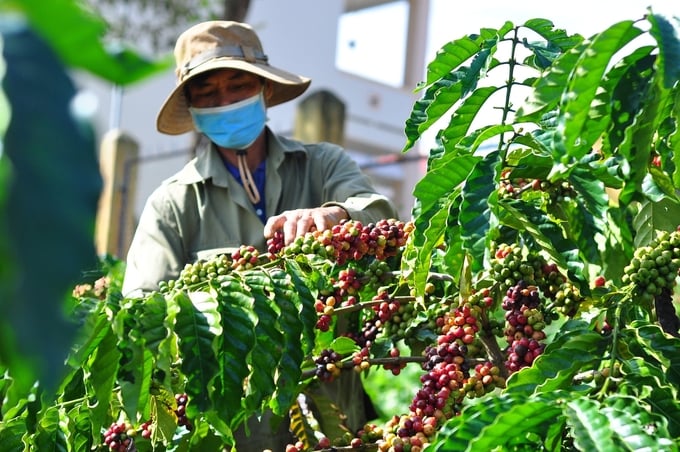
Thanks to its flexible adaptation efforts, Viet Nam has been classified as a “low-risk” country under the EUDR. Photo: Minh Hau.
Addressing the IUU “yellow card,” Ambassador Julien Guerrier emphasized that complying with regulations against illegal, unreported, and unregulated (IUU) fishing is essential to protect resources for the future.
“We need a system strong enough to ensure that all illegal fishing activities are detected and punished,” Ambassador Guerrier said, appreciating Viet Nam’s strong and proactive response.
According to the Ministry of Agriculture and Environment, as of 15 November, all 79,360 fishing vessels nationwide have been registered and updated in the National Fisheries Database (VNFishbase), reaching 100%, while the licensing rate has reached 96.7%.
However, Ambassador Guerrier noted that the biggest challenge now lies in law enforcement, as managing tens of thousands of fishermen is no simple task. Since monitoring responsibilities have been decentralized to local authorities, he urged each coastal province to ensure consistent and effective operational capacity.
He also acknowledged the determined leadership from the central government, particularly the weekly meetings chaired by Prime Minister Pham Minh Chinh with leaders of coastal provinces. These efforts have helped Viet Nam record significant progress.
The Ministry of Agriculture and Environment has just submitted its latest report on the implementation of the European Commission’s recommendations. While this document is under review, Ambassador Guerrier expressed hope that an inspection delegation will soon visit Viet Nam to verify progress on the ground. If the EC assesses that Viet Nam has met all necessary requirements, the IUU “yellow card” will be removed.

Fishermen and local authorities in the South Central region are working together to implement decisive measures to have the IUU “yellow card” lifted. Photo: Kim So.
The Competitiveness Compass report released by the European Commission on 29 January 2025 identifies competitiveness as one of the EU’s overarching guiding principles.
The Compass sets out two major objectives. First, it aims to define the policy changes needed for Europe to achieve strong and comprehensive transitions. While the EU will upgrade certain existing policies, Member States remain open to revising policies where necessary to better align with current realities.
The Competitiveness Compass strategy also seeks to develop new forms of cooperation that can accelerate and enhance the quality of decision-making, while simplifying legal frameworks and regulations to address fragmentation within the EU’s legal system.
“Europe must become the place where the clean technologies, services, and products of the future are invented, manufactured, and marketed, while still advancing toward carbon neutrality,” the EC emphasizes in its strategic report.
Remaining committed to its Net Zero pledge, the EU continues to support developing countries through climate finance, partnerships, and trade investment initiatives. Guided by the principle of leaving no one behind, the EU is one of the world’s largest providers of climate finance.
According to the EU’s report to COP30, in 2024 EU Member States contributed €31.7 billion in public funds and mobilized an additional €11 billion in private financing to help developing countries reduce greenhouse gas emissions and adapt to climate change.
Viet Nam has been benefiting from European green policies. Thanks to EU resources and technical assistance from international organizations, Vietnamese farmers have gained access to low-emission crop and livestock production techniques. Viet Nam’s agriculture sector now faces growing pressure to significantly cut emissions, as it accounts for nearly one-third of total national greenhouse-gas emissions, particularly methane from rice cultivation and livestock.
These technical solutions not only improve product quality and ensure traceability but also create sustainable competitive advantages. The EU wants to ensure that Viet Nam can export safe, organic, and sustainable agricultural products to the European market while protecting natural resources and safeguarding national food security.

EU Ambassador Julien Guerrier hopes Viet Nam will adhere to green standards to make strong strides in agricultural exports and green-transition investment. Photo: Khuong Trung.
Ambassador Julien Guerrier affirmed that the EU’s Net Zero remains unchanged. He noted that the Competitiveness Compass does not replace the European Green Deal but rather introduces a new approach to help the EU advance its green transition more efficiently and competitively.
According to him, while the Green Deal focuses on setting climate targets, environmental standards, and emission-reduction pathways, the Competitiveness Compass adds layer of strategic thinking.
Green transition, productivity stability, cost reduction, and strengthened economic competitiveness are the guiding factors shaping Europe’s policy adjustments. This approach ensures that green regulations do not become a burden but instead serve as a driver for businesses and organizations both within and beyond the bloc.
EU has always believed in the strong connection between green growth, productivity, and competitiveness.
“The products of the future are sustainable products. If we lead the way, we will secure stronger competitiveness on the global stage. This is the shared objective of the EU and Viet Nam, and we highly appreciate that Viet Nam has maintained its commitments and continued to make its best efforts, even during this challenging period,” he said.
Explaining the political and social drivers behind the Competitiveness Compass initiative, Ambassador Guerrier noted that today’s global economic environment is more fiercely competitive than ever. For this reason, the EU aims to move further, faster, and smarter in its green transition.
Through the Competitiveness Compass, the EU is reviewing its entire regulatory framework to make its system more competition-friendly. While maintaining its climate ambitions, the EU will prioritize effective, cost-efficient, and productivity-enhancing implementation measures.
“We remain committed to accompanying Viet Nam in its efforts toward sustainable development. From agricultural production, forest management, and combating IUU fishing to the green transition and strengthening competitiveness. These are all areas where both sides can leverage their strengths and support each other,” the Ambassador affirmed.
According to him, Viet Nam's progress in these areas not only benefits the Vietnamese people but also contributes to the global objectives jointly pursued by the EU and Viet Nam.
With existing cooperation frameworks and strong determination at both the central and local levels, the Ambassador expressed confidence that Viet Nam-EU relations will continue to deepen in the coming period.
The EU’s partnership, coupled with Viet Nam’s sustained efforts, is expected to pave the way for new breakthroughs, making bilateral cooperation a model for green transition, sustainable development, and regional and global economic integration.
Translated by Kieu Chi

(VAN) These meaningful messages from international partners affirm VAN News' increasingly solid standing.

(VAN) Former Minister Pham Khoi Nguyen expressed his hopes for VAN News as it embarks on a new chapter marking 80th anniversary.
![Hue aims for Net Zero: [5] Building a green and sustainable city](https://t.ex-cdn.com/nongnghiepmoitruong.vn/608w/files/content/2025/12/03/bai-5-anh-6-105459_830-111605.jpg)
(VAN) Hue City continues its efforts to build and maintain a green, sustainable, and environmentally friendly city, joining the Government in pursuing the goal of Net Zero by 2050.

(VAN) After 10 years of operation, Aus4Skills has awarded more than 500 scholarships and enhanced the skills of over 40,000 students, contributing to the strengthening of the strong relationship between the two countries.
![Hue aims for Net Zero: [4] The effectiveness of ERPA payments](https://t.ex-cdn.com/nongnghiepmoitruong.vn/608w/files/content/2025/12/02/bai-4-anh-1-103726_244-093242.jpg)
(VAN) In Hue City, ERPA payments have proven highly effective, serving as a green finance tool that helps reduce carbon and greenhouse-gas emissions and move closer to the Net Zero target.

(VAN) At the TARASA25 Conference, participating countries shared experiences on implementing agroecology and regenerative agriculture, contributing to a sustainable transformation of food and agriculture systems.
