December 3, 2025 | 02:06 GMT +7
Hotline: 0913.378.918

December 3, 2025 | 02:06 GMT +7
Hotline: 0913.378.918
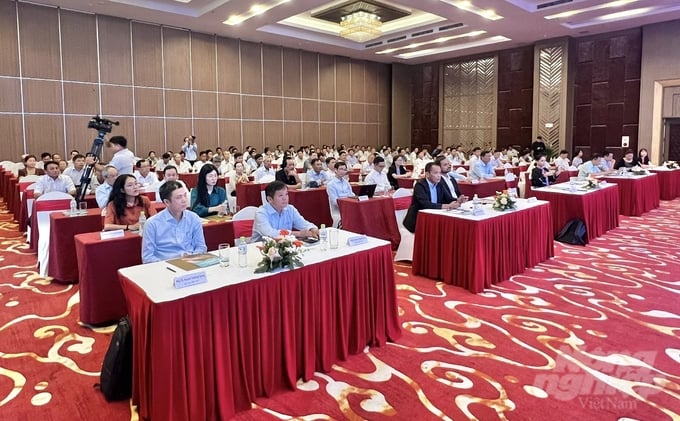
Cargill Group and the Asia Society for Social Improvement and Sustainable Transformation (ASSIST) announced their partnership and launched the Aqua Xanh project on May 8 in Ca Mau city. Photo: Trong Linh.
Cargill Group and the Asia Society for Social Improvement and Sustainable Transformation (ASSIST) announced their partnership and launched the Aqua Xanh project on May 8 in Ca Mau city. Accordingly, the project aims to reduce water pollution by promoting the implementation of sustainable aquaculture practices in the Mekong Delta.
The Aqua Xanh project will be implemented from May 2024 to July 2026, with the primary objective of reinforcing climate change resilience. The project will undergo a pilot phase in Cai Nuoc district, Ca Mau province, as a precursor to potential expansion into other regions.
The project is consistent with Cargill's global sustainable development objectives by positively impacting water sources, supply chains, and local communities throughout its operation.
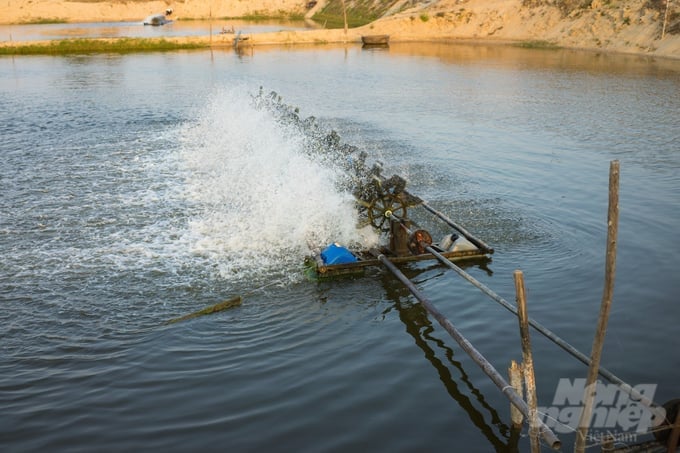
The Aqua Xanh project contributes to reducing water pollution by promoting the implementation of sustainable aquaculture practices in the Mekong Delta. Photo: Trong Linh.
Climate change poses as a significant threat to the Mekong Delta region, as evidenced by saltwater intrusion, unpredictable weather patterns, prolonged droughts and flooding. Consequently, these challenges force farmers to adopt unsustainable farming practices to offset crop losses, thereby creating potentially harmful crop cycle. A severe consequence of this struggle is the contamination of water sources, which endanger the sustainability of the fisheries sector and the health of local communities.
The Aqua Xanh project aims to address these challenges by promoting sustainable water usage and waste management practices in the Mekong Delta's fisheries sector. One of the project's objectives is to enhance farmers' capacity through training and technical support in sustainable practices in accordance with the standards set by the Aquaculture Stewardship Council (ASC).
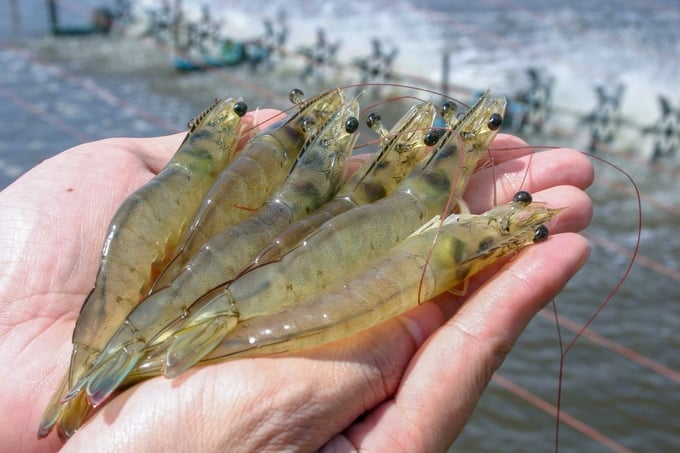
ASC-certified shrimp production in Ca Mau province. Photo: Trong Linh.
The Aqua Xanh project will also establish several model aquaculture farms to facilitate training and the implementation of recycling, waste reduction, and plastic pollution surveillance. The collaborative efforts between Cargill, ASSIST, and Can Tho University, as the project's primary technical partner and supervisor, will contribute to mitigating water pollution and promoting sustainability for the communities in the Mekong Delta region.
Maxime Hilbert, Country Director at Cargill Aquaculture and Nutrition Vietnam, remarked: "Cargill is honored to be part of a transformative project that combines environmental management expertise and economic benefits. By minimizing water pollution and reinforcing climate change resilience, we strive to protect the livelihoods of millions, including many shrimp farmers who have placed their trust in Cargill's products and solutions. Through training in ASC standards and enhancing access to sustainable raw materials, we hope to empower farmers to achieve long-term and sustainable economic development."

Mr. Maxime Hilbert, Country Director at Cargill Aquaculture and Nutrition Vietnam. Photo: Trong Linh.
Mr. Aru David, Regional Director of Assist Asia of the Mekong Area, shared: "At ASSIST, we have been addressing sustainability challenges in Vietnam since 2007. For the Aqua Xanh project, ASSIST fully endorses ASC standards, which focus on sustainable practices in water quality and waste management. We aim to enhance the capacity of farmers in the Mekong Delta region and protect the environment for future generations."
Assoc. Prof. Dr. Pham Thanh Liem, Head of the Faculty of Aquaculture Technology at Can Tho University, emphasized that Can Tho University, as the main technical partner in the Aqua Xanh project, is committed to providing technical support in aquaculture and environmental management, and fulfill the project's requirements. Through close collaboration with Cargill, ASSIST, and local communities, this project has the potential to establish a new model for sustainable aquaculture within the Mekong Delta region.
According to Assoc. Prof. Dr. Pham Thanh Liem, Ca Mau province is currently directing its aquaculture development towards efficiency and sustainability, with a focus on diversifying target species and farming methods, and organizing production linkages. Ca Mau has been awarded several international certifications including ASC, B.A.P, EU Organic, Canada Organic, Bio Suise, Selva Shrimp, Mangrove Shrimp, and Naturland, with a total certified area covering nearly 20,000 hectares.

Assoc. Prof. Dr. Pham Thanh Liem, Head of the Faculty of Aquaculture Technology at Can Tho University. Photo: Trong Linh.
Mr. Huynh Xuan Dien, Chairman of the Board of Directors of Tan Hung Cooperative in Cai Nuoc district, provided insights into the cooperative's evolution. Founded in 2016 with 19 members, the cooperative expanded to 50 members by 2019. As of 2024, the cooperative has reached 336 active members, organized into two divisions. Accordingly, thirty members manage a specialized 50-hectare whiteleg shrimp farming area; the remaining 306 members engage in two-stage improved extensive shrimp farming, with a focus on giant tiger prawn farming.
The Aqua Xanh project aims to train over 300 shrimp farmers in compliance with ASC standards and requirements for feed management, waste management, and biodiversity practices. Notably, ten outstanding shrimp farmers will receive further training to provide technical support to other farmers in subsequent stages of the project.
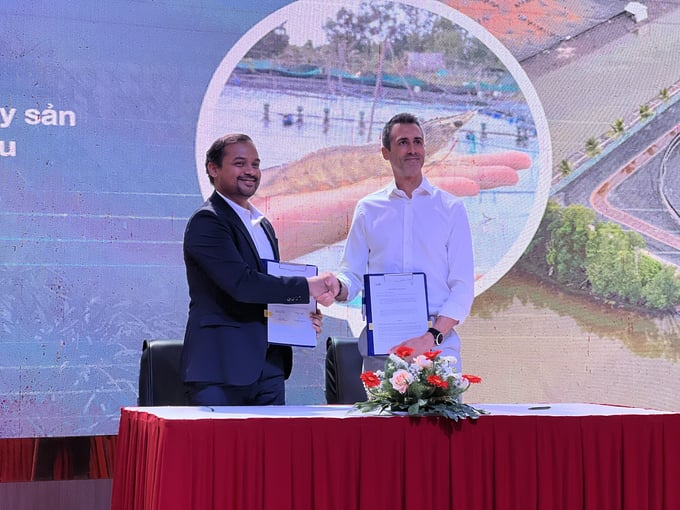
Representatives signing partnership agreements at the launch ceremony for the Aqua Xanh project. Photo: Trong Linh.
In addition, a shrimp farming cooperative has the opportunity to receive an ASC certification, and three pilot farms that aim to reduce wastewater by 30% and decrease nitrogen and phosphorus emissions by 20% by 2025. Furthermore, the project aims to engage with over 1,000 community members to enhance environmental consciousness, thereby contributing to the goal of fostering a climate-resilient aquaculture sector in Vietnam.
Mr. Tran Cong Khoi, Head of the Aquaculture Seed and Feed Department at the Directorate of Fisheries, reported that the Ministry of Agriculture and Rural Development recently organized the 2024 Shrimp Industry Development Conference in Ca Mau city. Accordingly, Vietnam aims to achieve a shrimp production output of 1.15 million tons and an export value of at least 4 billion USD by 2024. Additionally, he underlined the importance of a dedicated strategy in achieving these targets and bolstering the development of Vietnam's aquaculture sector
Translated by Nguyen Hai Long
/2025/12/01/0509-2-175427_206.jpg)
(VAN) Emission-reducing coffee areas in Lam Dong have entered the new crop with stable yields, improved quality, and a remarkably enhanced cultivation environment.

(VAN) The Institute of Agricultural Sciences for Southern Vietnam (IAS) marked its 100th anniversary in Ho Chi Minh City, celebrating a century of growth as a leading institute contributing significantly to Viet Nam’s agricultural development.

(VAN) An increasing number of livestock farms are using biogas generators to create a source of renewable electricity, helping to save costs and mitigate environmental pollution.

(VAN) Small changes in rice cultivation, from irrigation methods and straw collection to input management, are paving a new way for Vietnam's agriculture in the journey toward emission reduction.

(VAN) With the project of converting biogas into renewable electricity, Australia is both helping pig farms reduce their energy costs by up to 25% and contributing to environmental protection.
![Hue aims for Net Zero: [1] Initial steps from green transportation](https://t.ex-cdn.com/nongnghiepmoitruong.vn/608w/files/huytd/2025/11/28/0853-anh-6-giao-thong-xanh-hue-094717_940-153724.jpg)
(VAN) For sustainable development, Hue City is implementing many solutions to promote green transportation, which is an important initial step on the journey to building a Net Zero Hue.

(VAN) Nghe An Province, one of the localities with the largest forest area in Vietnam, is set to gain significant benefits from the implementation of forest carbon credit payments.
